A Pilgrimage to Find Flannery O’Connor
O’Connor initially captured their attention with her words, but this traveling sisterhood hoped they’d uncover something far deeper to help them grow in their writing and faith.
In 2014, three Catholic writers from the Midwest — a millennial, a Gen X-er and a baby boomer — set off on a pilgrimage to the “promised land”: the family farm in Milledgeville, Georgia, where Catholic author Flannery O’Connor wrote her award-winning fiction and lived until dying of lupus at 39.The new memoir of their journey, Finding Flannery: A Travel Memoir Exploring the Mystique of Flannery O’Connor and the Legacy She Has Left Us All, caps off a year-long celebration of O’Connor’s 100th birthday.
The writers, Christina Brajkovich, Karen Anne Mahoney and Roxane B. Salonen, met in a long-distance writing group. Instead of visiting O’Connor’s childhood home in Savannah, Georgia, they carpooled to Andalusia because it was there that “Flannery ultimately surrendered herself to God’s plans because of her failing health and diagnosis of lupus,” Brajkovich writes in the book, speaking for all three.
O’Connor initially captured their attention with her words, but the traveling sisterhood hoped they’d uncover something far deeper to help them grow in their writing and faith. Each had also connected with the Southern wordsmith through personal challenges. Mahoney struggled with her own autoimmune disease. And like O’Connor, Brajkovich and Salonen had both lost their fathers.
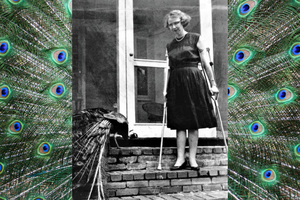
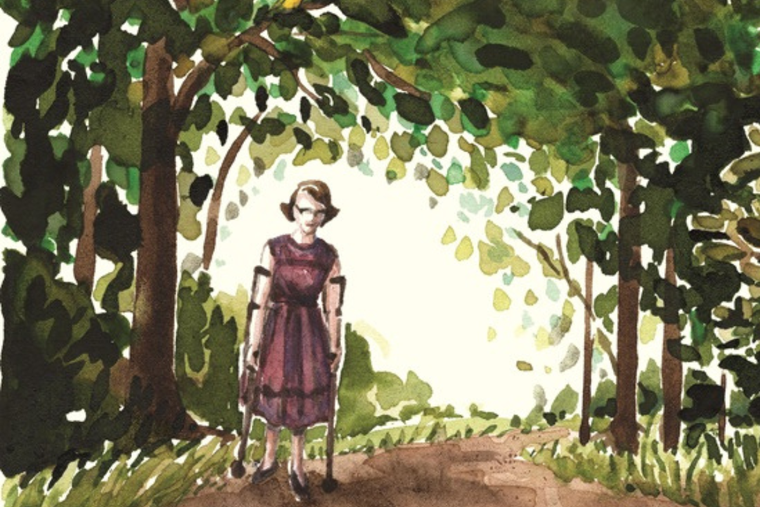
The authors chronicle their journey by alternating perspectives. Noting that O’Connor loved birds, each chooses a bird corresponding with their personalities. As an ode to O’Connor’s talent as a visual artist, the book’s illustrator, Andrea Meyer, cues each writer’s passage with beautiful watercolors of blue jays, canaries and cardinals.
I had initial doubts about the efficacy of a memoir with a trio of voices and thought the added task of keeping bird associations straight would only complicate matters. But it worked! Just the sort of oddball choice O’Connor herself might make.
O’Connor’s story could easily be reduced to a tragic headline: Promising writer of the grotesque struck by incurable debilitating illness in her prime leaves New York City for a farm in a backward, racist Georgia town to live with her mother. She died, too, without the consolation of her astonishing success. But the metaphor of birds continually reminds the reader that the heavenly realm prevails, even as the writers take turns examining weighty themes of pain, suffering and death.
This sisterhood plumbs every aspect of O’Connor’s life, appraising the influences that shaped her and gave birth to the characters she conjured from her imagination. They visit her home, church, gravesite, the town of Milledgeville and its nearby insane asylum (Andalusia, O’Connor’s home, is now maintained by her alma mater as a museum to the Southern Gothic writer’s legacy). They stay overnight at the monastery where O’Connor sought spiritual guidance, talk to locals, and share her writings aloud. They engage all senses, listening to the chirping cicadas, playing O’Connor’s piano, and devouring Southern food. They also consider the historical context in which O’Connor lived.
A deep dive on the internet would have turned up many of the facts they discovered, but only a pilgrimage would provide the time and optimum conditions for serious transformation. As Salonen explains in the book, “In occupying the same space that had been the backdrop for her vivid world, the picture in our minds of Flannery became more complete.”
Indeed, I’d encountered O’Connor’s writing early on, but I had forgotten about her for decades, only rediscovering her when I moved to Savannah at mid-life and joined a writing group that met in her childhood parlor. I later visited her archives at Emory University and made a day trip to Andalusia with board members of her childhood foundation. By immersing myself in her world, her words and her relics, O’Connor had also become my muse.
In her 80s, my mother became frail and housebound. “I’m worried,” I’d say when we spoke long distance, unsuccessfully trying to convince her to move. Every time we spoke, however, she responded the same way. She’d sing that famous hymn rooted in the words of Matthew’s Gospel, “His eye is on the sparrow, and I know he watches me.”
It was the same with O’Connor. And the writers grasp it. Amid her modest and mundane existence, O’Connor kept her eyes firmly fixed on God. In turn, God supplied her personal needs and inspiration for her writing. O’Connor’s peafowl show up in The Displaced Person. Milledgeville’s insane asylum finds its way into The Partridge Festival. And misfits abound.
As Salonen writes, “She knew who she was, and to whom she belonged above all.”
After attending Mass each day, O’Connor stowed her crutches against her bedroom wall and typed for hours. “No wonder themes from the Gospel, of fallen humanity, redemption, and grace, thus bled freely into her writing after she had just dwelled on the mysteries of faith,” Brajkovich observes. By book’s end, she makes the same connection with her own life. As she writes: “This time focused on God alone is what every writer needs for the craft to flourish and for the soul to breathe.”
The memoir has many strengths, chief among them the vulnerability to which the authors totally submit. This laying bare is not only key to crafting a worthy memoir, but essential for their change and personal growth, which is evident throughout. Their emotional intimacy with themselves and each other in turn allows the reader to join the pilgrimage. And in the midst of it, O’Connor too comes to life.
O’Connor taught me that writers must remain vulnerable and cherish the struggle in order to remain open to grace. And so, the authors do likewise, their eyes open to the grace that also surrounds them, including that which had brought them together in the first place, funded their trip, and followed them as they traveled. Often, they find it in small moments — the falling rain, the sound of church bells, and the “holy laughter” that, in pure O’Connor fashion, overtakes them on their way home.
In addition, they seamlessly weave in a substantial amount of data about O’Connor’s life, stories, relationships and surroundings, without passages ever feeling like an “information dump.”
A year after their trip, the women reunite to outline their book. And then a marriage, babies, moves, physical struggles and other challenges intervene. A decade passes before publication.
But the book is richer for the marinade of time, allowing the authors to fully gauge and appreciate the road maps O’Connor had provided for their futures.
Brajkovich credits O’Connor with the courage to leave home and follow her dreams. Salonen has found solace in her writing in the midst of her husband’s health crises. And Mahoney, the group’s matriarch who was burdened as a young woman with the caregiving of her parents and siblings, has finally embraced her inner child, found the resolve to say “No,” and learned to direct her suffering for the benefit of others.
Mahoney sums up what I consider the two most important takeaways from the pilgrimage. By journey’s end, O’Connor’s “DNA [had] intertwined with our own,” she writes. But more important, she observes, “We become what we eat, so by consuming Christ’s Body and Blood in the Eucharist, his DNA resides in us.”
When I attend Mass, I’m often reminded of O’Connor’s response to a friend who had characterized the Eucharist as a mere symbol.
“If it’s just a symbol to hell with it,” she’d said, knowing, as the traveling sisterhood come to realize, that it is the source and summit of the Christian life.
- Keywords:
- flannery o’connor