Newman Joins the Doctors — Saint’s Legacy Extends to Catholic Education
COMMENTARY: Pope Leo XIV recognizes Newman’s lifelong mission to unite faith and intellect — and names him Co-Patron for Catholic Education.
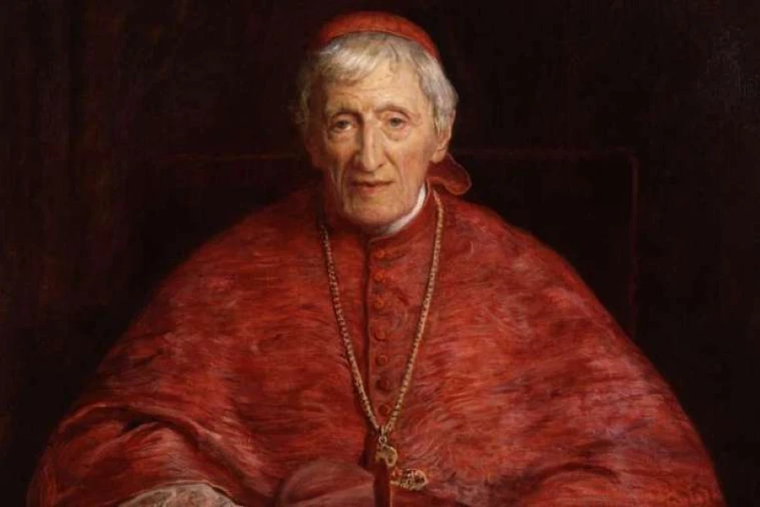
“Every scribe who has been trained for the kingdom of heaven,” says Jesus, “is like the master of a household who brings out of his treasure what is new and what is old.” (Matthew 13:52). The Doctors of the Church are those saints who draw from this treasure, offering both the richness of tradition and the insight of new understanding.
Few have embodied this description more fully than St. John Henry Newman (1801–1890), a holy priest, dedicated teacher, gifted writer, outstanding theologian, and founder of both a Catholic university and a boys’ school, as well as the Oratory of St. Philip Neri in England. The divine Master continues to raise up new scribes, new teachers, new models for his kingdom — and Newman is among the greatest of them.
In 1850, Newman received a doctorate in divinity from Pope Pius IX. In 1878, S. W. Wayte, president of Newman’s alma mater Trinity College, made him an honorary fellow. In March of the following year, Pope Leo XIII created him a cardinal. Roundell Palmer, Lord Selborne and his daughter delivered a message to the Pope. The daughter reported the Pope’s remarks: “My Cardinal! It was not easy, it was not easy. They said he was too liberal, but I had determined to honor the Church in honoring Newman. I always had a cult for him. I am proud that I was able to honor such a man.”
During his life, Newman was considered a holy priest, but it would be over a century before his holiness was officially recognized by the Church. He was declared venerable in 1991, blessed in 2010, and a saint in 2019. Following the recommendation of the Dicastery for the Causes of the Saints, Pope Leo XIV has now declared him Doctor of the Church. In hindsight, this development is not surprising — Newman was a towering intellect and passionate educator throughout his life. Still, the news brings great joy to those who have studied his life and teachings, and to all who hold a deep devotion to him.
Father Ignatius Harrison, provost of the Birmingham Oratory; various bishops in Great Britain and the United States; Father George Bowen of the Brompton Oratory, relator of Newman’s cause; as well as the National Institute for Newman Studies (in Pittsburgh) and scholars in collaboration with it, all played key roles in preparing for this historic recognition by the Holy See.
The recognition of St. John Henry Newman as Doctor is a profound opportunity for many to deepen their understanding of the Catholic faith through his writings — especially students at Newman Centers and Catholic university chaplaincies. His elevation may well mark the beginning of a new period of conversions and spiritual renewal, particularly in the United Kingdom.
One may ask why the Church needs new doctors. Several qualities in Newman answer this question and show his particular relevance for our times: He wrote in English, making his thought accessible to a broad audience. He engaged with the intellectual challenges of his time — materialism, agnosticism and theological liberalism — many of which continue today. And his works, though deeply theological, are widely available to the public online.
In addition to these qualities, the new Doctor was an educator. He once remarked, “From first to last, education … has been my line.” Because of his clarity and depth of thought, brilliant capacity of expression, and love for students, Pope Leo has just designated him Co-Patron for Catholic Education together with St. Thomas Aquinas. The Church has always devoted great effort and resources to the education of children and youth. She encourages parents to be the first and primary educators of children, but recognizes the need to support them in this noble and difficult mission. To assist her in this mission, she now offers us Newman as a new patron who will help with his example and prayers.
In an apostolic letter, Drawing New Maps of Hope, marking the 60th anniversary of the Vatican II decree on Catholic education, the Pope highlights Newman's consideration of the whole person in education and his view of education that goes beyond immediate utilitarian ends. He writes, "This integral anthropological vision must remain the supporting axis of Catholic pedagogy. It — following in the footsteps of St. John Henry Newman's thought — goes against a purely mercantilist approach that often today forces education to be measured in terms of functionality and practical utility."
As a great teacher, Newman has left a vast body of teaching in sermons, essays and books. He teaches us to reflect on the Scriptures, Tradition and the Church Fathers; to examine things with a philosophical habit of mind and by means of what he called the “illative sense;” and to look at life and religion with a historical view and a sense of the connectedness of ideas and realities.
The crisis of the modern world, which is philosophical, moral and political, is also a crisis in intellectual and moral education. Such a crisis calls for a renewal and promotion of Catholic education. Newman built on the biblical understanding of man as created in the image and likeness of God, and on the Aristotelian notion of being and its perfections, to promote education in the liberal arts and moral character. He understood learning as the perfection of the intellect and knowledge as a good in itself. He encouraged students to develop a philosophical habit of mind with which to understand themselves and the world.
Newman worked with parents to assist them as the primary educators and fostered in his students a healthy use of freedom joined to a true sense of responsibility. He anticipated the Vatican II decree Gravissimum Educationis, which says:
Parents are the ones who must create a family atmosphere animated by love and respect for God and man, in which the well-rounded personal and social education of children is fostered. Hence the family is the first school of the social virtues that every society needs.
The new Doctor’s work and writings at Oriel College, the Catholic University of Ireland, and the Oratory School offer a wealth of wisdom and practical experience for parents and educators. In the recently published volume John Henry Newman the Educator: His Formation, Philosophy, and Legacy, many of these points are discussed.
King Charles III has expressly recognized Newman’s importance as a religious leader and theologian. In 2019, as Prince of Wales, he attended Newman’s canonization and praised his courage to stand for his convictions. He noted:
At a time when faith was being questioned as never before, Newman, one of the greatest theologians of the 19th century, applied his intellect to one of the most pressing questions of our era: what should be the relationship of faith to a skeptical, secular age? His engagement first with Anglican theology, and then, after his conversion, Catholic theology, impressed even his opponents with its fearless honesty, its unsparing rigor and its originality of thought.
The prince referred to him as “this great Briton, this great churchman and, as we can now say, this great saint, who bridges the divisions between traditions.” Five years later, in September 2025, he visited the Birmingham Oratory where Newman lived.
A few days ago, on Oct. 22, 2025, King Charles made a state visit to Pope Leo XIV, during which the Pope and the King prayed together — the first such act since the English Reformation. One could say that Newman was spiritually present at this historic moment in the Sistine Chapel. A translation by him of a prayer of St. Ambrose was read at the service, and later, at St. Paul’s Basilica, one of his hymns, “Praise to the Holiest in the Height,” was sung. In a providential way, this newest Doctor of the Church may help revive the prayer and hope for Christian unity between Catholics and Anglicans. Newman’s fidelity to truth and love for the Church now find new relevance in this gesture of mutual respect and shared faith.
As Co-Patron for Catholic Education and Doctor of the Church, St. John Henry Newman stands as a guiding light for our times — a saint who shows that faith and reason are not enemies but allies in the pursuit of truth. His life and writings remind educators, parents and students that genuine learning must lead to wisdom, and wisdom to holiness. In Newman, God offers the modern world a teacher of integrity, a witness to the unity of truth, and a prophet of renewal for Christian education and Christian unity. May his example and intercession strengthen the Church’s mission to form minds and hearts in the truth that sets us free.