Vatican II at 60: A Renewed Vision of the Priesthood
COMMENTARY: ‘Presbyterorum Ordinis’ manifests a keen awareness of the priest’s special identity and vital mission in the Church.
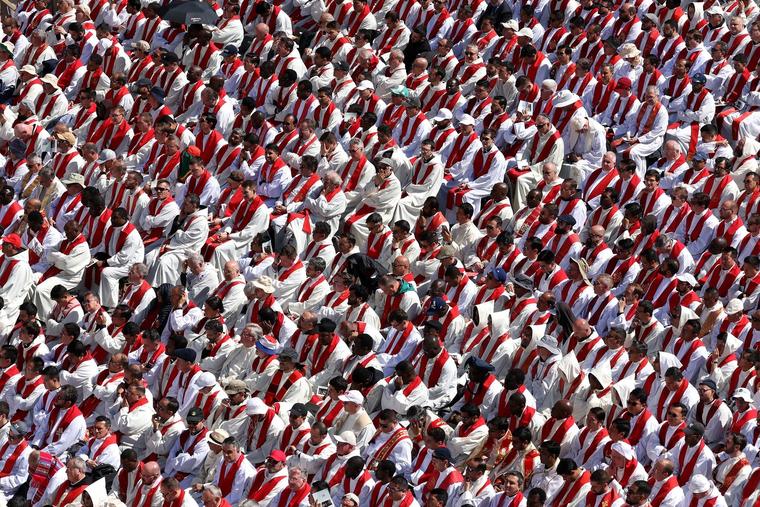
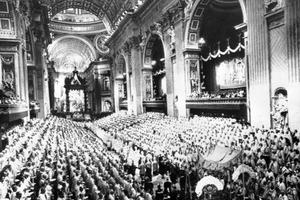
By October 1964, when the Second Vatican Council began discussing its document on priests — which we now know as the decree on the ministry and life of priests, Presbyterorum Ordinis — the Council fathers had already covered quite a bit of ground. The assembly had come to a much deeper awareness of the role of the laity in the Church, and also the specific mission of bishops in continuing the Church’s apostolic mission.
But what about priests? The Council ran the risk of neglecting this topic amid other pressing themes. One prominent Council father, the Belgian Cardinal Leo Suenens, voiced the complaint of some priests that they had been forgotten.
The Council had not been inattentive to the subject of priests. During the preparation of the Council, three drafts had been produced on the mission of priests, which regarded the holiness required of these ministers of Christ and some more particular practical questions regarding just compensation and the adequate distribution of clergy. As part of an overall effort to streamline the immense work of the Council, this material was eventually condensed into a short text of just 10 propositions, and later slightly expanded in light of the written observations made by the Council fathers.
This draft was presented to the Council on Oct. 13, 1964. Despite its many salient points, however, the overall judgment of the Council fathers was quite harsh. The U.S. Cardinal Albert Meyer, for example, noted that the text spoke almost exclusively of the various obligations of priests, but did not offer much to comfort priests and inspire them to the fulfillment of their duties.
He questioned why the first proposition of the text dealt with the priest’s relationship with laypeople, when the priest, first of all, is a man of God. His call for the draft to be completely redone, so as to respond to the pastoral scope of the Council and the expectation of many priests, was met with applause by the assembly.
The faults of the proposed text became ever more evident as the Council debate progressed, and on Oct. 19, a majority of Council fathers voted to reject the draft. This meant that the text would have to be sent back to the Commission on the Discipline of the Clergy to be redone according to the wishes of the Council fathers, and then re-presented.
The commission worked quickly with the help of its secretary, Opus Dei Father Álvaro del Portillo (now Blessed), and by Nov. 20, 1964, the Council fathers had a radically reworked and expanded document. This revised text included several completely new passages that expounded upon the mystery of the priest’s ministry.
The newer text explains the profound theological foundation of the priest’s special dignity: the sacrament of orders and the mission he has received from the bishop, through which the priest serves the People of God and is granted a participation in Christ’s ministry as Teacher, Priest and King.
While recognizing that the sacrament of orders brings about a particular identification with Christ — an identification that determines the priest’s identity and mission — the Council had also come to the realization, as expressed in Lumen Gentium, that the bishops possess the “fullness of the priesthood.” In light of this teaching, Presbyterorum Ordinis draws special attention to the way in which priests share in the ministry of the bishops.
Spanish Father Luis Marcos gave a speech in the name of the parish priests who were auditors at the Council, expressing his appreciation for this vision. He described the emotion his fellow priests felt in the affirmation in the text of the soon-to-be-approved Lumen Gentium — that priests are cooperators of the episcopal order, constituting one priesthood with them, and participating in the bishops’ pastoral mission.
At the same time, Father Marcos noted that parish priests have a particular role in making Christ present, as they are “between the bishop and the laity,” and in the “first line of pastoral work.”
The Council was also deeply aware that the ministry of both priests and bishops was called to give witness to Christ. As Father Marcos noted, the People of God, as well as unbelievers, knowingly or not, seek Christ, and looked to the Council to reveal the image of Christ, manifested in a particular way through the ministry of priests in humility, poverty and service.
The reworked document and final text of the decree would be strongly imbued with such a Christocentric vision of the priesthood. While Presbyterorum Ordinis recognizes that all of the faithful share in a holy priesthood through Christ, the decree also affirms that through the sacrament of holy orders, the priest receives a special anointing of the Holy Spirit, by which he is “signed with a special character” and “conformed to Christ the Priest” so as to be able to “act in the person of Christ the Head.”
The revised text of November 1964 would draw out the priestly ministry in more detail with new sections on the priest as minister of the Word of God, as a minister of the sacraments and especially the Eucharist, and in shepherding the people of God in charity.
Still, even with this deeper vision of these and other topics related to priestly life, the text would go through two rounds of revisions before the definitive text, which was approved just a few days before the Council ended. In this way, the Council was able to incorporate several new elements, which further refined its vision of the priestly ministry.
The final decree, for example, includes a much richer explanation of the attitude of detachment from earthly goods — a detachment by which the priest achieves an authentic “freedom” from earthly concerns and becomes more able to discern God’s voice. It also contains a much stronger affirmation and explanation of the charism of celibacy, as a “gift of the Spirit so fitting for the priesthood of the New Testament.”
While Pope Paul VI had decided that the Western Church’s practice of priestly celibacy should not be a topic of debate, many Council fathers desired the Council to commend this particular charism.
The Council fathers were aware that the portrait of the priest depicted in the decree was an exalted one. To this end, the document identifies a multitude of means to help priests face the challenge of living out their ministry in the contemporary circumstances, from fraternal charity and study to the traditional practices of the spiritual life — such as their own practice of confession, spiritual reading and mental prayer.
Thus, when the Council’s “Decree on the Ministry and Life of Priests” was promulgated by Pope Paul VI on Dec. 7, 1965, the penultimate day of the Council, it could not be said that Vatican II had “forgotten” the topic of priests. During the final period of the Council, the German Cardinal Lorenz Jaeger acknowledged that the text on priests was an arduous task, yet he also noted that never before had a Council addressed priestly life in such a broad scope in one decree.
Within a profoundly renewed vision of the Church as a whole, Presbyterorum Ordinis is a testament to the Council’s firm conviction of the essential role of priests in the Church’s saving mission.
Editor’s note: Latin-to-English translations of Council speeches and work are by the author.

Father Joseph Thomas Opus Dei Father Joseph Thomas, based in Princeton, New Jersey, is dedicated to ministry that focuses on college students. He writes regularly on theological topics and is the author of The Theology of Divine Grace (Scepter, 2023). He also serves as the U.S. representative for the Pontifical University of the Holy Cross in Rome.