Trinity Sunday: The Blessed Trinity Reveals Who God Is — and Who We Are
COMMENTARY: The mystery of the Trinity reveals that God is not solitude but communion — and we are made in his image.
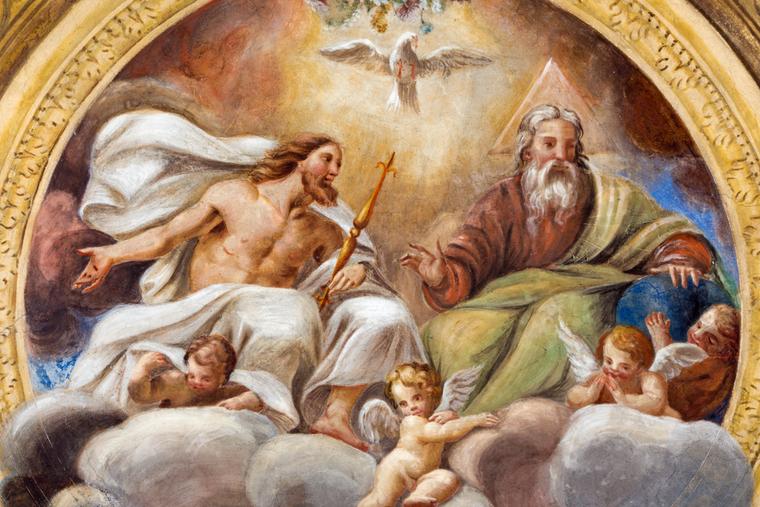
This Sunday throughout the universal Church, particular adoration is given to the Most Holy Trinity. The Catechism of the Catholic Church teaches us:
“The mystery of the Most Holy Trinity is the central mystery of Christian faith and life. It is the mystery of God in himself. It is therefore the source of all the other mysteries of faith, the light that enlightens them. It is the most fundamental and essential teaching in the ‘hierarchy of the truths of faith’” (234).
In showing us his interior life, God unveils to us that his innermost reality is a communal one. This truth can surprise us, since we oftentimes allow ourselves to think of God as an old man with a long white beard sitting on a throne far away from us.
The Trinitarian revelation, however, refutes this narrow view. It shows us — as Pope St. John Paul II taught — that “God in his deepest mystery is not a solitude, but a family.”
God reveals himself as a communion of persons — a divine family. He discloses to us the dynamism that exists within himself.
This truth about God can be startling. It can catch us off guard at first, and yet — upon reflection — we can see it played out in our hearts and in human history.
In light of the Holy Trinity, it shouldn’t shock us that in the course of human history, many cultures have fallen into polytheism. Without the help of Israel’s revelation, it would have been an understandable, even if incomplete, move to believe in multiple gods. Such a movement is comprehensible since humanity has always felt a pluralism in its encounter with God.
This intuition was not wrong, and now, with the help of the Holy Spirit, we can see its true origin and the true God who completes it.
We are made in the image of the Triune God and, as such, we are drawn to be with others.
We are a communal people because we are made in the likeness of a communal God. And so, we are most perfectly ourselves when we are in right relationship with others and with God. And we are less ourselves, and strangers to ourselves, when we are without God and the love and support of others.
Admittedly, the composition of the doctrine of the Trinity had a lot of stumbles, catches, falls, clarifications and developments along the way. There were many caricatures and competitors in the formulation of Trinitarian teaching.
Modalism is among the many false views of the Holy Trinity. Briefly summarized, modalism argued that God was only one Person, who reveals himself in three manifestations or masks. God, as it were, simply changes his appearance depending on circumstances or state of affairs.
Modalism’s god is a lonely and singular entity who is a master of disguises. Believers could legitimately wonder about the intentions of such a god.
In the end, modalism’s understanding of God raises serious questions about both internal and relational integrity. It was precisely because of these concerns that modalism was dismissed by the early teachers of the Christian faith. The three-mask god didn’t quite hold up against the revelation of God given by Jesus Christ.
Modalism, however, has left its trace in an unexpected way: The theological tradition preserved the use of the word “person,” which ironically comes from the Greek word for an actor’s mask.
For this reason, St. Augustine did not prefer the word “person” in reference to the Trinity, but accepted it out of deference to the theological tradition.
In keeping the word, however, Christian theology had to take it out of its historical context and redefine it. This process was one of the most significant acts of enculturation in Western history — as it involved Greek culture, the Roman legal tradition, and Judeo-Christian theology — and led to the birth of the notion of person in the West.
It’s a view that is now widely accepted and used in philosophy, jurisprudence, cultural arts, and debates involving human rights.
Christian theology left modalism behind, but it preserved the word “person.” It attached a new definition to the word, which came right from its own treasury of divine revelation. By insisting on three actual, particular persons, and thereby defining person as “a distinct subsistent within a shared nature,” the theological tradition was showing that each person within the Trinity is both communal and self-possessed.
Each person is a true person, and not merely a mask, and so he is a “someone” who can give himself to another. This emphasis is important as a refutation of modalism, but also as an assertion of the transparency and integrity of what it means to be a person. There’s no peek-a-boo, or guess-who mask swaps, or any such game of smoke and mirrors within personhood. Each person is truly the one he claims to be, and it is precisely himself that he gives to another.
This clarity is helpful to our world today, not simply because it gives us a precise formulation of biblical faith in God, but also because it provides us with a strong definition of the inherent integrity of persons, whether applied to the Trinity or to a human being. This is significant since an integrity of person leads inevitably to a call for self-possession and self-donation.
By asserting distinct persons within the Trinity, it also shows us that personhood is bound to relationship. We cannot have self-possession without self-donation and vice-versa. This point was stressed by the Second Vatican Council, which taught:
“Indeed, the Lord Jesus, when He prayed to the Father, ‘that all may be one ... as we are one’ (John 17:21-22) opened up vistas closed to human reason, for He implied a certain likeness between the union of the divine Persons, and the unity of God's sons in truth and charity. This likeness reveals that man, who is the only creature on earth which God willed for itself, cannot fully find himself except through a sincere gift of himself” (Gaudium et Spes, 24).
At a time when the neo-modalism of radical autonomy is praised and duplicity is rewarded in Western culture, the assertion of the distinctiveness and relational nature of persons by Christian theology can help society to regain a higher expression of what it means to be a person.
Just as Christian theology once guided the development of the concept of person in the ancient world, so it can once again help us today to regain a robust retrieval of human dignity and what it means to be both distinct and relational in our identity as persons.
The more we pine to understand ourselves and stretch ourselves to seek purpose in this life, the more we are led to springboard from our own hearts to a reality that is like us, but beyond us — ultimately pointing to the Trinitarian God who created us, sustains us, and seeks to redeem and sanctify us.
The journey of life keeps nudging us toward our identity in God, and this Trinity Sunday is an opportunity for us to discern and celebrate the wonder of who we are. We are the children of a Triune God!
We are human persons made in the image of the divine Persons of the Godhead. And the Trinitarian God, who is living and true, loves us and calls us to know ourselves and to rejoice in a fellowship with him and with those around us.