Faith, Friendships Flourish on the Street Where We Live
New Catholic Hubs: Second in a Series
Editor’s Note: Some of the places the Register will profile in the coming months as part of our ongoing “New Catholic Hubs” series are large towns, even big cities. But as the essay below illustrates, cultivating meaningful friendships and a sense of community built on a foundation of shared faith and values also can happen on a much smaller and more intimate scale.
There are eight houses on the little street where I live. They are modest houses, boxy colonials or little Cape Cods, built with three bedrooms and two bathrooms and small kitchens in the back. The houses were built in the years after the Second World War —built, that is, for the baby boom. They’re sturdy houses, but they’re aging now, and most of them need work.
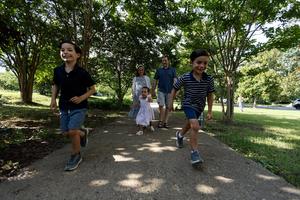
The neighborhood, located in Falls Church, Virginia, is pleasant and walkable, with mature tulip trees and oaks and drifts of azalea blooms in the springtime. There’s a park at the bottom of the hill with a stream where the neighborhood kids catch crayfish and minnows when the weather is warm and where they go sledding when it snows.
There are four Catholic families on our block, all with school-aged children. My wife and I have known the other parents, or at least their extended families, since we were undergrads together at the University of Dallas. Most of us didn’t grow up in this part of the country, but somehow we’ve ended up on the same street. I’m grateful for that every day.
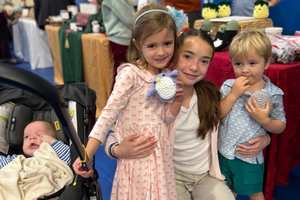
My own children are grateful, too. Ours is a good neighborhood to live in; it’s an outstanding neighborhood to live in if you’re a kid. And these days, there are lots of kids. At last count, there are 20 between the four families on our little street. Expand the circle a few blocks and the number of Catholic families and school-aged children more or less triples.
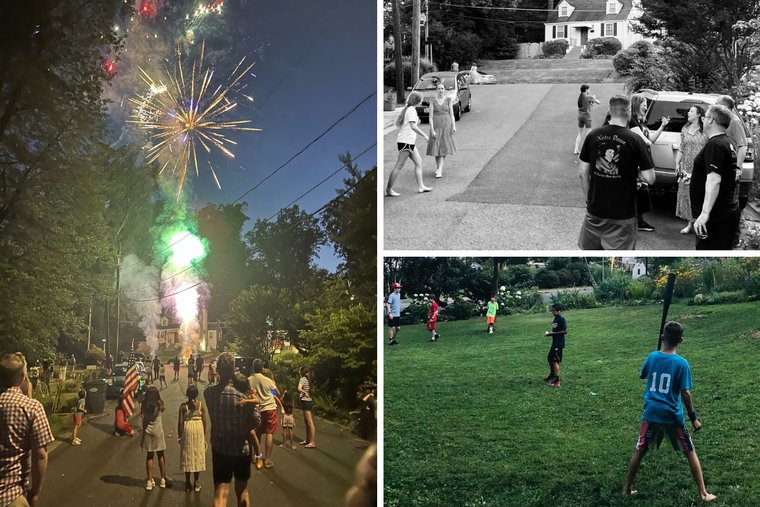
Our yard has a flat spot for wiffle ball or football or soccer, depending on the season, so it is usually filled with kids from the neighborhood. We have a rickety wooden swing set where the younger kids like to hang out. I usually manage to keep the kids out of my flower beds, but the lawn is perpetually worn thin. A bare patch of dirt marks where home plate usually is.
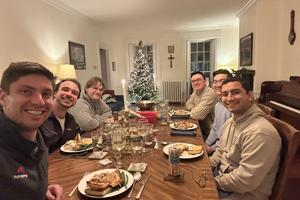
Sometimes on a fine evening, the dads will meet for a beer in the street while the moms chat and the kids play basketball or ride bikes or build tiny fairy houses with bits of sticks and leaves and such. When the nights are cool, the adults will sit around our fire pit and talk so late into the night you’d think we were in college again.
It’s a great place to live. I think so anyway.
People sometimes ask how we built the little community we have. I always tell them we didn’t build anything; it just sort of happened this way. My neighbors will tell you the same thing.
Still, it didn’t exactly come about by accident. Most of us grew up in and around big Catholic families, which means we were formed a certain way even if we aren’t always conscious of it. Many of us have a connection to the University of Dallas (like my wife and me), or to Opus Dei (particularly their schools), or both. There is a real sense in which our close-knit community rests on a foundation that was laid down for us long before any of us had families of our own. That’s a reason to be doubly grateful — grateful both for what we have received and for the chance to be able to pass some of that on to our own children.
I am also grateful for the blessings we didn’t have.
The truth is, most of the families on our block would have happily bought a bigger, newer, nicer house somewhere else if we could have afforded it. But we couldn’t. Sometimes the good things we cannot have turn into the greatest blessings. Call it luck or call it Providence, but this is also a big part of the story of our neighborhood.
Start with young, growing families on a tight budget (and, often, a single income) looking for a house in one of the country’s least affordable housing markets. Then consider that most of these families want to send their (four, five, six or more) kids to Catholic schools. Around here, that’s particularly expensive. Consider, too, that a lot of the families who move into the suburbs of D.C. didn’t grow up in the area, which means extended family isn’t around to help. Sprinkle in the attraction of a few excellent local Catholic parishes and suddenly those older houses that are a little too small and need some work start to look awfully appealing.
That’s how my wife and I ended up here. We both grew up in the Midwest. I was born in Chicago and mostly grew up outside Milwaukee. She was from Kansas City. We met in college. About a year after graduation, by different paths, we both ended up in the Virginia suburbs of Washington, D.C. Two years later, we got married.
We rented a series of mediocre apartments during the first few years of our marriage, but eventually found a little, two-bedroom, one-bath cottage for rent in a quiet neighborhood. Sure, the basement would flood when it rained too hard and sometimes, after the flood, snakes would get in. But it had a cozy little backyard and a wood-burning fireplace in the living room.
We spent more than seven years in that rental before we finally found a house in the neighborhood we could (just barely) afford to buy. By then we were a family of five. Some friends tipped us off that the house across the street from them was likely to go up for sale soon. The place was a real fixer-upper, but we might be able to buy it “as is” before it went on the market. So we wrote a letter to the family and left it in their mailbox. We made an offer; they turned us down.
Six months later, the house still wasn’t ready for sale. It still needed too much work. We made a second offer, which was accepted. We moved into our new fixer-upper on the street where our friends lived just after Christmas. The following spring, another family — also friends we had known since college — moved in two doors down. And just like that there were four young Catholic families, mostly from other parts of the country but each with some family or school connections, all living on the same little street.
Some may call that luck, but I’d call it Providence.
I want my kids to grow up knowing that our family doesn’t live the same way the rest of the world lives. We do some things differently because we are Catholic. But I also don’t want my kids to grow up thinking we’re the only family that does things differently. A critical mass of like-minded neighbors makes this possible. It makes being a little bit different seem … normal.
Having other families around — big, messy, Catholic families — takes a lot of the pressure off both parents and kids. It means that Catholic family life doesn’t have to be a maximum effort, us-against-the-world affair all the time. When good is normal, normal is good.
That’s also why, if you mention “intentional community” to my neighbors, you're likely to get a look. Whatever we have, that’s not it. Living close to other families who hold their Catholic faith as the most important thing means we can all wear it a bit more lightly. But one shouldn’t overthink these things.
It also means we can give and receive support from one another without feeling pressed into conformity. There are no agreements, formal or informal, between parents about how to handle smartphones or movies or video games or such things. We parents talk about that stuff, of course, but each family handles things as they see fit. No one’s interested in joining a “Catholic HOA.”
Over the years, life in the neighborhood has taken on its own seasonal rhythm. One neighbor hosts a chili cookoff in the fall, which can draw hundreds of people (mostly children) from the neighborhood and the local parish and the Catholic schools. The family across the street throws a cocktail party (this one is just for grown-ups) under a big white tent in their backyard. There’s usually a crab feast at the end of summer and a party on St. Patrick’s Day. We host a Halloween potluck in our driveway and serve as basecamp for trick-or-treaters who come from the surrounding neighborhoods.
Then there are the smaller parties for baptisms and first Communions, confirmations or graduations.
It’s not all Norman Rockwell scenes and block parties, of course. Living close to friends means learning to live with certain limits on privacy and quiet. Every now and then someone’s kid gets banned from someone else’s yard for a day. Little kids occasionally must be sent next door to ask forgiveness for some misdemeanor or other.
There have been overseas deployments and painful layoffs, hospitalizations and miscarriages, home improvements gone wrong, deaths in families and unexpected career changes. Through all these there are true friends, eager to help. There’s always someone offering to watch the kids or cook a meal or cut the grass. We pray for each other, and we often ask for each other’s prayers.
We genuinely like each other, too, which always helps.
We still mostly manage to wear it all lightly, which is as it ought to be. We all know it’s a gift, something we couldn’t possibly build on our own. We also know it’s something durable, right up until one tries to hold onto it too tightly. We all know it won’t last forever. Some of the older kids on the block have already left for college. Even the younger kids will be too big for the wooden swing set soon. Another decade or so and all my own children will all be out of the house.
Maybe my wife and I will grow old on the block. Maybe my kids will move into the neighborhood some day with families of their own. Maybe. It’s such a good place to live, but there’s no way to know. One must be careful not to overthink these things. Besides, there’s too much to be grateful for today. The Lord provides. It’s enough to trust Him, work hard, pray harder, lend a hand where it’s needed, and try to keep up with the gratitude.
Do you live in or know about an emerging Catholic community we should feature in our series? Send us an email at [email protected].
- Keywords:
- catholic community