What Catholics Need to Know About Magic, Divination and the Occult
COMMENTARY: The Church distinguishes harmless entertainment from occult practices and warns against divination, sorcery and attempts to contact the dead.
Magic, sorcery, conjuring and divination involve various strange and ancient practices and terms that can be quite confusing. All of these things fall under the heading of the much larger — and often misunderstood — concepts of superstition and the supernatural.
The Supernatural
In our modern-day secular world and within popular culture, the term “supernatural” often has a non-religious connotation that, to some people, is associated primarily with ghosts and hauntings. The truth, however, is much more profound. The Catechism of the Catholic Church (CCC) clarifies that the supernatural is that which surpasses “the power of created beings.” It teaches that the supernatural world exists as a result of God’s gracious initiative and further instructs that, for Christians, our vocation to eternal life is itself supernatural.
Superstition
To the Church, and as defined in the Catechism, superstition is the attribution of a supernatural kind of magical (i.e., occult-like) power to certain practices or objects.
Based on Deuteronomy 18, pagan superstition includes:
- Human sacrifice, referred to generally as “immolation” (with this Biblical footnote making particular reference to the ritual sacrifice of children), which was believed to unlock supernatural powers;
- Divining, which includes fortune-telling, soothsaying and similar practices (originally involving the observation of birds to discern omens, a practice known as “augury”);
- Black magic performed by a charmer or caster of spells.
- Necromancy, or attempts to contact the dead (e.g., ghosts and spirits).
Within the Catechism’s definition, Christians are warned that reliance on such supernatural occult-type powers, rather than on trust in God, “constitutes an offense against the honor due to God alone.”
Divination (Unveiling the Future)
Divination, which can involve recourse to Satan or demons, includes practices intended to “unveil” future events (CCC 2116). Divination includes various practices that seek to reveal the future, such as horoscopes, astrology, palm reading, fortune-telling, the use of mediums, the interpretation of omens or lots, clairvoyance, soothsaying, the wearing of charms and numerology.
All of these things have one thing in common: a desire for power over time and history, as well as a desire for power over other human beings.
The Catechism is quite clear in stating that all forms of divination are to be rejected (CCC 2116). Additionally, the Bible instructs: “Do not be deceived by the prophets and diviners who are among you” (Jeremiah 29:8) and “Do not go to mediums or consult fortune tellers, for you will be defiled by them” (Leviticus 19:31).
Black Magic (Sorcery)
“Black magic,” also known as sorcery or witchcraft, involves the invocation of evil spirits for evil purposes (i.e., recourse to Satan or demons) in an attempt to tame occult powers and obtain supernatural power over others (CCC 2117). Specifically, it involves attempts to gain control, insight or influence over people, events or things through supernatural forces outside of God, rather than trusting in God’s supreme sovereignty and guidance. It is often connected with the use of such items as spells, charms and potions.
One example of a sorcerer from the Bible is a man named Elymas (also known as Bar-Jesus), who was identified as both a “magician” (i.e., sorcerer) and as a false prophet. He was rebuked by Paul in Acts 13:10 as being the “son of the devil.”
The position of the Church is absolutely clear on this topic. All types of magic and sorcery that attempt to tame occult powers are gravely contrary to God and to the virtue of religion (CCC 2117).
Conjuring the Dead (Necromancy)
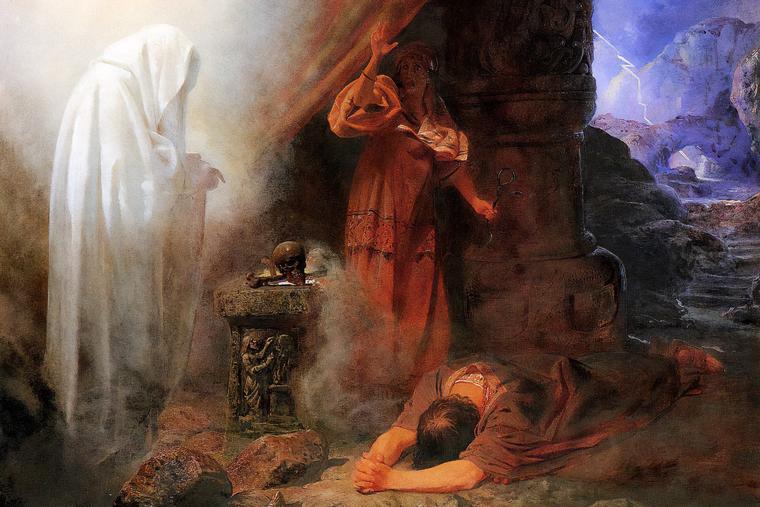
Necromancy is the ancient practice of attempting to communicate with or to summon the dead, ghosts or spirits, and it also can involve recourse to Satan or demons. The term necromancy originally meant “divination by means of the dead.” However, in modern folklore and popular culture, it has evolved beyond attempts to learn the future into the manipulation of life forces. As a result, it now includes: (1) the intentional or accidental creation of undead corpses (often referred to in modern storytelling as “zombies”); and (2) the resurrection of animals or individuals. In these more modern iterations, the connection to Satan or demons is often intentionally downplayed or ignored.
Ouija boards and séances are tools that are typically associated with necromancy. Ouija boards, also known as spirit boards (deceptively patented in 1891 as mere “parlor games”), are flat surfaces marked with letters and numbers that are designed to communicate with the dead. Séances are structured gatherings used for the same purpose, typically involving a medium.
On the topic of conjuring up the dead, the Catechism is clear that necromancy is to be rejected as contrary to the honor, respect and loving fear that we owe to God alone (CCC 2116).
A Note on Stage Magic and Magic Tricks
Although the Catechism and the Bible generally don’t make reference to any acceptable forms of magic, there is one type of magic that qualifies as such. Stage magic and magic tricks performed by entertainers and illusionists solely for entertainment purposes should be considered harmless fun. It should be noted, however, that acceptable magic does not include “tricks” used to deceive others for money, power or fame (historically referred to as charlatanry).
St. John Bosco is one example of a famous Catholic who performed harmless magic tricks as a form of entertainment. He used it to capture the attention of local children in Turin, Italy, specifically to draw them to prayer and to the Catholic faith.
The Church’s Advice
The position of the Bible and the Church is clear: All practices of superstition are offensive to the Lord (Deuteronomy 18:12). Such practices are to be condemned even more when they are accompanied by the intention of harming someone or involve recourse to the intervention of the Devil or demons (CCC 2117).
Regarding divination, the Church advises that a sound Christian attitude consists of placing oneself confidently into the hands of Providence for whatever may occur and giving up all unhealthy curiosity about the future (CCC 2115).
In general, with the exception of stage magic or magic tricks as entertainment, all of the practices described above — whether through direct participation or indirect observation — should be avoided.
- Keywords:
- magic
- divination
- occult
- necromancy