Archbishop Alemany: The Dominican Who Built Catholic California
Amid fire, famine and the chaos of the Gold Rush, Archbishop Joseph Alemany worked tirelessly to revive the faith across a fledgling California.
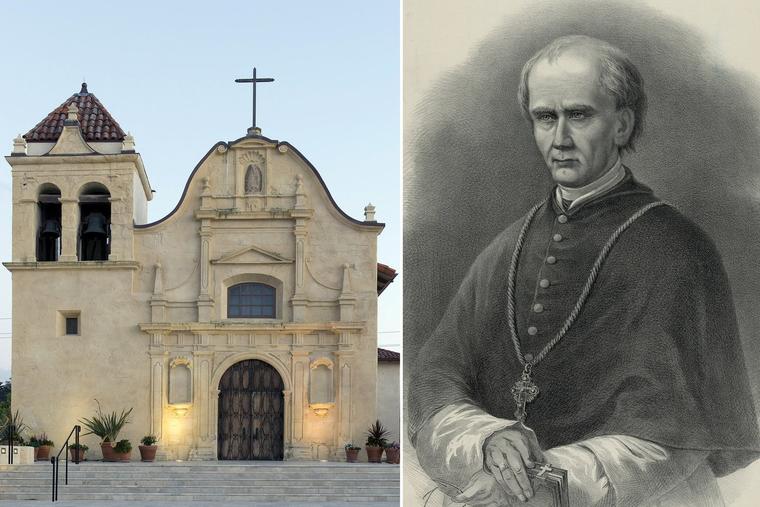
This year, the Western Dominican Province of the United States is celebrating the 175th anniversary of its founding in Monterey, California, by Dominican Father Joseph Alemany, who arrived as a newly appointed bishop to restore and to build up the Church during the California Gold Rush.
He was born in 1814 in Vich, Spain. After his ordination to the priesthood at age 26, he was assigned as a missionary to the United States to serve in Ohio, where he became a United States citizen, and then later in Kentucky and Tennessee, where he was appointed Prior Provincial of all American Dominicans. Thanks to an account written by a native San Franciscan during the Gold Rush, we have a wonderful insight into the dedication of Alemany, who took up residence in San Francisco following his appointment as the first archbishop in California.
The account opens, explaining that firemen often collapsed after fighting conflagrations for hours in the burgeoning, fire-prone city comprised of hastily built structures. One day, the writer witnessed the following:
The regular firemen of one of the engines were completely worn out and appealed in vain to the crowd standing around to aid them, until a man came running up, having just rescued two children from a house burning nearby.
That man was Alemany. Like a general, he took command and began calling out in both English and Spanish to onlookers for help. Within seconds, many had manned the engines to quell the flames. This, however, was not Alemany's sole participation at a fire. We learn he was present at every major fire in the city.
“Though a small man physically and slightly built,” the account concludes, “there was not a stronger man for his size in California.”
Alemany, however, questioned both his physical and spiritual strength upon hearing the unexpected news of his episcopal appointment by Pope Pius IX. He felt unfit, he later told his mother in a letter, to bear the burden of California. Hoping to have the appointment rescinded, he visited the Pope to make his request. But before he could utter a word, the Pope spoke: “You must go to California. Others go there to seek gold; you go to carry the cross.”
Accepting the yoke, Alemany arrived in California and, like Jesus, was moved with pity at the sight of the crowds, wandering and abandoned “like sheep without a shepherd.”
The state's first prelate, Francisco García Diego y Moreno, had been appointed in 1842, but died only six years later, overcome by the weight of his responsibilities. The missions established by Padre Junípero Serra were in ruins due to secularization laws, and Native American converts from the missions had fallen away from the faith due to a lack of pastoral leadership and a church community to call “home.”
According to a report in 1848 by Edward H. Harrison of the Quartermasters Department in California, Catholics in San Francisco numbered 200, and coexisted with “a wild motley set of all nations and creeds and no one to guide them.” There were 13 priests, some of whom, he stated with frankness, were “very old, others very ignorant and others again, very bad.” By the time Alemany arrived in San Francisco, Catholic numbers had increased to 40,000, only further emphasizing the need for thriving priests, more church edifices, and schools and teachers to provide education for the young.
For the next 35 years, then, Alemany was a man of action. He traveled the state, offering Mass, administering the sacraments and evaluating and providing for the needs of the people, especially those in the remotest areas. After founding the Western Dominican Province, he founded the Dominican convent of Santa Catalina, and appointed Dominican Sister Mary Goemaere as superior; Santa Catalina's became the first convent of women religious in California and the state’s first private school.
For five years, he worked through complicated civil litigation to reclaim Church property titles lost to the missions and was at last successful in restoring every mission as a place of prayer and a center of worship. He recruited missionary priests to administer the sacraments and teach the faith, and recruited more women religious to be educators, to care for the sick and orphans, and provide prayerful support.
As well, he oversaw the construction of church buildings to accommodate the growing population and provided for necessary repairs on edifices deteriorating or damaged in fires. Every project, however, required funding. And the Church, like everyone else, was struggling under a volatile economy and inflationary costs.
Alemany received gifts from local donors but relied greatly on financial aid from the Propagation of the Faith in Paris. His many letters testify to his limited resources and, often, dire needs. In 1866, alluding to the corruptive culture borne of the establishment of saloons, gambling houses and brothels during the Gold Rush, he wrote:
Our diocese was in the most miserable condition in regard to education. The poor boys and girls must be left a prey to immorality if we do not exert ourselves to open some good institutions. We have commenced the work, and we are already in debt.
A list of needs followed, including the seminary at Santa Ines, with “no funds,” and the college of Los Angeles, just begun by the Picpus Fathers, with “little funds.” Construction costs for convents, schools and churches, he explained, were exceedingly expensive, then added, “To help this, I have not been able to build to myself a small house.”
Small house, yes. And much worse. For, in 1866, an article in Catholic World magazine described the episcopal residence:
Go, then, up California street, turn round the cathedral, St. Mary's, and you will enter a miserable, dingy little house. This is the residence of the Archbishop of San Francisco and his clergy, who live in community.
Surrounding the house, the article described the neighborhood, lined with rotting compost, shabby homes with broken windows, dog houses, dead cats, dirty heaped-up laundry, and a miasma of odors rising, “which a mere spark,” the writer said, “would probably set the whole of these premises in a conflagration.”
In stunning contrast, as a light of hope and beauty, and as a fitting dwelling for the Real Presence in the Blessed Sacrament among us, Alemany oversaw the construction of St. Mary Cathedral, just around the corner from his little house. The brick edifice was dedicated during Christmas Midnight Mass in 1854, soon after the historic proclamation by Pope Pius IX of the Immaculate Conception of the Blessed Virgin Mary. St. Mary's became the first church dedicated to Mary after the proclamation. The cornerstone read “sub titula Immaculatae Conceptionis B. V. Mariae.” Overjoyed, Alemany described the dedication to his mother in a letter, writing:
All were surprised to see it as full as an egg. I do not remember having seen a church more crowded, and they told me that more than a thousand people had to turn back, not being able to enter.
In 1885, despite his claim to his priests, “I do not think I was born to be a bishop,” Alemany nevertheless fulfilled his directive by Pope Pius IX to carry the cross and provided for the entry of thousands into the Church.
An article in the San Francisco Monitor following Alemany's death on April 14, 1888, perhaps best summed up the reason why he will forever be celebrated by the Dominican Order and never be forgotten by all in California:
His small, slight figure and his ascetic countenance were familiar to all classes and creeds in this city, from the millionaire to the newsboy, and down to the inmates of the prison which he frequently visited in discharge of his pastoral duties in common with the humblest priest under him. While not an eminent preacher, he was an excellent administrator and under his direction the archdiocese kept full pace with the wonderful growth of the state at large.
- Keywords:
- california
- church history
- dominicans