Trump’s Bold Syria Move Echoes Leo XIV’s Call for Peace
COMMENTARY: The Vatican and the White House seem to be on the same page when it comes to the peace and survival of Christians in the Middle East.

The coincidence, or the divine Providence, seems eerie. Pope Leo XIV’s brand new account on X, began by tweeting repeatedly on May 14 about the need for peace, about being “willing to help enemies meet, so they may look each other in the eye and so people may be given back the dignity they deserve: the dignity of peace.”
Meanwhile, that most controversial of peace paladins, President Donald Trump, made peace and the dignity of others the centerpiece of his first official state visit as president (as he did in 2017) to Saudi Arabia and the Gulf states of Qatar and the United Arab Emirates.
For someone accused by his political enemies of being an opportunist, Trump’s interest in peace is not new. A decade ago, he was the only Republican presidential candidate to openly condemn the U.S. invasion of Iraq in 2003 as “a mistake.” That claim, made during a 2016 GOP debate, drew boos from the audience. During his first term, Trump resisted his own hawkish National Security Advisor John Bolton. Trump later mocked Bolton, saying, “If I’d listened to him, we would be in World War VI by now.”
Only in its fourth month, the Trump administration is deep into peace discussions on Ukraine, Gaza and Iran, sensitive discussions that show promise but could, of course, also fail. In Riyadh, reportedly against the wishes of some of his own NSC staff and the views of Israeli Prime Minister Benjamin Netanyahu, Trump announced the lifting of all U.S. sanctions on Syria, a decision received by open celebrations in the Syrian capital and approval in much of the Sunni Muslim world for whom Syria is a special cause.
Trump’s generous, open-handed gesture was followed by face-to-face meeting with Syrian President Ahmed al-Shara’a, who Trump praised. It is not the first time that an American president has met with a former terrorist turned head of state, but it is the first time that the president meets with a former member of al-Qaida and the Islamic State (ISIS) who is now a statesman.
The United States has stated real demands to Syria — no support for terrorists, expelling them, guarding jailed ISIS supporters and calm, leading to eventual peace, with Israel. Also of real concern by the administration is the fate of Syria’s ancient Christian community.
But the seemingly sweeping, unconditional gesture by Trump certainly caught the Arab imagination. Trump’s Syria decision is seen as a triumph of Saudi diplomacy but was also sought by America’s Islamist allies in Turkey and Qatar.
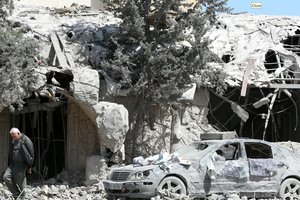
For the Syrian people — almost all impoverished now, desperate, broken after 13 years of brutal civil war — the announcement brought renewed hope and perhaps unrealistic expectations, but also a possible path forward towards a better future. The Trump decision should also help the economy of neighboring Lebanon, often seen as an entryway into Syria and economically linked to its neighbor in many ways.
The Iraq War that Trump criticized as a mistake in 2016 succeeded in bringing about the destruction of most of Iraq’s historic Christian community. Only about one-tenth of the Christian population that the country had in 2003 remains. Trump’s Syria decision could materially help Syrian and Lebanese Christians and improve the chance that they remain rooted in their ancestral homelands.
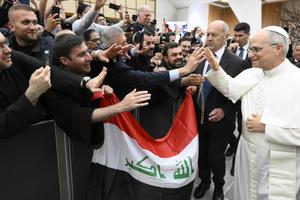
There was a curious echo of this on May 14 in Pope Leo XIV’s remarks during meetings for the Jubilee of the Eastern Churches, where he thanked God “for those Christians — Eastern and Latin alike — who, above all in the Middle East, persevere and remain in their homelands, resisting the temptation to abandon them.”
Trump made further news in Saudi Arabia where he delivered a much-lauded — by Arab opinion makers (American pundits seemed to have ignored it) — speech, which praised what the Gulf states have been able to build and contrasted it with decades of expensive, failed American intervention in the region: “This great transformation has not come from Western interventionists … giving you lectures on how to live or how to govern your own affairs. No, the gleaming marvels of Riyadh and Abu Dhabi were not created by the so-called ‘nation-builders,’ ‘neo-cons,’ or ‘liberal non-profits,’ like those who spent trillions failing to develop Kabul and Baghdad, so many other cities.” Trump’s pointed remarks against the “interventionists” and the “nation-builders” is a repudiation of both the $8 trillion “forever wars” and of the liberal internationalist “assistance-industrial complex” that was a feature of the bipartisan Washington Consensus for decades.
It is anybody’s guess if Trump’s multiple efforts at peacemaking will yield real peace. Obama left Iraq in 2011 only to have to return in 2014 with the rise of ISIS. But the focus of the new administration is crystal clear.
There is a strange irony here. Often criticized for being chaotic, Trump stays on target, speaking of “peace through strength.” Meanwhile, it was the supposedly savvy experts of the Biden administration that became deeply involved in two wars, in Ukraine and the Middle East, and found a way to both alienate allies while failing to defeat adversaries.
For the Vatican, the American president’s frenetic efforts at peacemaking present both a puzzle and an opportunity. Some in the clerical left seem to expect or wish to see major clashes between the new Pope and the new president.
Cardinal Blase Cupich of Chicago mentioned immigration, climate change and the drug and weapons trade in Latin America as possible priorities for Pope Leo XIV that would “complete and complement our political agenda.” The sense seemed to be that this meant an adversarial relationship between the Vatican and Washington. Perhaps.
But on the subjects mentioned by the Holy Father’s social media account on its first day — peace and the survival of the Christians of the East — the Vatican and the White House seem to find themselves, for now and possibly subject to change, on exactly the same side.