Beauteous Truth: Love, Reason and Imagination
COMMENTARY: An age that can’t think objectively or love self-sacrificially can still be touched by beauty.
“Beauty is truth, truth beauty, — that is all
Ye know on earth, and all ye need to know.”
— John Keats (Ode on a Grecian Urn)
John Keats’ pithy praise of beauty is both beautiful and elusive. It beguiles us; it seduces us; but does it satisfy us? Is it a satisfactory explanation of the relationship between the beautiful and the true? Doesn’t it beg more questions than it answers? If beauty is truth, what is truth; if truth is beautiful, what is beauty? These are questions that have animated the greatest philosophers since the time of Plato and Aristotle.
For the Greeks, and for Augustine and Aquinas, the good, the true, and the beautiful are inextricably entwined. And, for the Christian, they are not only entwined but ultimately are one. They are triune, a reflection of the Trinity.
They are also a reflection of Christ, who declares himself to be the Way, the Truth and the Life. He is the way of goodness (caritas), the truth of reason (logos) and the life of beauty (creation and the creative fruits of the imagination). All that is good, all that is true and all that is beautiful have their source in Christ and lead us to him.
The triune splendor of goodness, truth and beauty is incomprehensible to the Proud who have always sought to crucify beauteous truth on the altar of self-idolatry. For such as these, the purpose of the cross is to highlight cross purposes, the meaningless contradiction and not the meaningful paradox. They ask Pilate’s question, quid est veritas? not for the purpose of finding an answer, nor in the Socratic sense of seeking to prompt further questions, but merely as a means of affirming that there is no answer.
For deconstructed man, Pilate’s question is purely rhetorical because there is nothing but rhetoric. Words are toys with which we persuade ourselves that nothing is persuasive. Lacking the imagination to perceive the light of reason and the life of beauty and goodness, prideful souls perceive only a dark and godless cosmos in which there is nothing but matter; and if there is nothing but matter, nothing really matters. Lacking a living imagination, they lack life itself. They are the walking dead.
Deconstructed man is disintegrated man. He fails to see the integration of goodness, truth and beauty, condemning himself to a disintegrated cosmos in which sin is good, ugliness is beautiful, and truth is a lie. This is the fragmentation and inversion that leads to madness. It is the implosion of truth into disintegrating pieces.
The challenge of integrating our disintegrated culture has been central to the mission of the Church down the centuries. As the one body that, in Chesterton’s memorable phrase, has been “thinking about thinking” for two thousand years, the Church continues to warn against the self-deification that leads to self-destruction.
This ancient and venerable office of the Church was evident in November 2008 when Pope Benedict stressed the “urgent need for a renewed dialogue between aesthetics and ethics, between beauty, truth and goodness.” The Holy Father lamented the “dramatically evident split” between the pursuit of the external trappings of beauty and the idea of a beauty rooted in truth and goodness: “Indeed, searching for a beauty that is foreign to or separate from the human search for truth and goodness would become (as unfortunately happens) mere aestheticism and, especially for the very young, a path leading to ephemeral values and to banal and superficial appearances, even a flight into an artificial paradise that masks inner emptiness.”
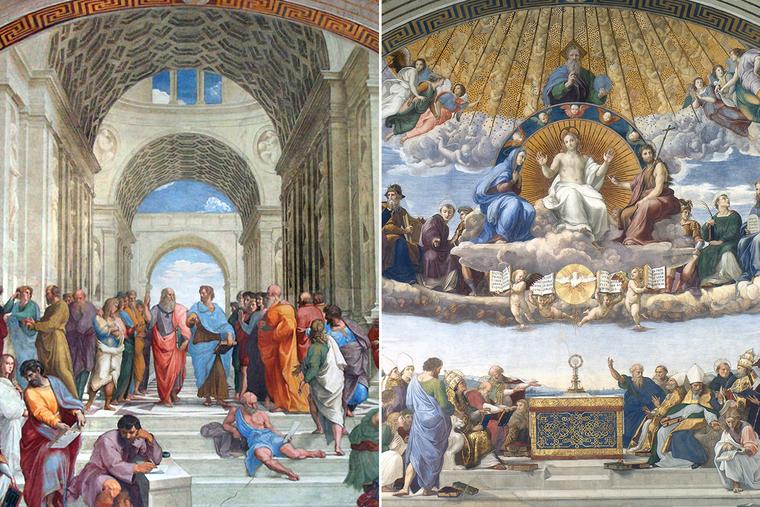
Invoking the wisdom of his predecessor, Benedict referred to John Paul II’s Letter to Artists, “which invites us to reflect upon … the fruitful dialogue between Holy Scripture and various forms of art, whence countless masterpieces have emerged.” When Christians create works that “render glory unto the Father,” Pope Benedict asserted, they speak of the “goodness and profound truth” that they are portraying, as well as the integrity and sanctity of the artist or author. Knowing how to “read and scrutinize the beauty of works of art inspired by the faith” can lead Christians to a “unique path that brings us close to God and his Word.”
This path was itself a means to evangelize the wider culture through the power of beauty and, as such, the Pope urged believers to use the power of the imagination to learn how to “communicate with the language of images and symbols … in order effectively to reach our contemporaries.”
With his customary eloquence and sagacity, Benedict XVI has provided the truth that elevates Keats’ poetic epigram to a level beyond mere banality. In an age of rational illiteracy, in which deconstructed man has turned his back contemptuously on truth in the name of an elusive and illusory “self-empowerment,” the power of beauty still speaks in colors and sounds beyond prideful words and thoughts. In an age in which the self-sacrificial heart of true love has been removed and replaced by egocentric counterfeit “loves,” beauty still pulsates with healthier passions and nobler desires.
An age that can’t think objectively or love self-sacrificially can still be touched by beauty. A sunrise still speaks to the most hardened hearts and arouses feelings of inarticulate gratitude. So do the greatest and most beautiful masterpieces of human creativity. Such beauty has a life of its own and can rekindle life in those who behold it. It can heal the proudest of hearts, bringing them back to life. The way of Christ is true love, the truth of Christ is true reason, and the life of Christ is true beauty. In the name of the Good, the True and the Beautiful. Amen.