God’s Answer to the Pain of Adolescence
COMMENTARY: The world wounds us early, but darkness has an enemy, and fear is not the end of the story.

“I wouldn’t go through that again for anything,” said a friend a few stools down at our local place. She and the bartender had been discussing their teenage years. They’d grown up in the same town about 10 years apart, one in a difficult situation, the other a star athlete, but they both had stories.
“Yes,” I answered my friend. I hadn’t thought about my teenage years in a long time, but once I did, I remembered a good bit of pain. I wouldn’t go through it again for anything. It’s a Darwinian world, teenage culture, with nature red in tooth and claw, nasty, dull, brutish, and not short enough.
In one of Charles Schulz’s Sunday Peanuts cartoons, poor Charlie Brown walks down the street to insults from other children followed by their hysterical laughter. Lucy asks him. “Is that your head or are you hiding behind a balloon?”
He gets home and listens to the radio, only to hear, “And what in all this world is more delightful than the gay wonderful laughter of little children?” He kicks the radio. That must have been an almost universally popular cartoon.
The Pain of Adults
One graduates from that stage of life. But what so many teenagers endure, very many adults endure. What so many experience as teenagers is only one form, and a much simpler one, of what they experience when they go into the world on their own. The world remains Darwinian, and for many it remains primarily Darwinian, and for some it gets worse.
People who work in religious institutions often have disturbing and sometimes horrifying stories of mistreatment and abuse. (I can tell some.) Over the years, many people who work in large corporate structures have told me the office politics they’d endured: the treachery, the traps, the lies and slanders, the fake friendships, the knives in the back, the threats.
I’ve seen this in the lives of people at the top of their world, which as a naïve young man I thought meant they had enjoyed great lives, and were enjoying great lives still. I found many times how wrong I was.
Many years ago, I was sitting in the living room of an Episcopal minister at whose parish I’d been speaking when he started crying. We’d just finished watching the movie True Confessions, the story of an ambitious monsignor destined for the top and his brother the cop who helped him cover up clerical misbehavior, which won the monsignor the archbishop’s favor. The ending was a beautiful picture of the glory and the pain of the pastoral calling, and it hit the pastor hard.
His parish was growing and lively, his people loved him, he had a great family and was very comfortable in life. Other ministers envied him, I knew, from hearing them snipe about him. His life worked unusually well. I thought he’d made it.
Then he began telling me about the pain in his life, not in great detail, but he way he spoke of it revealed how hard parts of his life had been, and still were. His own failures clearly haunted him. The end of the movie brought him hope, but brought up all the pain as well.
Given what I’ve done for a living, I’ve gotten to know a lot of very successful people. Mostly academics and churchmen, but also wealthy people and politically powerful people. Some told me about the pain in their lives — the ministers especially — sometimes with a quick offhand remark and sometimes at length.
At first, the stories surprised me, because they looked to be on top of their world, like the minister. But then they spoke about their lives and revealed suffering I never would have imagined.
Of Course We’re Unhappy
C.S. Lewis’ friend, the writer Charles Williams, had a difficult and disappointing life, despite being very smart and very gifted. He knew real pain and what to say about it. He said, Lewis wrote, “that when young people came to us with their troubles and discontents, the worst thing we could do was to tell them that they were not so unhappy as they thought. Our reply ought rather to begin, ‘But of course. ...’”
The reason, he continued, was that “young people usually are unhappy, and the plain truth is often the greatest relief we can give them. The world is painful in any case: but it is quite unbearable if everyone gives us the idea that we are meant to be liking it. Half the trouble is over when that monstrous demand is withdrawn.”
Many of us need to look at the world differently, to see what Williams saw. If we are at least securely middle class, we tend to assume, I think, in a society in which life is in some ways so astonishingly easy, that the world works well. We live the good life, as our society understands it, and pain may be an annoyance but it’s not usually a real problem.
And that’s why we can say to young people, and to other adults, that they should enjoy the world, that they don’t really feel so unhappy as they think. It’s a stage. It’ll pass. Which for many isn’t true and doesn’t help. At some point, it won’t be true for those of us who feel happy now. The Salve Regina begins with this reality, saying to the Mother of Mercy, “To thee do we cry, poor banished children of Eve; to thee do we send up our sighs, mourning and weeping in this valley of tears.”
Seeing the world as it is makes living in it a little easier. “What is unforgivable if judged as an hotel may be very tolerable as a reformatory,” Lewis explained.
What Fairy Tales Teach Us
Christianity doesn’t leave us with mere realism about the nature of the world, though that by itself is a gift, as Williams saw. We do better knowing the truth.
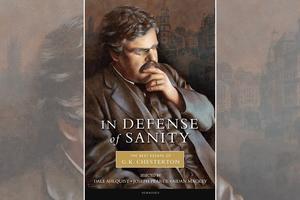
But we do best knowing the whole truth. The world is like this, yes, but in the world are found answers, answers from beyond the world. G.K. Chesterton saw this. His insight into the nature of fairy tales is one of his most popular quotes, I suspect because we sense that he’s not writing just about small children, but about us as well.
“Fairy tales do not give the child the idea of the evil or the ugly; that is in the child already, because it is in the world already,” he wrote, making the point that Williams would later make.
Fairy tales, he continued, “do not give the child his first idea of bogey. What fairy tales give the child is his first clear idea of the possible defeat of bogey. The baby has known the dragon intimately ever since he had an imagination. What the fairy tale provides for him is a St. George to kill the dragon.”
The stories answer the terrifying reality the child in some way knows from very early in his life by pointing to another reality he has not seen or seen so clearly. The fairy tale “accustoms him for a series of clear pictures to the idea that these limitless terrors had a limit, that these shapeless enemies have enemies in the knights of God, that there is something in the universe more mystical than darkness, and stronger than strong fear.”
The fairy tales point to Jesus Christ, the dragon to the man who had been tortured to death and died in great agony and the knight to the man who appeared alive three days later. Grim as it sounds, the teenage years aren’t a trial that once finished is over for good. They’re a stage in the human condition, and maybe not the hardest. But God doesn’t let us remain teenagers forever.