Femme Formidable: The Power of Faithful Women
COMMENTARY: History and literature are full of femmes formidables who shine forth feminine faith and fortitude.
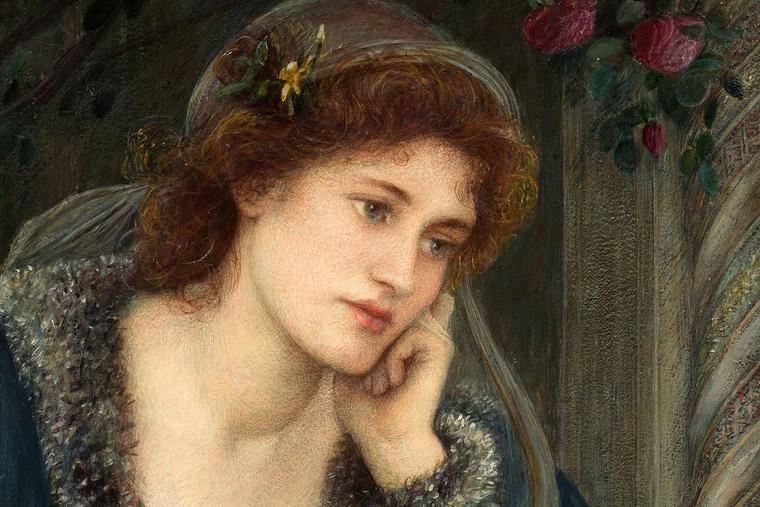
There are times when the English language, as rich as it is, is inadequate to express precisely the meaning that we wish to convey. On such occasions we grope in the direction of foreign tongues to find the word or phrase that’s on the tip of our own tongue. One such term is “femme fatale” which seems to express with nuanced and poetic precision what the English equivalents can’t quite manage.
A femme fatale is a woman whose allure is not only attractive and seductive but dangerous and deadly. History and literature are full of femmes fatales. Delilah, Jezebel and Salome are examples from Scripture. In literature, we think of Helen, whose face launched a thousand ships and destroyed the city of Troy. There is, however, the need for a term that encapsulates the woman of faith and fortitude whose presence is a boon and a blessing and whose actions are restorative, bringing health and healing.
Our own language is once again inadequate to the task. We need to look elsewhere. The mother tongue needs to adopt a foreign child into her own family so that she can be enriched by its adoption. Such a child is the “femme formidable” who, in her virtue, serves as the antidote to the viciousness of the femme fatale. The Blessed Virgin is the archetypal femme formidable who, as the New Eve, allows herself to be the means by which the wickedness of the Old Eve, the archetypal femme fatale, can be undone.
Let’s look for other examples of femmes formidables from history and literature.
In The Odyssey, Homer gives us the formidable feminine presence of Penelope as the anti-type to the fatal feminine charms of Helen in The Iliad. Whereas Helen, through her adulterous elopement with the equally culpable Paris, had caused the siege of Troy, Penelope retains her virtue in spite of being besieged by numerous unwanted suitors. She doesn’t say much and doesn’t need to say much because her virtuous actions speak louder than any words. She remains chaste and loyal to her long-absent husband; she has faith in the gods and is pious in prayer; she shows strength and resilience in her resistance to the suitors who are intent on forcing her into marriage.
It is no wonder that the ghost of Agamemnon, who had been betrayed to his death by his adulterous wife Clytemnestra, should compare Penelope’s loyalty and virtue with his own wife’s treachery and viciousness, declaring that Penelope will be an example of true womanhood for all generations.
Dante gives us a literary femme formidable in the figure of Beatrice. In her presence, we feel what T. S. Eliot felt in the presence of Dante. Eliot was in such awe of his poetic mentor that he declared that there was nothing to do in Dante’s presence but to point and remain silent. There seems little that we can do in the presence of Beatrice, Dante’s Muse, than to do likewise.
Shakespeare also provides several femmes formidables, one of the most powerful of whom is never seen. She never makes an appearance on stage and never utters a solitary word. This is Rosaline. We only know what Romeo says about her. He complains that “she’ll not be hit with Cupid’s arrow”:
And in strong proof of chastity well arm’d,
From Love’s weak childish bow she lives unharm’d.
She will not stay the siege of loving terms,
Nor bide th’ encounter of assailing eyes,
Nor ope her lap to saint-seducing gold.
Cordelia is another Shakespearean heroine whose potent presence is felt in her absence and whose virtuous voice is heard in its silence. In the face of demands that she should render all unto Caesar (King Lear) and threats that she will lose everything unless she waxes sycophantic in Caesar’s praise, she chooses to “love and be silent,” suffering exile and ultimately death for her refusal to compromise goodness or sacrifice truth.
Portia, on the other hand, is as loquacious as Cordelia is tight-lipped. Her eloquence, her wisdom and her wit exceed that of all the male characters in The Merchant of Venice and, dare we say, of all the male characters in the entirety of Shakespeare’s corpus.
Perhaps, in the contrast between Cordelia and Portia, we see the two types of femmes formidables, broadly conceived. On the one hand, we have those who love in silence and resilience; on the other, those who love with eloquence and elegance. The former were praised by G. K. Chesterton, who wrote that the wife of William Cobbett was the “powerful silence” in her husband’s life. Chesterton could have said the same of his own wife and perhaps he had her in mind as he wrote these words.
As for the latter, those who have not held their tongues but who have wielded them as weapons of wisdom, we will conclude with a litany of loquacious femmes formidables, both factual and fictional: Antigone, Felicity, Perpetua, Agatha, Lucy, Agnes, Cecilia, Anastasia, Fabiola, Callista, Clare of Assisi, Teresa of Ávila, Margaret Clitherow, Anne Line, Margaret Ward, Jane Austen, Elizabeth Bennet, Lucia Mondella, the Brontë sisters, Jane Eyre, Evangeline Bellefontaine, Thérèse of Lisieux, Teresa Benedicta of the Cross, Sigrid Undset, Lady Marchmain, Cordelia Flyte, Flannery O’Connor and Mother Teresa.
We could go on. Indeed, we could go on and on. History and literature are full of femmes formidables who shine forth feminine faith and fortitude. They are a powerful silence and a powerful presence. They are a boon and a blessing. Thanks be to God.
- Keywords:
- women
- english literature
- literature