This World Is Not Our Home — We’re Just Passing Through
COMMENTARY: From the Psalms of Ascent to the Camino de Santiago, the journey of faith is a journey home — and this earth is just a stop along the way.

One of the gospel songs I learned while being raised in an evangelical Protestant home went like this:
This world is not my home; I’m just a-passing through.
My treasures are laid up somewhere beyond the blue.
The angels beckon me from heaven’s open door
and I can’t feel at home in this world anymore.
It’s a belief we held close to our hearts, as keeping our eyes on our heavenly home helped put everything into perspective. We remembered Our Lord’s teaching that it made no sense to lay up treasures on earth where rust and moth destroy, and we quoted the Bible verse from Hebrews that said Father Abraham “was looking forward to the city with foundations, whose architect and builder is God.”
The Old Testament stories reminded us that God’s people were nomads. Some scholars think the derivation of the word “Hebrew” actually comes from the Egyptian word hapiru — which means worthless lowly nomads, migrant workers or homeless people.
The Old Testament Pilgrim People
Ever since Adam and Eve were expelled from their garden paradise, God’s people have been wanderers.
Father Abraham is called to leave his home city of Ur in Mesopotamia to set out for a promised land, and his descendants were nomadic shepherds. Generations later, Moses leads the Hebrews out of slavery in Egypt to embark on the great journey to the land of Canaan.
Consequently, pilgrimage became a vital part of the Jewish religion.
For the ancient Israelites, pilgrimage was a sacred duty. Each year there were three major pilgrimage festivals — Passover, Pentecost and Tabernacles — that required Jewish men to travel to the Temple in Jerusalem to offer sacrifices and worship. These journeys weren’t only made because the Temple was the focus of their worship, but also because, in making a journey, they were ritually participating in the key moments in Israel’s history — such as the Exodus from Egypt and the 40-year sojourn in the desert.
We can trace this pilgrimage spirit in some of the psalms. The “Songs of Ascent” (Psalms 120-134) reflect the spiritual depth of these pilgrimages. Sung by pilgrims who were going up to Jerusalem, these hymns express longing for God’s presence, trust in divine protection, and joy in shared worship. Psalm 122:1 declares, “I was glad when they said to me, ‘Let us go to the house of the Lord!’”
The depth of these Psalms reflects the heart of their meaning: that making a pilgrimage to Jerusalem was more than traveling to the Temple — it was a sign of the soul’s greater journey to the Father and to an eternal home in heaven.
Christian Pilgrim People
In the first centuries of the Catholic Church, pilgrimage was not a defining practice. Indeed, one of the key attributes of the first Christians is that they, like the Jews before them, were a homeless people. Jerusalem was leveled by the Romans in A.D. 70, and the first Christian communities were made up of exiled Jews, slaves, refugees from various Roman wars and migrants from the far-flung regions of the empire.
Once Christianity became the official religion of the empire under Constantine, a geographical focus for the faith became more important, and it was Constantine’s mother, St. Helena, who played a crucial role in the new focus. She traveled to the Holy Land to seek out the places where the events of the Gospels unfolded.
The story of St. Helena’s discoveries is thrilling. Around the year 130, Emperor Hadrian, in an attempt to quash Christian devotions, ordered a temple honoring the god Venus to be built on the historical site of Jesus’ crucifixion and burial. In Bethlehem, he built a temple to Adonis on the site of Jesus’ birth. In doing so he inadvertently marked the exact locations of Jesus’ birth, death and resurrection for future generations.
St. Helena had the pagan temples demolished, and the Church of the Nativity (which still stands in the heart of Bethlehem) and the Church of the Holy Sepulcher in Jerusalem became the premier pilgrimage sites for Christians.
As the faith spread north and west throughout Europe, the highlight of one’s Christian life became the possibility of making a pilgrimage to Jerusalem. To journey to Jerusalem involved a real sacrifice. Not only was it expensive, but it was also perilous. Medieval accounts, such as from Egeria (a fourth-century pilgrim) and those of Bernard the Monk (ninth century) and Geoffrey de Vinsauf (12th century), describe pilgrims enduring bandits, disease and harsh conditions to reach Jerusalem.
Nevertheless, pilgrimage had become a cornerstone of Catholic spirituality. To go to Jerusalem meant one was a member of “the pilgrim people of God.” The expense and hardships of the journey were a form of penance — a participation in the life of the Lord who had no place to lay his head and who said, “He who would be my disciple must take up his cross and follow me.”
After the Muslim conquest of Jerusalem in 638, access became even more dangerous and the Crusades (1095-1291) were launched to secure safe passage for pilgrims.
Rome — a Second Holy City
Because of the dangers and difficulties of getting to Jerusalem, Rome emerged as an alternative destination. Not only was Rome tied to the martyrdom of Sts. Peter and Paul, but the ancient Basilica di Santa Croce in Gerusalemme (Basilica of the Holy Cross in Jerusalem) was built on the site of the empress Helena’s villa and housed the relics of the True Cross. To visit Rome was a worthy substitute.
For those who couldn’t go to Jerusalem or Rome, life-sized outdoor Stations of the Cross were created to enable the faithful to walk in the footsteps of the Lord and share in his passion. Before long, every Catholic church featured Stations of the Cross to help the faithful make “mini-pilgrimages.”
As pilgrimages increased in popularity, regional sites developed and flourished. Santiago de Compostela in Spain claimed to have the relics of St. James. The great cathedral in Cologne housed relics of the Magi; Notre Dame in Paris had the Crown of Thorns, while Chartres Cathedral hosted the veil of the Virgin.
Pilgrimage routes sprang up, marked by hospices and churches. The popularity of pilgrimage helped to unify Christendom. As Christians traveled through other lands, they met and had fellowship with other brothers and sisters who also knew that this world was not their home — they were just passing through.
With the modern ease of travel, pilgrimage is more popular than ever. Now that the political scene in Israel is somewhat stabilized, pilgrimages are returning to the Holy Land. Rome is also observing a Jubilee Year, and crowds are descending on the Eternal City. In addition, films and documentaries about Santiago de Compostela have inspired increasing numbers to walk “the Camino.” Meanwhile, authorities in Europe are working to open up the Via Francigena — the ancient footpath from Canterbury to Rome.
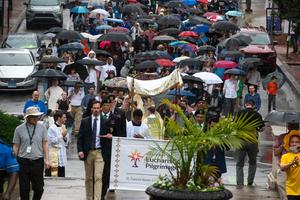
The spiritual dimension of pilgrimage is reinforced by the physical experience. Pilgrimage fosters a sense of communion with both God and the Church. Medieval pilgrims often traveled in groups, praying and singing together, much like the Jewish pilgrims going up to the Temple singing and praising God.
Finally, pilgrimage has an eternal dimension, pointing toward the ultimate destination of heaven. The journey is a sign of life itself — the prodigal soul’s pilgrimage to the Father’s house, and a daily reminder as the pilgrim travels that this world is not his home — he’s just passing through.
Father Longenecker’s autobiography is published by Ignatius Press. Join him on a pilgrimage to the Holy Land in April 2026. Details can be found at his website, dwightlongenecker.com.
- Keywords:
- pilgrimage
- pilgrimages