No Mere Coincidences: Fatima and the Shooting of John Paul II
COMMENTARY: The 45 years since the attempt on the Holy Father’s life allow us to see the hand of Providence more clearly.
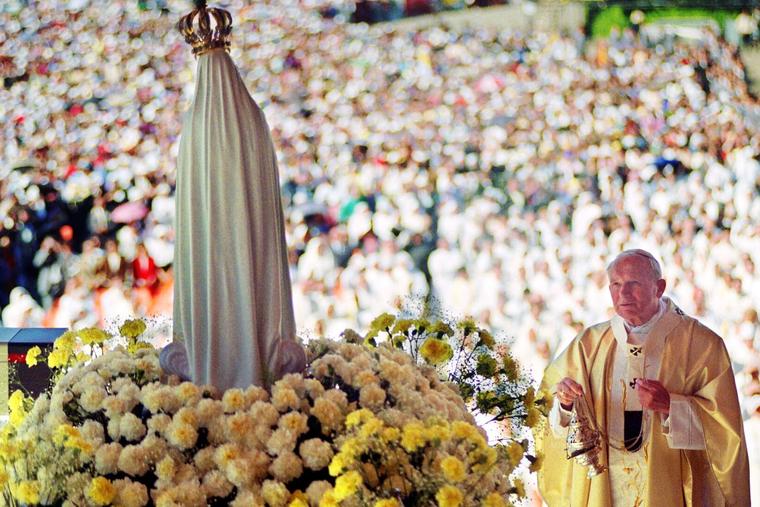
On this 45th anniversary of the assassination attempt on Pope John Paul II’s life, we can see more clearly the lessons we learn from his commitment to the challenging and joyful life God offered him.
The fact that he was shot at point-blank range in St. Peter’s Square shows enormous courage. After having stood up for human rights and the Gospel against several violent regimes, he risked assassination every time he appeared in public.
At 5 p.m. on May 13, 1981 — the Feast of Our Lady of Fatima — Pope John Paul II climbed into an open-air vehicle and was driven into St. Peter’s Square, where some 20,000 people awaited his weekly Wednesday audience. About 10 minutes later, and mere seconds after the Pope had picked up, held and returned a little girl to her parents, trained assassin Mehmet Ali Ağca fired multiple pistol shots from about 10 feet away and struck the Pope in the abdomen.
On the way to the hospital, Pope John Paul II told his secretary that he had already forgiven his assassin, immediately giving the shooting the meaning of discipleship. A few days later, in his very first address after the event, John Paul publicly forgave his would-be assassin and called Ağca “the brother who shot me.”
Although no one has ever proven that the Soviet KGB was behind the attempt, well-informed observers noted that the attack had the common features of a KGB operation and that the Pope’s effective opposition to communism gave them a motive. The Pope himself showed little interest in an investigation, perhaps because it would frustrate his strong desires to reconcile the Catholic and Russian Orthodox Churches and to end communism through diplomatic rather than military means.
The Pope recognized that his survival was a miracle. Ağca had first aimed at his head, but when the Pope picked up the little girl, the assassin adjusted to fire at the Pope’s abdomen. Doctors later found a perforated colon and five wounds in the small intestine, and they realized that the bullet had passed millimeters from the abdominal aorta. Had it been struck, the Pope would have died within minutes.
One year to the day after the assassination attempt, John Paul remarked, “In the designs of Providence there are no mere coincidences” during a pilgrimage to the Shrine of Our Lady of Fatima to thank her for protecting him. To those familiar with the secret of Fatima, the Pope’s survival might at first seem surprising. In 1917, Our Lady appeared to three young shepherds in Fatima, Portugal. She gave them visions symbolizing the living hell that would become the European communist regimes of the 20th century. She also provided encouragement that steadfast devotion to God would eventually win the day, but not without many martyred bishops, priests, religious, laity and even a pope, according to the third and last vision.
When Pope John Paul II read this vision after the assassination attempt, he realized that Our Lady of Fatima had, in fact, protected him. Instead of showing the inevitability of violence, the message of Fatima showed the power of devotion and penance to avert violence and reminded the world that God’s mercy is far greater than the plans of evil.
About a year and a half after the assassination attempt, the Pope extended the hand of mercy and forgiveness to his assassin by visiting Ağca in prison. In their conversation, the Pope calmed the young man’s fears, answered his questions about Our Lady of Fatima, assured him that she was not going to spirit herself through the prison walls to take revenge on him, as he feared, and then left, hoping for the assassin’s conversion.
In the Pope’s last book, Memory and Identity, he recalled: “In the course of our conversation it became clear that Ali Ağca was still wondering how the attempted assassination could possibly have failed. He had planned it meticulously, attending to every tiny detail. And yet his intended victim had escaped death. How could this have happened?”
John Paul observed that Ağca’s perplexity “had led him to the religious question. He wanted to know about the Secret of Fatima; more than anything else, perhaps he grasped something really important, that over and above his own power, the power of shooting and killing, there was a higher power. He then began to look for it. I hope and pray that he found it.”
The assassination attempt on the life of Pope John Paul II shows how God can turn a single act of violence into many signs of his Providence. A professional assassin shooting at point blank range does not kill his victim but is instead forgiven by him. Through the message of Our Lady of Fatima, the Church discerns the hand of God protecting, guiding and challenging her amid the evils of another century. A saintly pope, devoted to daily conversation with God, recognizes the signs of God’s Providence and witnesses forgiveness to the Church and to the world, including to his own assassin.
European communism fell less than a decade after Agca’s assassination attempt, but Fatima’s vision of hell reminds us that sin, soul-corrupting ideologies, and violence take new forms as old ones are overcome. Recalling this story today reminds us that our future is in the heart of God and that people who, like St. John Paul II, are willing to seek God, pray with honest devotion and act with courage become active partners in creating that future. This is what a life transformed by God’s mercy looks like — and it invites us to consider our own response.
Grattan Brown, STD, is the director of mission and ministry at the Saint John Paul II National Shrine in Washington, D.C.