Abortion in the Atomic Age: Hiroshima’s Moral Aftermath
COMMENTARY: The intentional taking of an innocent life is always gravely wrong — in war or in peace — and Hiroshima forces us to confront that truth.
One of the most painful things about growing older is the death of deeply loved and deeply wise mentors. A few years ago, during a terribly short span of time, three of my favorite priests passed away, but what magnified these tragedies is that my father — my greatest mentor — died shortly thereafter. And I would like to pass along an insight of my father’s.
Before I do — and to help me illustrate his insight — I’d like to tell you a little about my father, Bruce Clark.
As a loving father of seven boys and an Army Ranger combat veteran in Vietnam, my father had seen the best that humanity could achieve, and the worst that humanity could inflict. Born on Dec. 7, 1935, he spent his 6th birthday listening to radio reports about the bombing of Pearl Harbor. He lived through two-thirds of the bloodiest century the earth has ever known, and sustained lifelong injuries from one of its bloodiest wars.
He lived for nearly three decades as a leg amputee, during which time his level of suffering from phantom pains was often indescribable. Even in the depths of literally writhing agony, my father never complained. Instead, he offered his suffering for the souls in purgatory — convinced that his suffering on earth would help one more soul see heaven a little faster. Suffering, especially suffering that is offered as expiatory, can nourish wisdom. To be sure, my father was wise, but it was a hard-earned wisdom. And it was in my father’s final years that his insights grew increasingly profound.
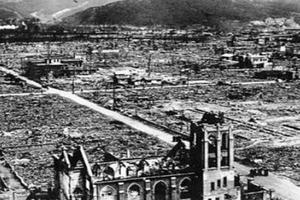
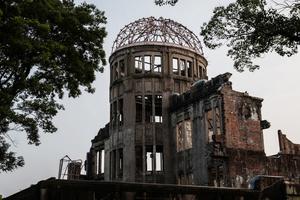
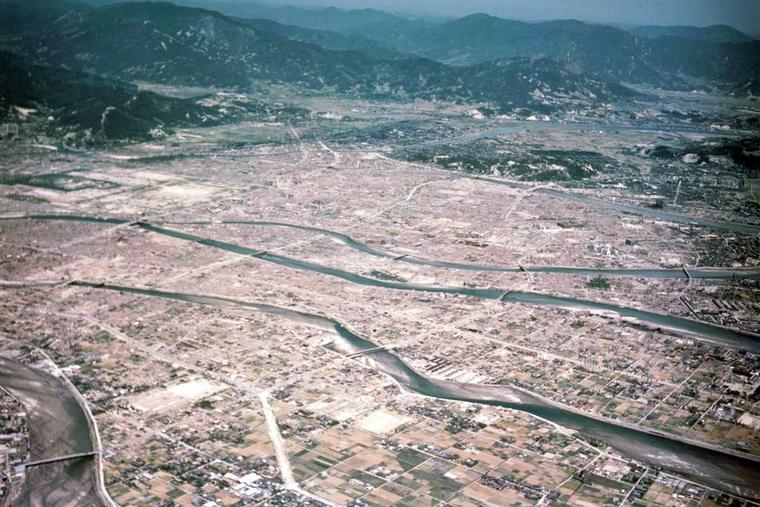
I was thinking about one of these insights recently as it pertained to a news item that seemed to gather everyone’s attention: Aug. 6 marked the 80th anniversary of the atomic bombing of Hiroshima. It seems that every year on the anniversary of the bombing, many people continue to argue in defense of America’s decisions in 1945 to use nuclear weapons on the Japanese people.
But these defenses tend to leave out a foundational and objective point of ethics: the intentional taking of innocent life is gravely wrong. Yes, it is true that innocent people can perish in the course of fighting just wars, but even within a just war, the intentional taking of an innocent person is grave matter. And as official documents illustrate, Hiroshima and Nagasaki were chosen, in part, because they had sizeable civilian populations.
One of the main exculpatory arguments for the bombing is that, had the American government failed to drop the atomic bombs, America would have suffered hundreds of thousands of casualties while invading Japan. (Or so the argument goes.)
It’s little wonder this argument is popular, because we live in an age of consequentialism — the position that the end justifies the means. But we need to recognize that consequentialism exists in a uniquely hubristic enclave of nihilism. That is, it not only repudiates the foundational principle of human ethics (the intentional taking of an innocent life is always wrong), but it also pridefully asserts with insistent certainty: “If A, then B.” In one fell swoop, this consequentialism manages to mock both the Decalogue and Divine Providence, essentially arguing we must disobey the commands of God, so that good may occur. That argument tracks to the Garden of Eden.
When these bombs were dropped, my dad was too young to ask the question, but in his later years, something struck him: Why were there no demonstrations in America against the atomic bombings? Though it was probably difficult to immediately get accurate numbers, it should have been clear that tens of thousands of civilians were killed.
In the coming months and years, it became clear that many tens of thousands of men, women and children died in the atomic blasts, while tens of thousands more persons quickly developed terminal illnesses due to radiation. Again, no riots, no mass demonstrations or marches, barely even a random and unwelcome whisper of protest.
And with the hindsight of decades to study history, my father wondered why. It’s a fair question; after all, the fabric of American history is sewn with the thread of protests. Dr. Steven L. Danver has assembled a three-volume encyclopedia titled Revolts, Protests, Demonstrations, and Rebellions in American History. Danver illustrates that Americans — from Bacon’s Rebellion in 1676, to the Boston Tea Party in 1773, to the suffragette movement, to modern immigration protests — have rarely been shy about protesting or even rioting over what they perceived as governmental malfeasance. To catalog all the politically themed marches in America would be nearly impossible.
We could also note that — from 1914 to 1917 — major protests from the political Left, Right and Center against American entry into World War I were held throughout the country, with some of them drawing thousands of demonstrators. A generation later, the pattern repeated, as thousands of Americans protested the idea of entering World War II. Without commenting on the merits of any of these protests, the fact remains: from colonial times to the 1940s, Americans protested by the thousands.
And then — after the most lethal physical weapon ever inflicted upon man — they didn’t.
Now we come to my father’s insight.
My father, along with many people who grew up in America in the 1930s and 1940s, had a difficult time determining how abortion became widely acceptable in the American mind. Was there a catalyst?
Over the decades of pondering the question, my father posited an answer. He believed that legalizing abortion was at least partially rooted in the fact that Americans just a generation prior had approved of bombing Hiroshima and Nagasaki. It’s a salient point. Though only heaven knows the exact figures, it is clear that some unborn Japanese babies were killed by these bombs in the wombs of their mothers.
My father’s insight is hauntingly inescapable. If it were morally acceptable to bomb civilian Japanese babies, what’s the argument against abortion?
I later discovered that my father was not alone in his observation. In 1974, Archbishop Fulton Sheen gave a talk in which he made a similar but broader observation. Sheen noted that the world had changed in the previous few decades — that the world had become meaner, more violent and more dishonest. What did he think the catalyst might be? Sheen stated:
See how much the world has changed? Now, what made it change? I think maybe we can pinpoint a date: 8:15 in the morning, the sixth of August, 1945. Can any of you recall what happened on that day? ... It was the dropping of the bomb on Hiroshima in Japan. When we flew an American plane over this Japanese city, and dropped the atomic bomb on it, we blotted out boundaries.
There was no longer a boundary between the civilian and the military, between the helper and the helped, between the wounded and the nurse and the doctor, between the living and the dead — for even the living who escaped the bomb were already half-dead.
So we broke down boundaries and limits, and from that time on, the world has said ‘We want no one limiting me.’ … We want no restraint, no boundaries, no limits.
A consequentialist denial of ethics that originates in war is bad enough, but this consequentialism will assuredly spill over to our daily lives — and our daily decisions. After all, there is not one set of moral principles for wartime, and a separate set for peacetime; we have but Ten Commandments. And those tablets are immutable. We must trust in the Providence of God. The bombings of Hiroshima and Nagasaki happened 80 years ago, but our moral stance on these bombings forms an immediate impression on our hearts and souls. Will we walk by faith in God and his commandments, or will we blind ourselves in a blizzard of consequentialism? My father’s insight many years ago stands as a challenge to all of us today: Will we stand up for innocent life — all innocent life — or not?
During World War II, American soldiers sacrificed their lives to save people — many of whom they had never even met. Americans should be enduringly proud of that fact. But just as we should celebrate that heroism, we must not — we cannot — endorse unethical wartime actions, especially those that involve the intentional taking of innocent lives. We must always and everywhere remain firm in that principle, both in war and peace.