Pope Leo’s Return to the Papal Apartment Corrects an Anomaly
COMMENTARY: Now that Leo has moved back to the papal apartment, will the relics of St. Peter return, too?
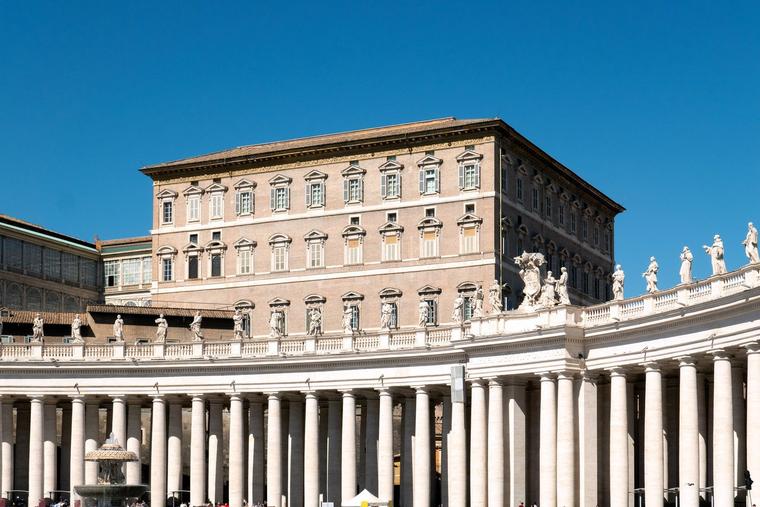
In the briefest of statements, the Holy See Press Office noted on Saturday that Pope Leo XIV had taken possession of the papal apartment in the Apostolic Palace, moving “into the rooms used by his predecessors” — a diplomatic way of noting that every pope since Pope St. Pius X had lived there, save for the singular choice of the immediate predecessor, the late Pope Francis.
Now that Leo has moved back to the papal apartment, will St. Peter return, too? Though mostly forgotten, Pope Francis removed the relics of St. Peter from the private chapel in 2019 — and sent them to Constantinople.
Leo’s return to the papal apartment is a highly significant move, if only because great significance had been placed on Pope Francis not living there, but deciding to live in a hotel room in the Domus Sanctae Marthae, the Vatican guest house used during the conclave for the cardinals and, at other times, for visitors in Rome on Vatican business. Most of the secular obituaries for Pope Francis last year highlighted his choice of lodgings, considered a powerful sign of his spirit of poverty and simplicity of style.
Pope Francis himself never made that argument, noting that the papal apartment was spacious but not luxurious, and explaining his decision in terms of his personality, preferring to be surrounded by the comings and goings of a guesthouse, rather than a small, stable household. Though Pope Francis did from time to time comment on his own psychology, he never did explain the objectively curious choice to live in a hotel room for 12 years.
Pope Francis, it should be emphasized, never claimed that his decision had anything to do with poverty or simplicity, knowing full well that his choice was massively costly. The Sanctae Marthae lost the entire second floor of available rooms, at a cost of millions in lost revenue, to say nothing of the high cost of providing papal security in a hotel designed to have a constant flow of strangers coming in and out.
Pope Leo, for his part, has discreetly not explained his decision on the grounds of cost, not claiming that a cash-strapped Vatican can no longer afford the extravagance of accommodating the papal personality to the tune of tens of millions of euros over the course of a pontificate. In fact, he has not explained his decision at all, simply moving to where it is provided for popes to live.
The move was delayed for some 10 months due to extensive renovations. When Pope Benedict XVI was elected in 2005, similar renovations were done, but on a tighter timeframe, as Benedict was living in temporary quarters in the Vatican Gardens — something also done by Pope St. John XXIII in 1958.
The Vatican faced no rush this time as Pope Leo XIV is the first pope since Pope Pius XII, elected in 1939, who was already living inside the Vatican City walls. As prefect of the dicastery for bishops, Cardinal Robert Prevost was already resident in Rome, unlike John XXIII, who moved from Venice, Pope St. Paul VI, who moved from Milan, Pope Blessed John Paul I (Venice again), and Pope St. John Paul the Great (Kraków).
Cardinal Joseph Ratzinger had lived nearly 25 years in Rome before his election as pope, but his residence was just outside the Vatican City, on a small piazza thronged by tourists, where it would not be possible to live securely as pope. Leo, on the other hand, was already in an easily secured location inside the walls. Hence, the leisurely pace of the 10-month renovation.
The choice to live where it is provided for popes to live is another example of Leo taking the view that a man conforms himself to the office more than the office conforms to the man. Hence his choice of dress, use of the papal residences — including Castel Gandolfo — and observance of papal liturgical traditions, principal among them offering Holy Mass in public, which Pope Francis had not done for several years.
It is not remarkable that the Holy Father would live in the papal apartment, any more than for the American president to live at the White House, or the British prime minister at 10 Downing Street. That it is unimaginable that either of those would opt to live instead at a nearby hotel underscores just how remarkable it was for Pope Francis to live at Sanctae Marthae.
The return to normality that has marked Leo’s short time as pope requires another act of repair to the papal apartment itself.
There is the issue of the private chapel, in which were kept small pieces of the bones of the Apostle Peter. Among the most precious relics in the possession of the Holy See, some bone fragments were kept in the Pope’s private chapel for his veneration.
In 1968, the relics of St. Peter were archaeologically determined to be under the high altar in St. Peter’s Basilica. The majority of the bones found were left on-site. But Paul VI took nine small fragments and placed them in a special reliquary, which he kept in the chapel in the papal apartment. He desired that the Successor of Peter’s daily prayer be nourished by the corporeal presence of the Prince of the Apostles and that Peter’s relics would protect the pope and his ministry.
His successors maintained the custom, never removing the reliquary for public veneration. Pope Francis exposed the relics for public veneration at the conclusion of the Year of Faith in November 2013, after which they remained in the private chapel of the papal apartment.
In 2019, having given the idea less than 24 hours’ consideration by his own account, he gave the relics to the delegation representing Ecumenical Patriarch of Constantinople Bartholomew I, at the Solemnity of Sts. Peter and Paul in Rome.
“I no longer live in the Apostolic Palace, I never use this chapel, I never serve the Holy Mass here, and we have St. Peter’s relics in the basilica itself, so it will be better if [these relics] will be kept in Constantinople,” Pope Francis said when presenting his gift to the astonished delegation. “This is my gift to the Church of Constantinople. Please take this reliquary and give it to my brother Patriarch Bartholomew. This gift is not from me; it is a gift from God.”
Now that Pope Leo XIV is back in the papal apartment, it remains for him to quietly indicate that the relics of Peter belong back in the pope’s chapel. It is likely that Bartholomew would agree, and the transfer could be arranged in June, when his delegation makes its annual Roman visit for Peter and Paul.
That the Pope didn’t live in the papal apartment for 12 years was an anomaly that the Holy Father has now corrected. That Peter himself has been absent remains to be corrected.