Choosing Mary: Queen of All Saints
COMMENTARY: For me, all roads simply led to Mary.
When I first learned about the tradition of choosing a confirmation saint, one name rose above the others. But how could I pair my name with hers? Even the thought humbled me.
I’d bonded with Mary, Queen of All Saints, early on and on many occasions during my journey to the Catholic Church. As a child, I yearned to play the role in the yearly Christmas pageant at my Baptist church. Baby Jesus would grow up and star during Easter and throughout the year, but Christmas was Mary’s big moment. I was never chosen.
After the holidays, Mary slipped into obscurity. She peeked out occasionally in Sunday School stories but never had a starring role from the pulpit.
Despite her being shrouded in mystery, I sensed there was far more to know about her. But I was afraid to ask. Catholics worshipped idols, I’d been told, Mary chief among them.
Her primary claim to fame, though, was acceptable in Protestant circles: Mary had said “Yes” to God. And so, at 8, I said “Yes” to God too, stepping into the aisle one Sunday morning during the altar call.
I dated Catholic boys in college. I attended a Catholic law school. Catholicism swirled around me, though I never got too close — until my 40s, when my husband left and filed for divorce.
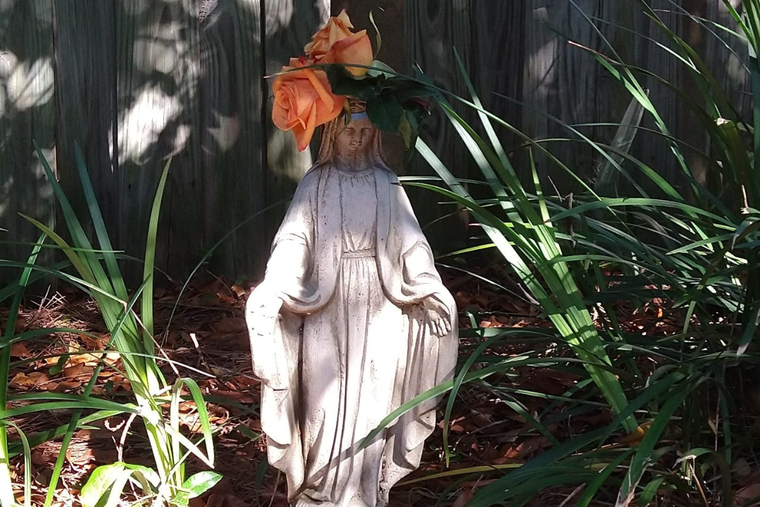
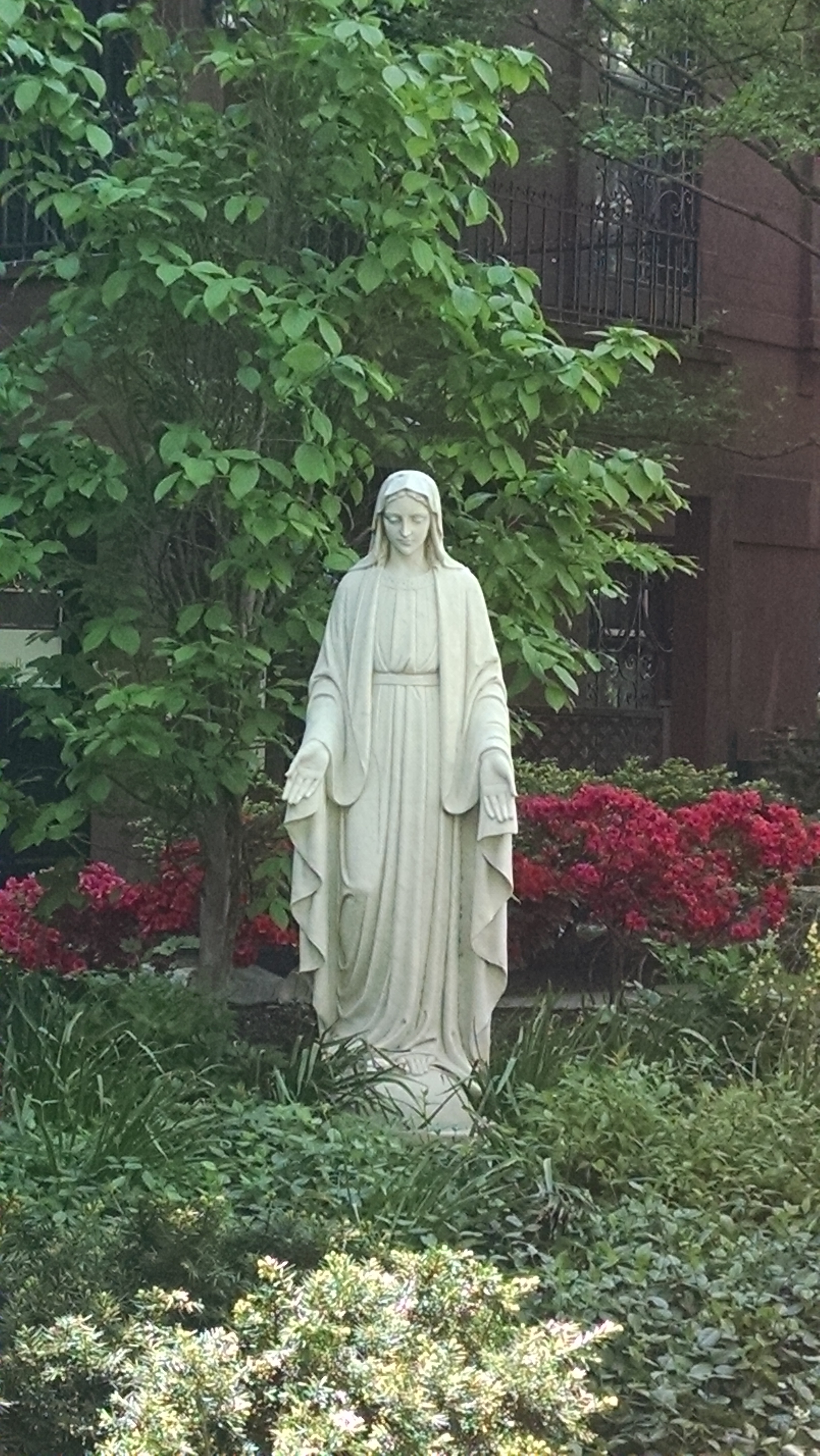
One day, after dropping off my youngest at school, I walked the long way home and stopped at a local bakery. After leaving, I sensed something — or rather someone — calling to me over my shoulder. When I turned, no one was there, no one except a white stone statue of Mary in a front lawn. This depiction of Mary showed her head bowed, her arms outstretched; she resembled dozens of similar statues that adorned gardens in my Brooklyn Italian neighborhood. Except, this Mary wore a jewel-encrusted golden crown.
From then on, I stopped at the iron gate in front of that house each day, confiding my burdens to Mary. Would my husband ever return? Would I be able to save our home, allowing my children to grow up with the stability of their schools, neighborhood and church? Could I persevere in faith despite my pain?
I looked closer and noticed something about that stone depiction: Gentle Mary stood on the head of a serpent. One day, her crown disappeared. I was beside myself. Had someone stolen it? The Mary sculpture appeared unfazed, arms open, ready to listen to my troubles. So I unburdened myself again, dried my eyes, and got through another day.
Eventually, Mother Mary beckoned me to the Abbey of Gethsemani in Kentucky, which I’d been reading about. During orientation, when it was my turn to introduce myself, through a quavering voice, I recounted my unwanted divorce and desire for healing. Afterwards, a nun invited me to the daily Rosary service.
At 3 p.m., I entered the dimly lit chapel, took rosary beads from a basket, and followed along the best I could. I returned each day. I checked out Quiet Places with Mary from the abbey’s library and mixed my mind with Mary’s while meditating beneath a tree.
What had it been like for Mary, I wondered, fearing for the safety of her own child as she and Joseph fled to Egypt? I pictured her at the foot of the cross, bearing unfathomable pain with grace. My heart cracked open in a way it had never done before. Peace settled in the fissures between my worries.
On the last day, I thanked Brother René, the cherub-faced monk who had led the Rosary. He reached into his tunic, pulled out his handmade rosary beads, and placed them in my hand.
My children grew up in their home, where each September I watched from our stoop as parishioners from a nearby Catholic church processed down our street on the feast day of Our Lady of Sorrows.
When I could no longer pay the mortgage, like Mary, I let go and moved to a place where I knew no one and started over. Nearby, I discovered Mepkin Abbey, where I’ve gone on silent retreats ever since. At Compline, monks and retreatants turned toward Mary’s statue and sang the Salve Regina. Aging monks with hunched shoulders, some in wheelchairs, had never seemed so young as when they entrusted themselves to the care of their Mother right before sleep. Yet what was more natural?
When my mother died in 2016, I’d never craved a mother more. God in his supreme wisdom had known long before that we earthly beings needed two mothers. A year later, I started Order of Christian Initiation of Adults.
“Have you chosen your saint yet?” my sponsor asked shortly before my confirmation.
“Not yet,” I said, hoping she wouldn’t press the issue.
I was still searching for a runner-up to Mary and was shocked to learn there were more than 10,000 saints and that I could pick from either gender.
Saints weren’t part of my Protestant tradition, so I’d only begun to dabble. I considered women first and turned to the Bible. Esther’s courage had resonated with me when defending my marriage in court demanded that I dig deep for my own. But Esther wasn’t a saint.
I’d read books by St. Teresa of Avila and St. Thérèse of Lisieux during retreats. However, Dark Night of the Soul by St. John of the Cross had had the most profound effect on me. But Beverly Ann John Willett didn’t sound quite right. Was that silly?
I’d practiced law early on; now, I’m a writer and write frequently about marriage. St. Thomas More covered all those bases.
Still, I hemmed and hawed. The decision had gravity. The saint I chose would be the one to inspire me throughout the rest of my life. Yet of all my vocations, I’d always considered motherhood the most important. I tried to save my marriage, in part, for the sake of my children and was laughed at for my stance. Perhaps pregnant Mary had been jeered at too. Perhaps some thought her overprotective by running off to Egypt or keeping her intellectually gifted son squirreled away in the sleepy town of Nazareth. But she put motherhood first.
During the summer of 2018, I traveled to Portugal and felt the Holy Spirit’s call to convert during Mass at the Basilica of Our Lady of the Martyrs in Lisbon.
For me, all roads simply led to Mary.
A few weeks before my December confirmation, I met with our deacon to firm up the details. He asked the same question my sponsor had.
“Mary, Mother of God!” spilled out. And then I started to cry, explaining that a sinner like me couldn’t possibly take on such a holy name. Choosing a saint who was the pinnacle of humility smacked of pride, I thought.
The deacon chuckled, smiled and said, “How wonderful!” He thought my choice was perfect.
I laughed through my tears and nodded, allowing myself to experience the joy I’d been holding back.
Growing up, I’d been taught that, in his final moments on the cross, Jesus had honored the Fifth Commandment and provided for the care of his mother. A wonderful sentiment, surely, but when had Jesus ever played small? As a Catholic, John 19:26-27 finally made sense. He’d not only entrusted the care of his mother to John, but had given her to all of us and to his holy Church.
Year by year, Mary had lovingly guided me into her orbit. As she did, I inexorably drew closer to Christ. She chose me early on. All that remained was for me to embrace her.
- Keywords:
- marian devotion
- queen of all saints