When Mercy Defies Death: Erika Kirk’s Forgiveness
Forgiveness of enemies is not achievable by human strength alone. It requires grace.

Erika Kirk’s forgiveness of Charlie’s assassin is far beyond human strength, an incomprehensible act of grace. In it, she shows the sign of the cross in the world, the paradox that death is conquered not by violence repaid, but by mercy.
She spoke these words on the world’s stage at Charlie’s memorial service, before the president, the vice president, senior cabinet officials, and a crowd of 100,000, with more than 100 million watching online. In the sight of rulers and nations, when the world expected fury, Erika forgave her husband’s murderer.
“Our Savior said, ‘Father, forgive them, for they know not what they do.’ That young man … I forgive him. I forgive him because it was what Christ did, and it’s what Charlie would do.”
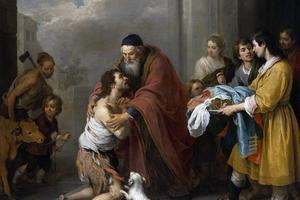
Nothing is more unfathomable than mercy in the moment of grave injustice. Christ’s words from the cross remain staggering for this reason: He forgave in the midst of brutal assault, when evil was at its most obscene. His mercy revealed divine love poured out where sin was at its worst, “while we were still enemies” (Romans 5:10). The power of Erika’s forgiveness lies here: It mirrors Christ’s.
She forgave not an insult, but a crime the world would call unforgivable. Such an act is not humanly possible. It is, like Christ’s prayer, a work of grace, a revelation of divine mercy breaking into history at humanity’s point of greatest violence. That paradox is the heart of Christianity. On the cross, Jesus spoke words that still reverberate: “Father, forgive them; they know not what they do” (Luke 23:34). This was no denial of evil, nor a cheap absolution, but the deepest unveiling of mercy — the refusal to let hatred or violence be the final word.
The forgiveness Erika extended to the man who murdered her husband participates in that same mystery. It is not private healing but a public, ecclesial act: the church, through one of her members, making present the cross in the world once more.
The Catechism of the Catholic Church reminds us:
“It is impossible to keep the Lord’s commandment [to forgive] by imitating the divine model from outside; there has to be a vital participation, coming from the depths of the heart, in the holiness and the mercy and the love of our God” (2842).
Forgiveness of enemies is not achievable by human strength alone. It requires grace.
When the Church calls forgiveness a work of mercy, it does not mean sentimentality or softness. Mercy is the hardest demand of discipleship. It names evil for what it is and yet refuses to perpetuate the cycle of violence. That is why Christian forgiveness has always astonished the world: It reveals a power greater than hatred itself.
This, however, does not eliminate justice. The Church teaches that legitimate authority must punish crime proportionately (Catechism, 2266). Mercy does not erase justice but transfigures it, renouncing vengeance and entrusting judgment to God. In forgiving, Erika allowed justice to run its course without binding her soul to hatred — and in doing so, she set both herself and the community free.
Our world lionizes strength but defines it as domination. Forgiving an enemy is scandalous because it seems to relinquish power. Yet Christianity reveals that true strength is not the ability to strike back but the freedom to love in the face of violence. This is why the martyrs of every age, from Stephen to the persecuted Christians of today, have shaken empires and softened hardened hearts: Their forgiveness bears the stamp of eternity.
Every act of forgiveness is a glimpse of the future God has promised. When Erika forgave, she did more than speak words; she collapsed eternity into the present. She bore witness to the day when “death shall be no more; mourning and crying and pain will be no more” (Revelation 21:4).
Her forgiveness is not only a personal act of grace but an eschatological sign. It proclaims that the kingdom of God is breaking into history here and now, that mercy is stronger than death, and that the cross has the final word.
The world often asks whether Christianity is relevant, whether it has anything new to offer to an age weary of violence. Erika’s act gives the answer: The Gospel is not an abstraction or an ideal. It is power; grace embodied in flesh and blood; mercy extended when all the world expects vengeance.
In forgiving, Erika has shown the world a living image of Christ crucified and risen. The Gospel is never most visible in our triumphs, but in our willingness to love where hatred reigns. It is here, at the edge of human possibility, that the grace of God shines forth most clearly.
- Keywords:
- erika kirk
- forgiveness