Cardinal Timothy Dolan, Cardinal James Gibbons and the Virtue of Courtesy
COMMENTARY: How many souls have been impressed, amused, uplifted and comforted by priests exercising this common practice?
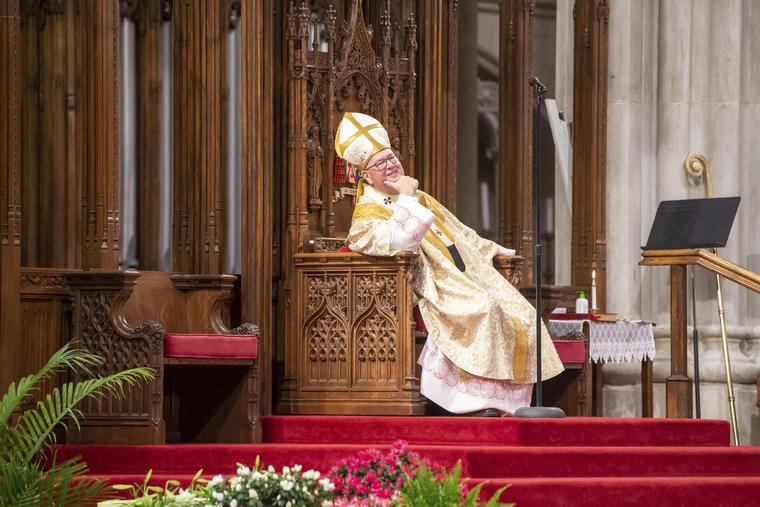
Cardinals, calls, cards, chairs — and courtesy. All come to mind as Cardinal Timothy Dolan takes leave of his cathedral in New York. Amid the grand ceremony, the virtue of courtesy should not be overlooked.
Today is Cardinal Dolan’s last day as “apostolic administrator” of the Archdiocese of New York, a title he has held since he retired as archbishop in December. Tomorrow, Archbishop Ronald Hicks will be installed the new archbishop.
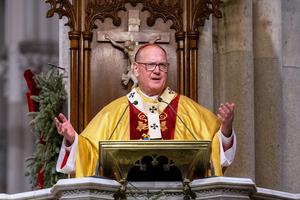
After nearly 17 years of Sunday Masses at St. Patrick’s Cathedral — “America’s parish church,” as he calls it — Cardinal Dolan offered his final one this past Sunday. A “cathedral” gets its name from being the home of the bishop’s “cathedra” or liturgical chair. Cardinal Dolan usually sits on the cathedra. On Sunday, he spoke to it.
“I want to bid farewell to this great piece of furniture,” he said after the final prayer. “My dear cathedra, I am going to miss you! And listen, please be as comfortable for Archbishop Hicks, who’s going to plop down into you this coming Friday, as you have been to me.”
“I’ll miss you,” he said, giving the top of it an affectionate pat.
I have written about Cardinal Dolan in these pages when he was appointed to New York and upon his retirement, principally celebrating his excellence as a preacher of the Gospel and teacher of the faith.
George Weigel reflected this week on his good friend’s service and mentioned that out on the streets of New York, he rarely went a few steps without pausing — “virtually everyone we passed along the way wanted to greet the archbishop, share a story, thank him for this or that, or just say hello.”
It has not been much commented upon, but Cardinal Dolan was a model of courtesy — a virtue much needed in today’s combative culture and a measure of personal kindness in a time of impersonal digital encounters.
St. John Henry Newman, the most recent doctor of the Church, wrote a famous passage about what it means to be a gentleman.
Newman compared the true gentleman to the “comforts” of “an easy chair or a good fire.”
“The true gentleman in like manner carefully avoids whatever may cause a jar or a jolt in the minds of those with whom he is cast … his great concern being to make everyone at their ease and at home,” Newman continued. “From a long-sighted prudence, he observes the maxim of the ancient sage, that we should ever conduct ourselves towards our enemy as if he were one day to be our friend.”
When Newman used the image of a comfortable chair, he did not have an episcopal cathedra in mind. But why not? Gentlemanly courtesy goes a long way in priestly ministry. Conversely, how many distance themselves from Christ and the Church because a priest was unkind, or rude or dismissive?
When Cardinal Dolan speaks of his cathedra being comfortable, it is a mark of his ministry. Life brings challenges, and the faith brings sufferings, so a measure of comfort here and there is welcome. He made others comfortable, noticed them, welcomed them — and greeted them.
Two days before his final Mass at St. Patrick’s, my parents celebrated their 60th wedding anniversary. The day before that, a handwritten Epiphany card arrived congratulating them, sent from Rome while Cardinal Dolan was there for the consistory of cardinals. He took the time amid those busy days to remember my parents. On the day itself, he called them on the phone to congratulate them.
My mother had spoken to him over the years. He called when she was having surgery and when my sister was ill. When my parents were in New York a few months after their 50th wedding anniversary, he invited them to dinner and sat them at his right and his left — on Holy Thursday, surrounded by all the bishops and priests at his table that night.
Amid Cardinal Newman’s papers are thousands upon thousands of letters, some treating weighty matters, but many more exhibiting the refined courtesy of a great man who made himself available to everyone.
For Cardinal Dolan too, there were literally thousands of such cards written, calls made and invitations issued over his nearly-50-year priesthood. Even as his responsibilities increased, and the pressures of being in New York were formidable, Cardinal Dolan did not abandon that lifelong practice of the great priestly virtue of courtesy.
When I was in the seminary, Dolan gave a noted rector’s conference on courtesy — not as important as Eucharistic devotion or theological study, but nevertheless essential in the life of a priest, as it is more commonly exercised, for priests have innumerable occasions each day to be courteous.
Courtesy, he taught us, is rooted in recognizing that both I and every other person is made in the image of God and worthy of respect. Respect is more than a smile, a polite greeting, a kind word, but it begins there.
“Courtesy is built on the commonsense conclusion that society — whether as small as my [seminary] corridor or as large as the Church — can only survive, prosper and fulfill its purpose if it is well-ordered by self-evident rules of civility, consideration and care,” he said.
In the coarse and combative culture of our day, how needed is the Church’s witness of civility and consideration and how terrible the counterwitness when that is lacking. The ancient Christians drew converts because of their love for each other. What if, instead, they did not even extend basic courtesy?
It is harder to be charitable without courtesy. Cardinal Dolan reminded us that it begins with little things because “God is in the details”: the smile, standing up when someone enters a room, holding a door. And he was blunt about avoiding the bad priestly habits of not responding in a timely way to invitations or not sending thank-you notes.
St. John Henry Newman was a teacher of gentlemanly courtesy, and another of Pope Leo XIII’s cardinals, James Gibbons of Baltimore, the second American in the sacred college, was an exemplar.
The great American Church historian Msgr. John Tracy Ellis wrote a two-volume biography of Cardinal Gibbons, who was archbishop of Baltimore for 44 years (1877-1921). Cardinal Dolan produced his own doctorate in Church history under Msgr. Ellis, and from him, he gleaned an inexhaustible supply of apposite anecdotes about Cardinal Gibbons.
Cardinal Dolan’s conference on courtesy began with a story about Cardinal Gibbons: There was a Presbyterian couple who would take a Sunday afternoon stroll with their son in a nearby park. Each week they would pass a Catholic priest, who would smile, tip his hat and say “Good afternoon.” The boy would want to return the greeting, but his parents never did and would pull him quickly along. They would explain to their son that a prominent family such as theirs did not associate with Catholic priests. Nevertheless, every Sunday, the priest would offer the same courteous greeting, even though constantly rebuffed.
That courtesy prompted a certain fascination in the boy about who these Catholic priests were, and as he learned more about them, he eventually discovered the Catholic faith. To the horror of his parents, he decided to become Catholic himself. At his confirmation in Baltimore’s cathedral, he saw the old priest again — it was Cardinal Gibbons in procession to the altar!
The life of Cardinal Gibbons included monumental achievements; but the greeting in the park converted one soul. Manhattan’s streets are less tranquil than Baltimore’s parks, but how many souls there too have been impressed, amused, uplifted and comforted by Cardinal Dolan?
The cathedra of New York will bring to Archbishop Hicks an immensity of responsibility, much of it onerous, some of it unpleasant. So Cardinal Dolan wishes for him too a measure of comfort, beginning with the cathedra upon which he will sit, a cathedra from which has spread comfort and courtesy these last 17 years.
- Keywords:
- cardinal timothy dolan
- christian virtues