Full Text: Bishop Conley’s Homily for the 2026 March for Life Vigil Mass
‘Our brothers and sisters in the womb are the most vulnerable and most voiceless of victims.’
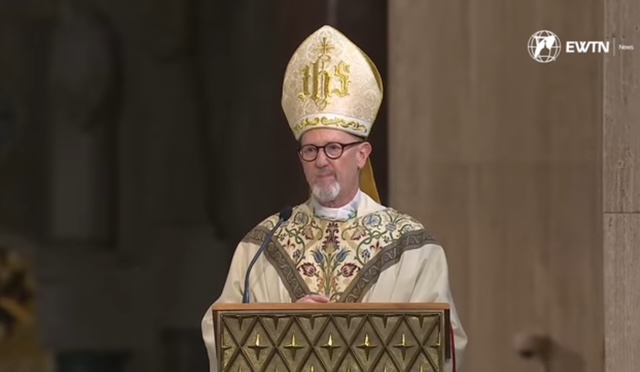
Editor's Note: Bishop James Conley celebrated the March for Life Vigil Mass at the Basilica of the National Shrine of the Immaculate Conception on Jan. 22, 2026. Please find a transcript of his full homily below, edited for clarity.
Dear brothers and sisters in Christ, it is a deep honor and privilege to
celebrate this Vigil Mass here in the Basilica of the National Shrine of the Immaculate Conception on this national day of prayer for the legal protection of pre-born children. I'm grateful to Bishop Daniel Thomas, chair of the US Bishops' Pro-Life Secretariat, for inviting me to celebrate this Mass in his place.
We just heard the words from the prophet Isaiah in our first reading:
"The Lord called me from birth. From my mother's womb, he gave me my
name. The Lord has spoken who formed me as his servant from the womb."
I have been coming to this Vigil Mass and the March for Life off and on ever since my days in the seminary just up the road at Mount St. Mary's in Emmitsburg over 40 years ago. Each year, it's like a shot in the arm to be with you, so many of you, particularly you young people, who share a passion and joy for the gift of life and who want to build a culture of life and a civilization of love where babies are protected in their mothers' wombs and women are loved, heard, and cared for when they find themselves faced with very difficult and life-changing decisions.
But I have not always been pro-life. I didn't grow up Catholic and never had the benefit of a Catholic education like many of you here today. I never really thought much about life in the womb or the issue of abortion. In my high school years, I think I was mostly interested in where the next Grateful Dead concert was.
When the Supreme Court decision Roe v. Wade came down in 1973,
we were taught that the fetus was just a blob of tissue, a mass of cells.
The science wasn't very well developed back then in the '70s, and so abortion
really didn't seem like a big deal to me. But I remember very vividly in the '70s
going to a high school party soon after abortion was legalized. There was a friend of mine at this party who let it be known that his girlfriend was pregnant, and he was asking us if we could all chip in some money so he could take care of the problem.
I can't remember too much about the story, but I do remember feeling deep
down inside of me that there was something wrong with all of this. I didn't know what and I didn't know why. I knew his girlfriend well; we were in middle school together, and I remember feeling very sad for her and for him. That stuck with me for a long time.
Fast forward a few years later, and I'm in college at a huge state university.
Providentially, I ended up stumbling into a Great Books program, a humanities
program, and being exposed to the great works of literature and poetry, art,
music, and history — the greatest that's ever been thought or said. I discovered truth and goodness and beauty for the very first time in my life,
much better than any Grateful Dead concert.
And I discovered the Catholic Church in Jesus Christ, who is truth, goodness, and beauty incarnate. I'd never been baptized, so halfway through my junior year in college, I was baptized and confirmed and received my first Holy Communion. And then sometime after that, someone gave me an old beat-up copy of Humanae Vitae by Pope Paul VI, his monumental encyclical on human life. When I read that encyclical, which is probably one of the shortest papal documents in history, the scales fell from my eyes.
Now I knew why I felt so uneasy and sad. Back in high school, for the first time, I saw that human life was a mysterious gift from God and how each one of us is made in his own image and likeness, and how human sexuality has a unique sacredness and beauty. And how in the sanctuary of our mother's
womb, the Lord has formed us and made us his servants, as Isaiah spoke today. And that God had a plan for me and that God has a plan for each one of us.
As I began looking at the world through a Catholic lens, I saw how
everything was beautifully connected and integrated into a whole.
How everything had meaning and purpose. And how, again from Isaiah,
"I am made glorious in the sight of the Lord, and my God is now my strength."
I soon discerned a vocation to the priesthood, and well, the rest is history.
Just two years after my ordination, my bishop appointed me the pro-life
director of my home diocese of Wichita, Kansas. As I continued to
become more and more involved in pro-life ministry, it became crystal clear to me that, in the words of St. Mother Teresa, "Abortion is the greatest destroyer of peace in the world." Here was a woman who spent her whole life serving the poorest of the poor, living in absolute poverty herself, giving of herself. She knew that abortion was the greatest evil of the day.
The US bishops also teach that abortion is the preeminent issue of our day for
several reasons. Abortion is a direct and intentional destruction of human
life at its most fundamental level, and the right to life is the condition for
all other human rights. Two, the sheer number of lives lost through abortion, more than a million a year, is catastrophic. Imagine if there were over a million
murders each year through gun violence. Would we tolerate that?
Pre-born children, three, are considered the most vulnerable and voiceless members of society, unable to speak and defend themselves. And finally, abortion is an attack on the family itself, which is meant to be a sanctuary of life.
To be sure, the bishops teach that there are other very grave threats to the life
and dignity of the human person, including euthanasia, gun violence,
terrorism, the death penalty, human trafficking. There are also the redefinition of marriage and gender, threats to religious freedom at home and abroad,
lack of justice for the poor, the suffering of migrants and refugees,
wars and famines around the world, racism, the need for greater access to
healthcare and education, care for our common home, and more.
All threaten the dignity of the human person. But our brothers and sisters in the womb are the most vulnerable and most voiceless of victims.
In most other cases of injustice, those who are threatened can speak out for themselves and have at least some power to defend themselves, some form of advocacy. Our Holy Father, Pope Leo XIV, has recently spoken out along these same lines in his speech to the diplomats accredited to the Holy See on January 9th in his State of the World address. In his speech, he confirms the
importance of abortion as the preeminent priority when he says, "We firmly reiterate that the protection of the right to life constitutes the indispensable foundation of every human right." Cardinal Pierre just quoted that line in his introduction.
Pope Leo goes on to say that "The Holy See considers it deplorable that public resources are allocated to suppress life rather than being invested to support mothers and families. The primary objective must remain the protection of every human child and the effective concrete support of every woman so that she is able to welcome life."
Later on in that same address, Pope Leo writes, "The vocation to love and to life, which manifests itself in an important way in the exclusive and indissoluble union between woman and man, implies a fundamental ethical
imperative for enabling families to welcome and fully care for unborn life. This is increasingly a priority, especially in those countries that are experiencing dramatic declines in birth rates. Life, in fact, is a priceless gift that develops within a committed relationship based on mutual self-giving and service."
On June 24th, 2023, the Dobbs v. Jackson Women’s Health Organization Supreme Court decision overturned Roe v. Wade and returned authority to
the states to regulate abortion. Thanks be to God. In Dobbs, the US Supreme Court ruled that there never has been a constitutional right to intentionally kill an unborn child in the womb. Nevertheless, there are still over a million abortions each year in our country, mostly through chemical and non-surgical means.
In 2024, approximately 1.1 to 1.4 million abortions occurred in the United
States, marking a slight increase from 2023, driven partly by telehealth services. The Guttmacher Institute, the research arm for Planned Parenthood, recorded slightly under 100,000 chemical abortions per month through their facilities. In 2023, according to Guttmacher, medication abortions or chemical abortions accounted for 63% of all abortions in the United States.
In my own state of Nebraska, on November 5th, 2024, we passed a ballot initiative, the Nebraska Protect Women and Children Initiative, amending the Nebraska State Constitution to ban elective abortions in the second and third trimesters. At the same time, we also defeated a ballot measure that would have allowed abortions all the way up through the ninth month.
No matter what happens politically, we as Catholics must always be here to lovingly serve women and to welcome them and their new life. One way the church does this is through Walking With Moms in Need, where Catholic parishes all over the country are stepping up efforts to provide even
more services, support, and accompaniment to vulnerable pregnant and parenting mothers.
And the church does not abandon those who’ve chosen abortion.
As pastors, we witness the wounds of women and men, what they endure after ending the life of their child. We want to serve their spiritual and emotional needs so that they can find mercy and freedom and healing in Christ.
Project Rachel Ministry offers confidential, compassionate support to women and men who have participated in abortion. Anyone interested can visit hopeafterabortion.org for more information.
Brothers and sisters, while we continue to change laws so that babies remain safe in their mothers' wombs and women are cared for and protected in times of crisis and need, we need to redouble our efforts to continue building, in the words of St. John Paul II, "a culture of life and a civilization of love."
We need to continue to pray and to work to change hearts. As it has often been said, in the end, the measure of a society is how well it treats its weakest
members. Only God can change hearts. But we know that God listens and answers the prayers of his people. Today's Gospel from Matthew, Jesus, pointing to a child, says to his disciples, "Whoever receives one child such as this in my name receives me."
My dear young people, you are the pro-life generation. I have said to young people in my own diocese that I firmly believe that 50 years from now, when my generation has gone to God, your grandchildren will ask you, "Is it true that when you were my age, they put children to death in the womb?" Our goal is not just to make abortion illegal; our goal is to make abortion unthinkable.
- Keywords:
- march for life
- vigil masses
- bishop james conley