What a Priest and a Mortician Teach About Dying Well
COMMENTARY: The more you remember your death in a good way, the more you can embrace this life.

Reflections on death draw us away from the world and deeper into the spiritual realm. The world has a strong gravitational pull on both the mind and the heart, which can lead to forgetting that the most important existence is yet to come. Christians don’t really ever forget that, yet the day-to-day can interfere with right balance between the visible and invisible.
While focusing on this balance, I called Father Stefan Starzynski, who worked as a hospital chaplain for eight years, and I also read a book by a small-town mortician about the unique perspective such a job offers on life and death.
Father Starzynski served as a full-time chaplain at Inova hospital in the Diocese of Arlington. He wrote Miracles: Healing for a Broken World and is currently parochial vicar at Holy Trinity Parish in Gainesville, Virginia.
“If we are still alive, it means that God still has a plan for us,” he said. “But we need to make sure that we tell the people we love that we love them, and we appreciate them, and we are proud of them. If there’s any unforgiveness, we need to forgive. We need to prepare ourselves for eternity while we are still living.”
Quoting from a homily he gave in February on the one-year anniversary of his father’s death, he said, “Life is not just holding on. In order to get to heaven, we must die — so we are preparing ourselves, not resigning ourselves.”
At age 56, Father Starzynski marked 30 years as a priest on May 18.
“I tell people that I don’t want to be younger than I am,” he said. “I’d rather have wisdom and truth. Every day I’m one step closer to heaven. I am looking forward to being with God in his timing. That is not resignation but recognizing that each day is drawing closer to heaven while, at the same time, living my life to the fullest. We have to do our best with what God has given us.”
Father Starzynski warned that too often people find their worth in busyness and accomplishments. He referred to St. Paul, who said: “Though outwardly we are wasting away, yet inwardly we are being renewed day by day” (2 Corinthians 4:16).
“God is calling you to see that your value is who you are as a child of God, not in what you do,” he said. “That can be a hard transition for many people, but that is when we are most useful. We can offer up our suffering.”
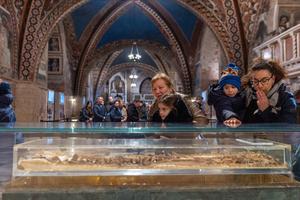
Some of the saints, like St. Francis of Assisi and St. John Fisher, kept a skull around to remind them of this, according to Father Starzynski.
“People think it’s morbid, but it keeps you grounded as to what life is about. It’s almost paradoxical. The more you remember your death in a good way, the more you can embrace this life. The saints all talked about looking forward to seeing God. While our life has its charms and its goodness, when you get closer to God, the charms of this life seem so much less than when you will encounter God.”
Father Starzynski suggested that a step in that direction is letting go of material possessions and money before you die.
“You go to God with empty hands,” he said. He referred to St. Peter Chrysologus, who emphasized that only treasures given away to the poor on earth are kept in heaven.
“It’s paradoxical but beautiful,” he said. “Regarding parents and inheritance, give away your money while you are still alive so that you can see their joy. Wills often divide families. If God has given you resources, you want to bring peace and good rather than arguments. One of the ways is to give it away while you are still alive.”
A Mortician’s Take
In the book, Now Departing: A Small-town Mortician on Death, Life, and the Moments in Between, Victor Sweeney, known as “the internet’s favorite mortician,” chronicled his role helping people say goodbye to loved ones and his insights on what matters most in life and death. It’s a good read, with one caveat: There is a chapter about scattering cremated ashes, which the Catholic Church prohibits. But that does not diminish the rest of the book.
In a previous interview, I expressed surprise that Sweeney became a mortician, since he was known for his sense of humor in the high school he attended with some of my children. He noted that the job of a mortician is as much to care for the living as the dead, so being personable is a good trait.
Sweeney pointed out that most of us assume we will end each day as we began — alive. But he pointed out it’s only a small step from feeling entitled to life each day to embracing all probabilities, including death.
“Having either end of the human condition as a possibility,” he wrote, “makes life richer, the contrast sharper, and the good things taste all the sweeter when living and dying are both on the table. Optimism remains.
“I can do as the old Latin phrase says and memento mori. I can remember my death and live accordingly. Having my end in sight, I ought to use the knowledge to live better. One can take the gamble of living, knowing that death is an inevitable outcome, possible at any moment, and live more purposefully as a result.”
The Universal Task
The task of facing death falls upon us all. We can either ignore it or embrace it. My starting point is Scripture, which reveals that what God has prepared for those who love him is beyond human imagination (1 Corinthians 2:9), where there will be no more suffering or death (Revelation 21:4).
Catholic mystics and visionaries have described heaven as an overwhelming, joyous and indescribable experience. Reading such accounts, and studying the lives of the saints, helps lift us above this world to the next. And some people find that accounts of near-death experiences help remove fears about passing into eternity.
In the poem Canticle of the Creatures, St. Francis of Assisi wrote: “Praised be you, my Lord, through our Sister Bodily Death, from whom no living man can escape.”
He embraced death alongside all of creation as the path to an encounter with God. He joyfully surrendered to God’s loving design, recognizing that both life and death are gifts from him.
- Keywords:
- death
- dying
- memento mori

Patti Maguire Armstrong Patti (Maguire) Armstrong is an award-winning journalist and was managing editor and co-author of the bestselling Amazing Grace Series. Her latest books are the humorous and inspirational second-edition Dear God, I Don't Get It, Dear God, You Can't Be Serious!, What Would Monica Do?, Holy Hacks and Michelle Duppong: Hope in the Depths of Suffering. Patti worked in social work and public administration before staying home as a freelance writer while she and Mark raised their 10 children in North Dakota. Follow her on Twitter at @PattiArmstrong and read her blog at PattiMaguireArmstrong.com.