From the Little Flower to Opus Dei, October’s Saints Call Us Into the Deep
COMMENTARY: October’s feast days remind us that God’s glory shines through daily life and hidden acts of love.
I have the chance to give a short talk to a group of friends — a circle of Catholic women, all around my age, some (like me) with children still at home, and some (also like me) beginning to welcome grandchildren.
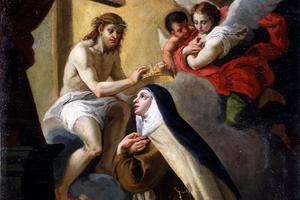
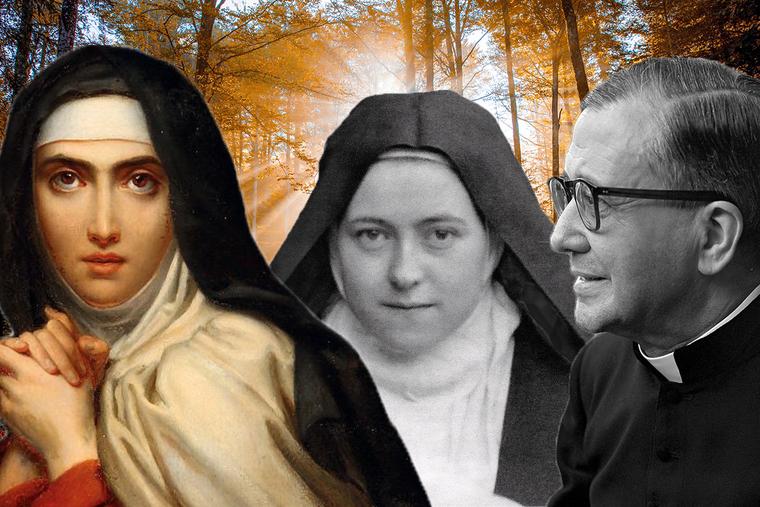
The timing of our conversation, at the beginning of October, feels especially fortuitous. This month is rich with feast days that celebrate saints whose lives and works turn our eyes to the glory of God: St. Thérèse of Lisieux, the Little Flower (Oct. 1); St. Teresa of Ávila (Oct. 15); and the anniversary of the founding of Opus Dei (Oct. 2) by St. Josemaría Escrivá. These examples, along with the witness of other saints, echo the Church’s teaching that God’s glory is made visible in daily life and faithful love.
The glory of God is here, now, touching our lives in concrete ways. As we hear in the Psalms, “The heavens declare the glory of God; the firmament proclaims the works of his hands” (Psalm 19:1). But it is not only the heavens. Our lives, our bodies, our choices, our sufferings and our joys — all of these reveal his glory.
The Catechism of the Catholic Church puts it clearly: “The glory of God consists in the realization of this manifestation and communication of his goodness, for which the world was created” (294). God’s glory is inseparable from his goodness, revealed in creation and throughout salvation history. To give glory to God is not flattery. It is allowing his goodness to shine through our lives. St. Irenaeus said, “The glory of God is man fully alive.” To live as God created us is to reflect his glory.
Of course, life distracts us. Work piles up. Illness slows us down. Relationships bend and sometimes even break. Children grow up and move out. Our bodies age. In all these changes, we may feel something essential has been lost. Yet with faith, we see that even loss and suffering are part of God’s careful design. He allows them to draw us closer to him. Jesus shows us that the cross is never absent from glory; ours may be lighter than his, but in carrying it, we participate in his glory.
The Catechism explains: “The ultimate purpose of creation is that God who is the creator of all things may at last become ‘all in all,’ thus simultaneously assuring his own glory and our beatitude” (CCC 294). God’s glory and our happiness are not opposed; they are the same reality. To glorify him is to find joy ourselves.
The two Teresas said it beautifully. St. Teresa of Ávila reminds us that prayer is where we rediscover God’s glory. “All things must come to an end,” she writes, “but God’s glory lasts forever.” St. Thérèse of Lisieux, in her “little way,” insists that even the smallest hidden act can glorify God: “To pick up a pin for love can convert a soul.” Nothing is wasted. Each act, offered in love, magnifies his glory.
On Oct. 2, 1928, the feast of the Guardian Angels, St. Josemaría Escrivá founded Opus Dei, a personal prelature of the Church. St. Josemaría taught that God’s glory is revealed in ordinary life: “Do everything for Love. Thus, there will be no little things: everything will be big.” That means that for moms like me, fixing lunches, folding laundry, writing emails, and carpooling are not interruptions from holiness, they are its very substance.
St. Josemaría, repeating Jesus’ command to Peter, often urged his spiritual sons and daughters: Duc in altum! — “Put out into the deep!” He saw this as a summons to trust God in the ordinary currents of daily life, to leave the safe shallows and live boldly for holiness. Decades later, St. John Paul II repeated this phrase in Novo Millennio Ineunte, calling the whole Church to deepen prayer, renew holiness, and witness courageously in the modern world. Together, they remind us that God’s glory is never found in staying safe at the shoreline, but in daring to live fully in love and faithfulness.
Our challenge, then, is to keep our eyes fixed on God’s glory. We pray daily to tune our hearts to his presence. We immerse ourselves in the Old and New Testaments and the lives of the saints to reorient our souls. We embrace daily duties with love. We carry our crosses with hope, remembering that Christ bore the heaviest load. And we remain close to Our Lady and to the sacraments, which are encounters with his glory.
October’s feast days remind us that holiness is possible in ordinary life. Our lives, with all their ordinariness, struggles and joys, are radiant with God’s glory. The challenge before us is to see it, embrace it, and share it with the world.