Why Catholicism Is a Religion of the Hard Reset
COMMENTARY: The Catholic Church teaches that we need more than a quick prayer — we need confession’s hard reset to keep us on course.

When I was first driving, my dad’s car would often slowly accelerate — something wrong with the throttle — and even when I let my foot off the gas would keep speeding up. Eventually I’d have to swerve off the road and slam on the brakes to make the car throttle down.
It always got worse, but unpredictably. Sometimes twice on the same trip and sometimes not for weeks. My dad didn’t want to buy another car and he knew I could handle it. (He finally sold the car when my sister got her learner’s permit.)
I frequently needed to reset the throttle. I couldn’t just try to fix it on the run, or try to manage it, because then I would have wound up wrapped around a tree on some New England country road. I needed to get the engine back to idling and start again.
It’s something I saw in myself, when I got religiously serious enough to notice.
Moving Too Fast
I was moving through life too fast, and sometimes speeding up when I didn’t want to, making decisions on the fly, too often decisions I would not have made had I been going slowly enough to think and pray about them.
I moved too fast because I felt much too confident in my ability to do the right thing all the time. I would have said, once I had the vocabulary, that I was a sinner who needed God’s forgiveness disturbingly often, and that I needed to do the Christian things, like read the Bible and go to church and hang out with other Christians.
That would have been true, but it would not have been enough. I needed to periodically reset, the way I’d reset my dad’s car.
Of my need for the Catholic experience of confession, I had not a clue. The Christianity I first experienced was a religion of the soft reset, in some cases after a dramatic conversion experience by which you became one of the “saved.” One hard reset and you were done. It held that the only confession one needed was a quick but sincere prayer to God with the promise to do better.
Eventually I saw that I, and most of the Christians I knew well, needed more. We didn’t change much and we kept doing the things we knew we shouldn’t do and didn’t do the things we should, as St. Paul himself admitted.
Some of us got used to feeling guilty and some of us learned not to care, and many of us learned how to explain away our sins. Or (I include myself) all three.
A Religion of the Hard Stop
The soft reset didn’t work for me, though it seemed to work for others. I knew some saintly Evangelicals. But I needed a religion that brought me to a hard stop, that reset me before I went further, knowing that if I didn’t stop and wasn’t reset I’d eventually crash.
The Catholic Church calls this “concupiscence.” It is, the Catechism of the Catholic Church explains, “an inclination to evil” whose “movements … never cease leading us into evil.” It calls it tinder, a thing that’s so easily lit and burns so hot it helps start something burning that doesn’t burn so easily.
The Church knows that every sin, even the very little ones, puts our lives a little out of control, sticking the throttle a little higher, and eventually, unless we do something about it, we’ll go too fast to stay on the road. Even the saints went to confession and had sins to confess.
The image doesn’t cover every way this works. The crash might not look like a crash. It might look more like running out of gas. We still wind up where we should not wind up. People can turn their backs on God and march away, or they can tune him out and wander off. You can be just as dead lost in the woods as hitting a tree.
The Church knows how much we need to be reset, but most people see that human beings need some kind of continual resetting. How could we not? Even if we think we’re okay — a common human delusion — we all know people with out-of-control lives, who careen through life from mess to mess to mess. We look at them thinking, “Why doesn’t she …?” or “How can he not know …?” or “What does she think is going to happen if she keeps that up?”
That person is us, maybe more dramatically, but us. We should know we need to do better, and how could we not, with a religion that constantly points us to the perfect being, compared to whom we don’t do very well, and whose commands we don’t always obey.
The culture favors the soft reset, but it does have its stories of hard resetting, for particular kinds of people, without realizing we’re all that kind of person in some way. People suffering from alcoholism or other addictions, for example, people believed to have a special need for a radical change most people don’t need.
And indeed, Alcoholics Anonymous’ famous meetings are forms of resetting, much like confession. The members need to go and they need to go regularly.
Its “Twelve Steps” describe the Catholic understanding in a secular form, beginning with the first step, “We admitted we were powerless over alcohol — that our lives had become unmanageable.” The steps include “Made a searching and fearless moral inventory of ourselves,” “Admitted to God, to ourselves, and to another human being the exact nature of our wrongs,” and “Continued to take personal inventory and when we were wrong promptly admitted it.”
The Church Resets Us
I think we tend to assume we need soft resets, not hard resets. Resetting requires looking at the past and admitting that you’ve gone wrong. That you need to stop, and probably stop hard, do the kind of point-by-point inspection the car mechanic does, admit your problems, maybe take a penalty, and fix them.
In one way, you go back to the factory settings, and in another way, you upgrade. You get fixed and you get better. And at the end, now reset, you resolve to do better, which includes the implicit promise to reset yourself regularly so you’re always at your best.
You don’t want to go wrong, you’ve promised to try to go right, but you being you and things being what they are in this world, you’ll know you’ll go wrong somehow. You appreciate the upgrade, but the upgrade doesn’t fix you permanently.
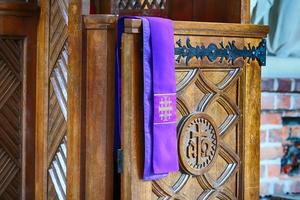
The Church year gives us an annual period for resetting, starting with Ash Wednesday and running through Good Friday, when we see so graphically the effect of our not being who we should be. The sacraments give us ways of resetting, most obviously the hard resets of baptism (if you’re an adult, as I was) and the examination of conscience followed by confession.
But the whole Catholic faith offers us chances for soft resets. Any kind of regular prayer or Scripture and spiritual reading, if done attentively and with reflection on who we are and what we should do, resets us. Giving of ourselves to someone who needs our help and care resets us. Sitting with Jesus in the tabernacle resets us.
The Mass is, if I may put it this way, the supreme soft reset. It resets us not because we look at ourselves, but because we look at Jesus. The Mass doesn’t tell us to turn around and go in a different direction, so much as to come closer, to come inside, to meet the person we should be. In the famous words of Gaudium et Spes, Jesus “fully reveals man to himself and brings to light his most high calling.” That revelation, if we accept it, resets us.
The Catholic life, expressing the Church’s understanding of our sins and failings, is a life of continual resetting, soft and hard. You will be resetting yourself for the rest of your life, until you reach what might be called the Great Reset.
- Keywords:
- confession
- repentance
- metanoia