What the Confession Line Taught Me About Living the Faith
COMMENTARY: Confession lines reveal both our impatience and our devotion — and whether our faith runs so deep that even our faults take place within it.
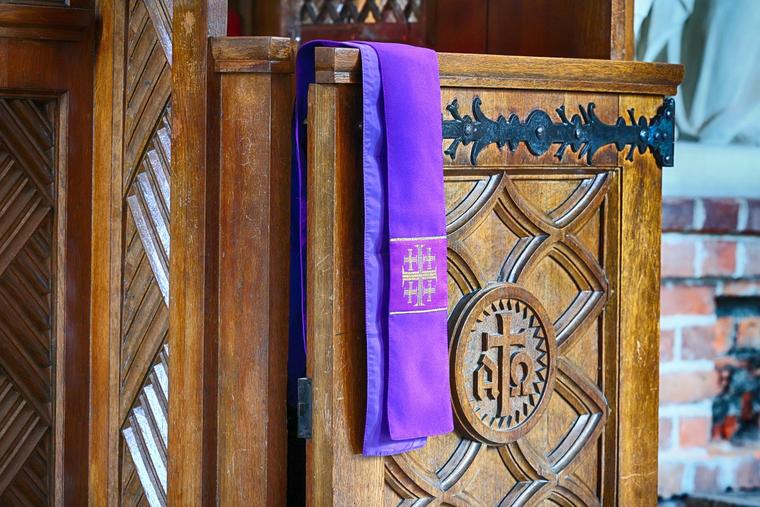
You’d think Catholics would be on their best behavior waiting to go to confession, but they aren’t always. Our pastor missed confessions before the Mass one Wednesday night and stayed to hear confessions afterwards.
Someone was already in the confessional when I arrived. I was second in line, up the center aisle, nearest the door for anonymous confessions. The door for face-to-face confessions was next to the outside aisle.
I’m Next
The line was much longer than usual, a benefit of the priest changing the schedule. As soon as a woman came out of the anonymous door, another woman dodged into the face-to-face door from the outside aisle. Another was standing there as if in line. The woman in front of me said to her, peevishly, “I’m next.”
The woman said, pugnaciously, “We always go back and forth,” waving her arm between our line and hers. I had gone to confession there many times at that point, 50 or more over about 15 years, on Wednesday nights and Saturday mornings, and never, ever, never had there been a second line along the outside aisle. People lined up in the center aisle and then chose the door they wanted. The woman was inventing a custom that got her a few people ahead.
The woman in front of me repeated, almost hissing, “I’m next. I was here first. I’ve been waiting.”
The woman on the outside aisle said, glaring, “I know. What do you think I’m doing?” She stood with her shoulders pulled back and her head thrust forward, and a scowl that would curdle milk three blocks away.
The woman in front of me went in and came out a couple of minutes later. I did not move, but the woman on the outside aisle, glaring at me, almost dove for the door, yanked it open, and, while still glaring at me, shot inside.
Sliding Along
One year, I’d missed confession the Saturday before Palm Sunday, and then found that none of the parishes around offered confessions during Holy Week. I hadn’t known that.
The Pittsburgh Oratory, bless them, heard confessions on Holy Saturday. The people waiting sat in the pews, sliding along and moving back pew by pew as the last person in the back pew reached the head of the line and went to one of the two confessionals. The chapel was half full with people waiting, and as the priests took their time, the line moved slowly.
I was sitting and sliding along with a woman who would have fit in any 1950s movie church scene. She had short puffy hair, wore a sensible dress and sensible shoes and an old-fashioned wool dress coat, with an unchanging prim, serious expression and a crucifix around her neck.
When we both got to the end of the fourth row and stood up to move to the third, she darted around me into the second row, therefore getting seven seats ahead. She sat in her stolen seat with a very slight smile.
A Natural Faith
I know how this will sound, but I think there’s something to be said for the kind of faith the two women had. It also tells us something about the way different Catholics live in the world. We’re all imperfect, but imperfect in different ways. I don’t mean it’s good to be bad, but that being so comfortable with your faith that you can be bad in it in that petty way suggests the faith feels natural to you, that it’s completely — though imperfectly — integrated into the way you live. You may be unthinkingly bad, but you’ll also be unthinkingly good.
Religion may become too routine, too normal and too unconscious, in a way that lets you cheat others to get ahead in the confession line. But that routine may include regular confession and spontaneous prayers and acts of charity made naturally and without thinking because you see a need. What seems to me a distressing lack of basic ethics is the flip side of a character that does good spontaneously and naturally.
I knew a devout Catholic woman who spent her time praying and helping people, who cheated in little ways and felt no embarrassment about it. She would park in the “Expectant Mothers” parking space at the grocery store, and when chided for it said, “I’m a mother and I’m expecting a parking space.”
But she lived her Catholic life naturally and unselfconsciously. She spoke with the Blessed Mother as easily as she spoke to me. Once when I complimented her for going out of her way to help someone without a second thought, when I and most of the people I know would have stopped to think about it and maybe decided against it, she looked at me as if I’d praised her for breathing. Someone needed prayer and help, she prayed and helped.
A Not-So-Natural Faith
For others, like me, the faith doesn’t feel so natural. I think about whether I’m doing the Catholic thing or not. Not nearly so much as I did early in my Catholic life, because with years of experience the thing has become more natural and unconscious. But more, I’m certain, than the women who stole places in the confession lines or my friend who took parking spaces that weren’t hers.
Life is a religious drama in which I have, under God, the major part, and I try to play the part as well as I can. My problem — friends have said they have the same problem — is that I don’t always remember to play the part and that I tend to be better at playing it when I’m doing something overtly religious.
I’m never so conscious of avoiding sin as when I’m standing in the confession line, for example. I have enough to confess as it is. I don’t want to add being a jerk two minutes before I kneel down.
In the confession line, I stifle my feelings of impatience more attentively than I do when standing in the line at the grocery store behind someone who searches, slowly, through his wallet and pockets because he wants to give the clerk the exact change while chattering merrily away as if the people waiting behind him had all the time in the world. This happened a couple of days ago, and my thoughts were not as charitable as they could have been.
I work harder at not judging people childishly bickering about who’s next in the confession line than I do listening to the loudmouthed guy at the bar who shares his political opinions when he has no idea what he’s talking about. My thoughts tend to be judgmental and not understanding.
It Works Best
What C.S. Lewis said about worship applies here, I think, especially if we think of our life as a continuous act of worship. He describes the ideal state both types of Catholics should strive for, though he describes my sort more than the other.
He writes in Letters to Malcolm (one of his last books) about the need for church services to stay the same. An Anglican who’d suffered from liturgical experiments, he wrote that the service “enables us to do these things best — if you like, it ‘works’ best — when, through long familiarity, we don't have to think about it.”
I think that describes the goal of our life as Catholics in the world. “As long as you notice, and have to count, the steps, you are not yet dancing but only learning to dance,” he continued. “A good shoe is a shoe you don’t notice. Good reading becomes possible when you need not consciously think about eyes, or light, or print, or spelling. The perfect church service would be one we were almost unaware of; our attention would have been on God.”
My sort of Catholic has to watch the steps, and remember to watch the steps. The other sort needs to remember there are steps to watch. But we both, we hope, are learning to dance in God’s steps — when, through long faithful practice, we don’t have to think about it.
- Keywords:
- confession
- faith