The Heavenly Beauty of Wedding Rings
This 19th-Century Mystic Could Miraculously Sense the Presence of the Eucharist, Blessed Objects — and Wedding Rings

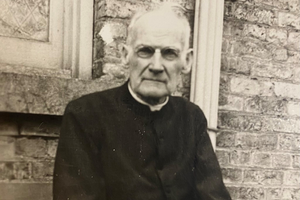
Many years ago in Belgium, in a little village called Bois d’Haine, there lived a beautiful young woman named Louise Lateau. Although she never married, she shone a brilliant light on the beauty of wedding rings.
Born in 1850, Louise loved Jesus very much and had a particular devotion to his Passion. And every Friday, she experienced an ecstasy for many hours at a time. In modern times, the word ecstasy is often used to refer to physical pleasure, but a mystical ecstasy — or supernatural ecstasy — is far different. In a “supernatural ecstasy,” as the Catholic Encyclopedia explains, “the mind rivets its attention on a religious subject” to such a degree that “the activity of the senses is suspended.”
In Louise’s case, the “religious subject” was the scenes of Jesus’ Passion; on many Fridays, she also saw Mary, the Mother of God. And notwithstanding the encyclopedia’s definition, Louise’s ecstasies had somewhat of a twist. The rumor began to spread that, in the state of ecstasy, Louise was able to distinguish between ordinary items (a picture, jewelry, a piece of bread) and holy items. It was said that the ecstatic Louise could immediately discern, for instance, between a blessed holy card and an unblessed holy card. For another example, if an unconsecrated host were in her room, Louise would have no reaction or response. But if a consecrated Host — that is, the Body, Blood, Soul and Divinity of Jesus — were in her room, she would be clearly and powerfully elated.
Of course, the idea that Louise could possibly do this was quite a claim; it would be a miracle — pure and simple. As you might imagine, some doctors and psychologists believed she was simply faking the whole thing — at least at first. So the doctors began to run a series of experiments on Fridays during her ecstatic experiences.
Plenty of experiments.
The French Catholic physician Dr. Antoine Imbert-Gourbeyre, who conducted many experiments on Louise, wrote that more than 1,000 experiments were conducted on Louise’s ability to discern ordinary items from holy things. It’s important to note that these tests were largely done by various doctors who possessed an animosity toward the Catholic Faith.
In one such test, Louise was presented with a holy picture that was unblessed. To that image, she was unmoved. But when that exact same picture was secretly blessed by a priest and re-presented to Louise, she became overjoyed.
After 1,000 such tests, many of which were intentionally tricky, Dr. Imbert-Gourbeyre notes that Louise was correct 998 times. Was she just a good guesser? For statistical clarity on how amazing that would be, we can point out that the odds of picking heads and tails correctly 49 times out of 50 would be about one in 22 trillion. But Lateau chose correctly 499 times out of 500. Clearly, Louise was blessed by God with a gift.
And this brings us to, as Paul Harvey famously used to say, “the rest of the story.”
In one of these tests, the Count of Beaufort had an interesting idea. He placed an unblessed ring in front of Louise, to which she was completely unresponsive. But separately, he placed his wedding ring in front of her. As a Catholic, his wedding ring had been blessed during his matrimonial ceremony — making the ring a sacramental. As the Catechism explains, sacramentals “are sacred signs which bear a resemblance to the sacraments. They signify effects, particularly of a spiritual nature, which are obtained through the intercession of the Church” (CCC 1667). Thus, a blessed wedding ring is a sacramental.
And when that wedding ring — that wondrous sacramental — was presented to Louise, she trembled and smiled.
In her state of ecstasy, Louise expressed a truth far more meaningful than any jeweler will ever tell you. Your wedding ring is a sacramental, signifying a sacrament. That is a majestic claim of what is otherwise only a little bit of metal accompanied a tiny stone.
There is a saying in the jewelry industry that “diamonds are forever.” They are not: diamonds will eventually turn to dust. What is forever is the effect of the sacrament of Matrimony — a sacrament designed to help us, and others, gain eternal life. That is something to think about the next time you look at your wedding ring, and the wedding ring on the finger of your spouse.
- Keywords:
- wedding rings
- holy matrimony
- marriage
- sacramentals
- mystics