St. Theodore, Alpine Exorcist and Bell-Bearer, Pray for Us
SAINTS & ART: In Switzerland’s Valais region, the memory of a little-known Alpine bishop lives on
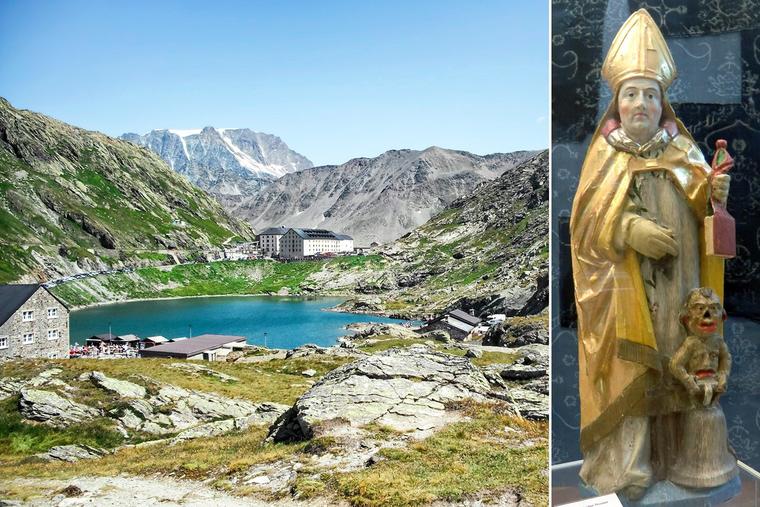
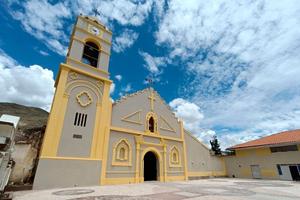
One of the most beautiful corners of Switzerland is Valais/Wallis, a bilingual (French/German) region in the southwest of the country, bordering Italy.
Most people heading south on the highway from Bern reach the shores of sparkling Lake Geneva and head west towards Lausanne and Geneva. A more interesting (but less traveled) road heads east, towards the Valais capital of Sion (Sitten in German) that then breaks up as it heads into the central Alps. Another smaller road goes south through Martigny (the original diocese, “Octodurum”) towards the Italian border, crossed at the Grand St. Bernard Pass, atop which (at about 8,100 feet above sea level) is the beautiful St. Bernard monastery, dating from the 11th century.
(If you’re wondering, yes — the St. Bernard dog came from here, initially bred to rescue travelers lost in the pass.)
That corner of Switzerland is also one of the oldest areas for the penetration of Christianity into Switzerland. That’s why St. Theodore is honored there.
St. Theodore (or Theodul) is actually a historically ambiguous figure, because there were three separate bishops who bore that name. The earliest (on which I’d put my francs) came from around A.D. 350-400 and presided in Octodurum (today’s delightful town of Martigny, population around 18,000). The second lived around A.D. 515, by which time the see may have been moved to Sion. The third — perhaps the most legendary — dates from ca. A.D. 890.
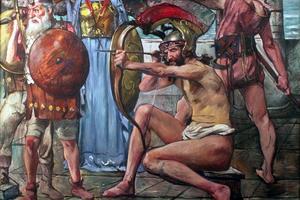
Martigny enters Christian history early, under St. Maurice. Maurice was the head of a Roman legion there that was almost entirely Christian. During the Diocletian persecution (ca. A.D. 305), they refused to worship the pagan gods and, in turn, were punished until every last man was killed.
Late-fourth-century Theodore was known to St. Ambrose of Milan and is recorded to have participated in synods in Aquileia and Milan. His remains were destroyed during the Napoleonic occupation of Valais.
The statue of St. Theodore depicted here is from the Benedictine Monastery Museum in Disentis, high in the mountains of east-central Switzerland. It dates from around 1500 and depicts Theodore in his episcopal garb, pointing with his right hand at two attributes commonly connected with him: a bell and a devil. Such carved statues are an attraction of Swiss church art.
Tradition has it that he exorcised a man and commanded the devil he expelled to bring him a bell the Pope had given him as a gift. (Considering that the bell had to be lugged manually across the high Alps, better to put subject spirits to some better purpose.) The bell was a “weather bell,” i.e., sounded to warn people of sudden changes in weather. Meteorological conditions in mountains change rapidly, which is why the St. Bernard dog was developed: People who suddenly found themselves in the midst of a snowstorm or avalanche needed help — even better if they could be forewarned. Tradition also has it that when the bell arrived, pieces were chipped off to be melted in other bells across Valais.
Another legend holds that a devil appeared to St. Theodore, boasting he was about to tempt the Pope successfully. Theodore told him the Pope would not succumb if he was in Rome so, in arrogant confidence, the devil brought him there. The Pope was saved and, in gratitude, gave Theodore a bell that the devil had to bring back across the mountain passes to Switzerland.
Bells are, in fact, a most attractive feature of Switzerland. I recall with fondness a tradition in Bern that, every Saturday evening, around 7 p.m., church bells began to peal. The tradition was called the “invitation to Sunday” and followed after most businesses had shut down for the day and the rest of the weekend.
The foot pass beneath the Matterhorn, leading from Switzerland to Italy, is named after St. Theodore.
Modern transportation makes us forget the arduous nature of getting around a mountainous land like Switzerland. The Swiss Reformation and Counterreformation, for example, occurred almost on a canton-by-canton basis. Even today, having worked in Switzerland, one can hear local people in one area commenting on the accent of people from other cantons.
Catholic Switzerland — starting at the Grand St. Bernard and heading north through Martigny, Sion, on to Fribourg (with its beautiful St. Nicholas Cathedral and its unique Mehoffer stained glass windows, as well as the little neighboring shrine of Our Lady of Bourguillon) is certainly worth your exploration. Be prepared, however: Switzerland is expensive!
- Keywords:
- saints & art
- st. theodore
- switzerland