The Unsung St. Nicholases, Martyrs of the English Persecution
Meet the layman and the priest who bore St. Nicholas’s name and defended the faith with ingenuity and grace.

There is a magic about the name of St. Nicholas. His feast day, celebrated during the Advent season, is a little foretaste of the Christmas to come. In many cultures, there is the giving of gifts on the feast of St. Nicholas as there is the giving of gifts at Christmas. And, of course, St. Nicholas, as popularized in metamorphosed form as Santa Claus, is inseparable from the celebration of the Christmas season in many people’s eyes.
And then there’s his manifestation as Kris Kringle in which he seems to blend with Christ himself, Kris Kringle deriving etymologically from the German, ChristKind, meaning Christ Child. In this etymological sense, we can even say that St. Nicholas has become more Christ-like than all the other saints, his spirit melding with the gift of the Christ Child himself.
It would be odd to begin a series on the Unsung Heroes of Christendom by singing the praises of such a saint. It would be so odd that we’re not going to do it. The unsung St. Nicholas is not the St. Nick who is sung about in countless Christmas-related popular songs but a lesser-known St. Nick who is hardly sung about at all. This is St. Nicholas Owen, one of the Forty Martyrs of England and Wales canonized in 1970 by Pope Paul VI.
Unlike the vast majority of the English Martyrs, Nicholas Owen was not a priest but a Jesuit lay brother. He traveled with the Jesuit martyr, St. Edmund Campion, during the latter’s tragically short mission to England and was arrested for protesting Campion’s innocence when Campion was apprehended in 1581. Following his release, Owen entered the service of another Jesuit priest, Henry Garnett. From 1588, when he entered Father Garnett’s service, until his arrest in 1606, Nicholas Owen traveled the country building priest holes in Catholic houses.
Nicholas Owen was born in 1562, four years after the accession to the throne of Bloody Bess, Queen Elizabeth I. During Elizabeth’s reign, it was illegal to be a Catholic priest in England, a “crime” carrying the death sentence, which was executed by the torturously slow method of hanging, drawing and quartering. It was also illegal and similarly fatal to hide a priest from Elizabeth’s priest-hunters. Nobody hid more priests from the Elizabethan butchers than Nicholas Owen, whose artful construction of priest holes over a period of 18 years saved many a priest from the gallows, enabling them to continue ministering to England’s beleaguered Catholics in their hour of darkest need.
A very small man, with a crippled leg and generally poor health, he worked as a traveling carpenter during the day and as a builder of priest holes by night, always working alone to ensure the greatest degree of secrecy with respect to the location of the hiding places he was constructing. A man of great gifts and astonishing ingenuity, he often constructed easily discoverable priest holes as a means of keeping the real ones hidden. He is also thought to have masterminded the daring escape from the Tower of London by the Jesuit priest, John Gerard, in 1597.
Nicholas Owen was finally arrested in 1606, giving himself up in the hope of protecting Father Garnett and another priest who were hiding nearby. Robert Cecil, Elizabeth’s chief spymaster, was overjoyed when he realized that the legendary builder of priest holes had finally been apprehended: "It is incredible, how great was the joy caused by his arrest ... knowing the great skill of Owen in constructing hiding places, and the innumerable quantity of dark holes which he had schemed for hiding priests all through England.”
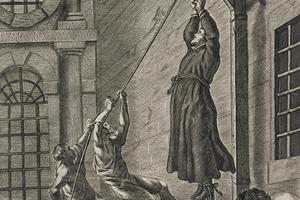
Believing that Owen could be forced to reveal the whereabouts of the priest holes he’d built, he was tortured repeatedly during his imprisonment in the Tower of London. With astonishing courage and endurance, he revealed nothing to his torturers and died while on the rack. The debt that the Catholics of England owed to this remarkable man and saint was encapsulated by the words of John Gerard, the Jesuit priest whom Owen had helped escape from the Tower of London nine years earlier.
“I verily think no man can be said to have done more good of all those who laboured in the English vineyard,” Father Gerard wrote. “He was the immediate occasion of saving the lives of many hundreds of persons, both ecclesiastical and secular.”
As a footnote to this singing of the praises of an unsung St. Nicholas, we will sing the praises of another Nicholas, who is even less known. Blessed Nicholas Postgate, one of the Eighty-Five Martyrs of England and Wales beatified by St. John Paul II in 1987, served the Catholics in the remote Yorkshire moors for almost 50 years before finally being betrayed by a spy and arrested.
Born in 1596 or 1597, he went to France to study for the priesthood in 1621. He was ordained in 1628 and returned to England two years later. In a letter written to the president of the English College at Douai in 1664, Father Postgate spoke of the 34 years he had served his flock in the Yorkshire moors. He had secretly joined in marriage 226 couples, baptized 593 infants, buried 719 dead, and received 2,400 converts into the Church. At the time of writing, he had at least “600 penitents” whom he served.
He would serve his flock for a further 15 years before finally being betrayed and arrested. He was certainly in his late 70s and perhaps in his early 80s when he was executed in August 1679. In spite of his age, no mercy was shown. He was dragged through the streets on a hurdle and then suffered the usual gruesome execution by hanging, disemboweling and quartering. It is said that he and other martyrs had prayed from the scaffold for the conversion of the king. These prayers were apparently answered because Charles II was reconciled to the Church on his deathbed six years later.
It is not for any of us to refrain from singing the praises of the St. Nicholas whom everyone knows (may he pray for us), but let’s also lift our voices in praise and prayer to those who share his name and his heavenly reward but not his celebrity.
St. Nicholas Owen, layman, carpenter and protector of priests, pray for us.
Blessed Nicholas Postgate, priest and humble shepherd of the moors who served his far-flung flock with the humble diligence of Chaucer’s holy Parson, pray for us.
- Keywords:
- st. nicholas owen
- blessed nicholas postgate