Why Pride Is the Devil’s Favorite Sin
From Augustine to Catherine of Siena, the Christian tradition has seen pride as the root of all sin — the self exalting itself above the Creator.
It was not until the dawn of the modern age, which in the popular mind signaled the rise of reason and progress, that pride ceased to be chief among the Seven Deadly Sins, despite its having long since been designated as such by Christian usage. In fact, the whole idea of sin itself as a grave affront to Almighty God was pretty much replaced by wrongdoing as an offense against others, especially the poor and marginalized. And, of course, if there is no God, the Deity having been retired in order to make room for Evolution, how can anyone possibly offend him?
How far we have come from the age of Augustine and Aquinas! Indeed, an entire tradition rooted in both reason and revelation has largely come undone. Leaving what? The exercise, more or less unfettered, of the self-centered self. Hardly enough on which to ground a cohesive or stable social order, is it?
But even if the theological import of the word itself no longer signifies, that scarcely invalidates the fact that, for most people, evidence of pride is almost always seen as a moral shortcoming. Why is that? Why should the sight of a puffed-up person, overflowing with self-importance, invite ridicule — censure even? If there is no God, why does it matter that someone refuses to humble himself in his sight?
Perhaps it may be helpful to have a closer look at pride, seeing it from the standpoint of pre-modern sensibility, and ask why it had so little to commend among our ancestors. Or why the feeling persists that, on the whole, it would be better if one were not quite so proud. In other words, why do most people, including even people consumed with pride, prefer not to be characterized as such? Why do the proud and haughty so often assume an attitude entirely opposite to pride, which is that of humility, when it is clear to everyone that it is purely a pose, nothing more than affectation? I mean, why should the proponents of vice feel it necessary to pay tribute to virtue anyway? “You can have no greater sign of a confirmed pride,” writes William Law, author of A Serious Call to a Devout and Holy Life, “than when you think you are humble enough.”
The fact is, most people would far prefer to be thought of as humble, modest and unassuming, than as proud. So, what exactly is pride? And why, among even the most egregious examples of it, are efforts so often made to deflect attention from it, as if the proud and the haughty could hope to hide under a bushel basket? Or take refuge in hypocrisy, a word the original meaning of which was that of an actor performing a stage part?
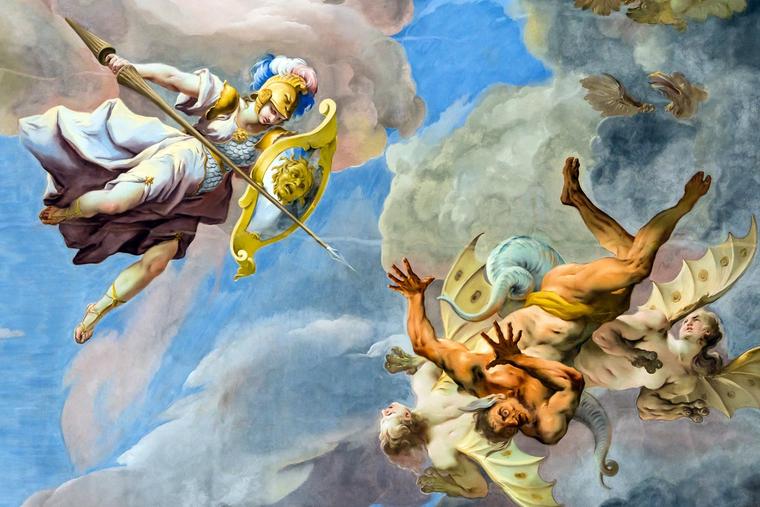
“They are proud in humility,” observes Robert Burton in his Anatomy of Melancholy; “proud that they are not proud.” Oh, how it must please the Devil, too, who was the first to fall, owing to an abundance of self-importance, and who now wishes to enlist everyone in the same failed enterprise. It is his “favorite sin,” writes Robert Southey in a charming poem about him called “The Devil’s Walk.”
He passed a cottage with a double
coach-house—
A cottage of gentility;
And he owned with a grin,
That his favorite sin
Is pride that apes humility.
Of course, there is nothing in the least charming about pride. Because, at the end of the day, what it all comes down to is nothing more than an insistence upon the self to the exclusion of all others, which is far from attractive in anyone.
“Let me have my own way exactly in everything,” writes Thomas Carlyle, striking the perfect note on the symphony of the self, “and a sunnier and pleasanter creature does not exist.”
Yes, but at what price must others be forced to pay it? Notice the implicit logic at play here, too, which is that when anyone dares to get in the way, it may be necessary to eliminate them. Sound familiar? Hadn’t the entire philosophy of the Third Reich harnessed itself precisely to that end, with the result that much of European Jewry simply disappeared?
Which brings us back to God, doesn’t it? Because without God against whom pride mounts its offensive, on what grounds are we to object to the self-centered self? Remove the ultimate sanction against sin, and what are you left with? On whose side are you then standing? It’s pretty clear, isn’t it? You are on the side of the one who was the first to fall, “the proud angel,” St. Augustine calls him, “who turned from God to himself, not wishing to be a subject, but to rejoice like a tyrant in having subjects of his own.” Who, by his refusal to obey, and thus to live happily with God in Heaven, now reigns in misery amid the everlasting fires of Hell.
“Pride goeth before destruction,” we are told in Proverbs 16:18, “and a haughty spirit before a Fall.” In what precisely, then, does the Fall consist, whether of the angels or men, but of the sin of disobedience whereby the creature substitutes himself for the Creator. And since creation implies something coming out of nothing, it follows that we owe God everything, most especially owing to an existence none of us could ever himself give.
“Do you know, daughter,” asks God of St. Catherine of Siena, “who you are and who I am? If you know these two things, you have beatitude in your grasp. You are the one who is not, and I AM he who IS.”
To requite such a gift by remaining obedient hardly seems very much to ask of anyone. And does that not account for the special awfulness of the sin since it really was so easy to obey? I mean, the apple was not bad in itself, but only insofar as God had forbidden Adam and Eve to eat it.
And why would God do that? In order to instill the virtue of obedience as an operative principle among beings made in his image and likeness. The very virtue, adds Augustine, “which is, so to speak, the mother and guardian of all the virtues.” And if to obey is the most obvious and proper office of the creature, why not abstain from the forbidden fruit as something rather more delightful than merely dutiful? It’s not as if there were an absence of delicious fruit nearby.
Another great mystery, to be sure, but not for this essay.
- Keywords:
- pride