Weekly Catechesis
Register Summary
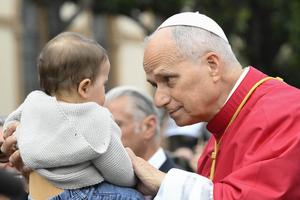
During his general audience on Jan. 4, Pope Benedict XVI divided his time between the Paul VI Hall, the usual site for general audiences in the winter, and St. Peter’s Basilica, where he welcomed those pilgrims who could not get into the meeting hall. The theme for his catechesis was St. Paul’s hymn on the preeminence of Christ found in the first chapter of the Letter to the Colossians.
“Christ — whose preeminence and work both in creation and throughout the history of redemption is exalted — is at the center of this hymn,” the Holy Father pointed out. Christ is presented to us as the first-born of all creation and the image of the invisible God. Like an icon, the expression “image” indicates more than a likeness: It emphasizes the profound intimacy that exists with the subject that is represented.
Pope Benedict noted out that Christ is also portrayed as our Redeemer within the vast sweep of salvation history.
“Christ is ‘the firstborn from the dead,’ the one who unlocks the doors to eternal life by snatching us from the clutches of death and sin,” he said. “With his life-giving presence that allows us to participate in his divinity, we are transformed internally, reconciled, and find peace.”
At one point, Pope Benedict departed from his prepared text.
“In this, St. Paul shows us a very important truth: Man’s ongoing history has a goal, it has a direction. History is going towards a mankind that is united in Christ, and so it is going towards the perfect human being, towards the perfect humanism. In other words, St. Paul tells us, yes, there is progress in history. There is, if you will, an evolution in history. Progress is everything that brings us closer to Christ and so brings us closer to a united mankind, to true humanism. And so, within these words is hidden a command for us: to strive for progress — something we all want. We can do it by striving to bring people closer to Christ; we can do it by conforming our own selves to Christ, which will have us walking the path to true progress.”
The Pope concluded his general audience by quoting St. Proclus of Constantinople who emphasized that Christ, our Redeemer, is not merely human but God with a human nature, who clothed himself in our humanity to save us.
During this first general audience of the New Year, we will pause to reflect on the well-known Christ-centered hymn found in the Letter to the Colossians, which is like a solemn entryway to St. Paul’s rich composition and is also an entryway to this year. The hymn on which we will reflect is set within the framework of a lengthy thanksgiving (see 1:3, 12-14). It helps create for us the spiritual atmosphere in which to live to the fullest these first days of the year 2006, as well as our journey throughout the entire length of the New Year (see verses 15-20).
The praise of the Apostle Paul and therefore ours rises to “God, the Father of our Lord Jesus Christ” (verse 3), the source of our salvation, which is described in negative terms as deliverance “from the power of darkness” (verse 13), that is, as the “redemption” and “forgiveness of sins” (verse 14), and then restated in positive terms as sharing “in the inheritance of the holy ones in light” (verse 12) and as entering into “the Kingdom of the beloved Son” (verse 13).
The Image of God
At this point, the great hymn, so packed with meaning, begins. At its center is Christ — whose preeminence and work both in creation and throughout the history of redemption is exalted. The hymn, consequently, has two movements. The first movement speaks about Christ as “the firstborn of all creation” (verse 15). He is “the image of the invisible God,” an expression that is as rich in meaning as the icon is in Eastern culture: More than the resemblance, his deep intimacy with the subject that is represented is emphasized.
Christ reintroduces among us “the invisible God” in a visible way. In him we see the face of God, through the common nature that unites them. Due to this supremely high dignity, Christ is before “all things” not only because of his eternal nature but also and above all because of his work of creation and provision: “For in him were created all things in heaven and on earth, the visible and the invisible. … And in him all things hold together” (verses 16-17). Moreover, they were created “for him” (verse 16).
In this, St. Paul shows us a very important truth: Man’s ongoing history has a goal, it has a direction. History is going towards a mankind that is united in Christ, and so it is going towards the perfect human being, towards the perfect humanism. In other words, St. Paul tells us, yes, there is progress in history. There is, if you will, an evolution in history. Progress is everything that brings us closer to Christ and so brings us closer to a united mankind, to true humanism. And so, within these words is hidden a command for us: to strive for progress — something we all want. We can do it by striving to bring people closer to Christ; we can do it by conforming our own selves to Christ, which will have us walking the path to true progress.
Savior of the World
The second movement of the hymn (see Colossians 1:18-20) is dominated by the figure of Christ the Savior within the history of salvation. His work is revealed, first of all, in being “the head of the body, the Church” (verse 18), the favored field of salvation where liberation and redemption — the life-giving communion that flows between the head and the members of the body, namely between Christ and Christians — are fully manifested. The apostle is looking ahead to that ultimate goal towards which history is converging: Christ is “the firstborn from the dead” (verse 18), the one who unlocks the doors to eternal life by snatching us from the clutches of death and evil.
Here, in fact, is the pleroma, the “fullness” of life and grace that is in Christ himself, and is given and communicated to us (see verse 19). With his life-giving presence that makes us sharers in his divinity, we are transformed internally, reconciled, and find peace. It is a harmony of the entire being that has been redeemed where God is from now on “all in all” (1 Corinthians 15:28). Living as a Christian means letting oneself be interiorly transformed in this way towards acquiring the form of Christ. This is how we are reconciled and find peace.
Jesus Is Our Brother
We shall now meditate on this wonderful mystery of redemption, recalling the words of St. Proclus of Constantinople, who died in 446. In his First Homily on Mary the Mother of God, he interprets the mystery of Redemption as a consequence of the Incarnation.
God, Bishop Proclus reminds us, became man in order to save us and deliver us from the power of darkness and transfer us to the Kingdom of his beloved Son, as this hymn from the Letter to the Colossians reminds us. “The one who redeemed us,” St. Proclus observed, “is not just a man: The entire human race was enslaved to sin. But neither was he a God lacking a human nature: He did, in fact, have a body. Had he not put on the clothes of my nature, he would not have saved me. Having appeared in the womb of the Virgin, he put on the clothes of the condemned man. There the tremendous exchange took place: He gave up the spirit and took on the flesh” (8: Testi mariani del primo millennio, I, Rome, 1988, pg. 561).
So, we are faced with the work of God, who brought about our redemption precisely because he was also man. He is at the same time the Son of God, the Savior, but he is also our brother and, because of this close bond with us, he pours out into us his divine gift.
He really is God-with-us. Amen!
(Register translation)
- Keywords:
- January 22-28, 2006