Weekly Catechesis
Register Summary
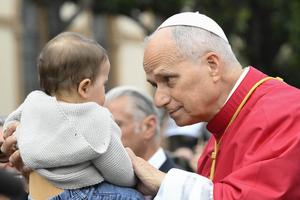
Pope Benedict XVI met with 8,000 pilgrims in the Paul VI Hall during his general audience on Feb. 1, where he offered his reflections on the first part of Psalm 145.
The Pope pointed out that Psalm 145 portrays the Lord as a “tender and loving king” who has a concern for his creatures. “He is not indifferent to the history of mankind,” the Holy Father noted. “Rather, he desires to work out a plan of harmony and peace with us and for us. Moreover, all of mankind is called to fulfill this plan by embracing God’s will for salvation, a will that extends ‘to all men,’ to ‘all generations’ and to ‘all ages,’” he added.
Unlike the rulers of this earth whose reigns are often marked by power, dominion and even oppression, God’s reign is one of gentleness, grace and justice.
“We are not at the mercy of some dark forces nor are we alone in our freedom,” Pope Benedict said. “Rather, we have been entrusted to the work of the Lord, who is powerful and loving and who has a plan, a ‘reign,’ that he will establish for us.”
The Pope pointed out that the portrait of God that Psalm 145 depicts is synthesized in one verse: “The Lord is slow to anger and abounding in love.” He concluded his teaching with a reference to St. Peter Chrysologus, who noted that even greater than the Lord’s works is the Lord’s mercy.
Dear Brothers and Sisters,
We have prayed Psalm 145 together, a joyous song of praise to the Lord who is exalted as a tender and loving king who has a concern for all his creatures. The Liturgy of the Hours presents this hymn in two parts, which correspond in turn to two poetic and spiritual movements in the psalm. At this time we will reflect on the first part, corresponding to verses 1 through 13.
The psalm is addressed to the Lord, who is both called and described as a “king” (see Psalm 145:1), a divine symbol that is predominant in other psalms (see Psalms 47, 93, and 96-99). In fact, at the spiritual core of this hymn is a deep and passionate celebration of God’s royal splendor where the Hebrew word malkut (reign) is repeated on four occasions (see Psalm 145:11-13) as though to indicate the four cardinal points of existence and of history.
A God of Peace
We know that these royal symbols, which are also central to Christ’s preaching, are the expression of God’s plan of salvation: He is not indifferent to the history of mankind; rather, he desires to work out a plan of harmony and peace with us and for us. Moreover, all of mankind is called to fulfill this plan by embracing God’s will for salvation, a will that extends “to all men,” to “all generations” and to “all ages” — a universal action that uproots evil from the world and, in its place, enthrones the “glory” of the Lord, namely, his presence, which is personal, effective and transcendent.
The prayerful praise of the psalmist, who represents all the faithful and who wishes to be the spokesman for all of us today, is directed towards the heart of the psalm, which appears right in the center of the composition. Indeed, the highest form of biblical prayer is the celebration of those works of salvation that reveal the Lord’s love for his creatures. The psalmist goes on to exalt God’s “name,” that is, his very person (see verses 1-2), which is manifested through his works in history. More precisely, he speaks of his “mighty works,” “wonderful deeds,” “power,” “great deeds,” “justice,” “graciousness,” “mercy,” “love,” “goodness” and “compassion.”
A God of Mercy
It is a prayer that is sort of in the form of a litany proclaiming God’s entry into the events of human life in order to lead all of creation into the fullness of salvation. We are not at the mercy of some dark forces nor are we alone in our freedom; rather, we have been entrusted to the work of the Lord, who is powerful and loving and who has a plan, a “reign,” (see verse 11) that he will establish for us.
This “reign” does not consist of power, dominion, triumph or oppression as is often the case, unfortunately, with earthly kingdoms. Rather, it is a place where mercy, compassion, goodness, love and justice will be manifested, as the flow of praise within these verses repeatedly confirms.
The synthesis of this divine portrait is found in verse 8: The Lord is “slow to anger and abounding in love.” These words recall God’s revelation of himself on Sinai, where he said: “The Lord, the Lord, a merciful and gracious God, slow to anger and rich in kindness and fidelity” (Exodus 34:6). Here we are prepared for St. John the Apostle’s profession of faith in God, who told us simply that he is love: “Deus caritas est” (see 1 John 4:8,16).
A God of Love
Besides reflecting on these beautiful words that show us a God who is “slow to anger and abounding in love” and always ready to forgive us and help us, let us also focus our attention on that very beautiful verse, verse 9: “The Lord is good to all, compassionate to every creature.” It is a word for meditation, a word of consolation, an assurance that he brings to our life. In this regard, St. Peter Chrysologus (from around 380-450), expressed the following words in his Second Discourse on Fasting: “‘Great are the works of the Lord.’ However, the greatness that we see in the grandeur of creation, this power, is surpassed by the greatness of his mercy. In fact, having said, ‘Great are the works of God,’ the prophet adds the following in another passage: ‘His mercy is greater than all his works.’ Mercy, brothers and sisters, fills the heavens and fills the earth. … Because of this, the great, generous and unique mercy of Christ, which reserved all judgment for only one day, designated all of man’s time for a peaceful time of penance. ... Because of this, the prophet, who did not have confidence in justice itself, has total confidence in mercy: ‘Have mercy on me, God, in your goodness’ (Psalm 51:3).” (42, 4-5: Sermoni 1-62 bis, Scrittori dell’Area Santambrosiana, 1, Milan-Rome, 1996, pp. 299, 301).
We, too, say to the Lord: “Have mercy on me, O God, you who are great in mercy.”
Register translation of the
Feb.1 general audience.
- Keywords:
- February 19-25, 2006