US Bishops’ Pro-Birthright-Citizenship Brief Gets Mixed Reviews
Should babies born in the United States to parents without legal residency here automatically become U.S. citizens, as they are now? And does Catholic teaching require such a policy?

The U.S. Conference of Catholic Bishops is calling on the U.S. Supreme Court to uphold so-called birthright citizenship, saying it is required by the federal Constitution and the right thing to do. But critics say the bishops’ conference is overstating what the Church actually teaches.
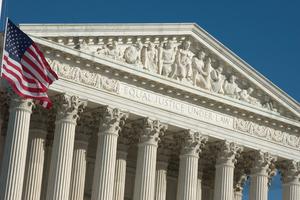
Of the 36 friend-of-the-court briefs filed in Trump v. Barbara, the birthright-citizenship case currently before the high court, the USCCB’s brief has generated the most public comment, much of it negative.
A few examples: The brief has drawn sharp criticism from The Catholic University of America theology professor C.C. Pecknold in The American Mind (“embarrassingly weak”), Ethics and Public Policy Center fellow Michael Fragoso in First Things (“Call it Critical Catholic Theory”); columnist Jacqueline O’Hara in The Catholic Herald (“damaged the bishops’ credibility”); and veteran Catholic commentator Phil Lawler at CatholicCulture.org (“incoherent”).
Support for the bishops’ brief, which has been less widespread and more muted in public forums, includes Catholic school psychologist and writer Ariane Sroubeck in “Where Peter Is” (“a compelling defense of the vulnerable”).
Bishop Daniel Flores of the Diocese of Brownsville, Texas, who appears to be the only U.S. bishop to have commented publicly on the brief, has recommended it to his followers on social media.
“The brief is not primarily a theological argument; it proposes that birthright citizenship is solidly part of US law, and a legal principle that is in deep concord with the Church’s teaching on human dignity, the primacy of the family as a prior social reality that government should respect and protect, the principle of subsidiarity, and the inherently social character of human nature underlying the whole social order,” said Bishop Flores, vice president of the USCCB and a member of its Committee on Migration, in a tweet Feb. 28.
He equated opposition to the current birthright citizenship policy with the U.S. Supreme Court’s 1857 decision in Dred Scott v. Sandford, which held that neither slaves nor free Blacks were citizens of the United States.
“One really can’t argue that the Church should have said something when Dred Scott was being decided, but should not say something now,” Bishop Flores said on social media.
A spokesman for Bishop Flores referred a request for an interview from the Register to the press office of the U.S. Conference of Catholic Bishops, which could not be reached by publication of this story.
The Brief
The bishops’ amicus brief presents birthright citizenship as a desirable policy, a legal requirement, and a moral imperative.
“The principle of citizenship by birth is firmly rooted in Western legal tradition, enshrined in the Fourteenth Amendment, and reaffirmed by this Court’s precedent,” states the brief, which was filed Feb. 26 on behalf of the USCCB and the Catholic Legal Immigration Network, which the USCCB created to help immigrants. “It is equally grounded in Church
teachings, which affirms the inherent dignity of every human person, especially the innocent child.”
The brief raises concerns about freedom of worship for noncitizens worried about being detained by immigration authorities and about family separation and statelessness if the parents’ home country doesn’t recognize a child born in the United States as a citizen of the home country.
The brief also invokes the Catholic principle of subsidiarity, arguing that it “imposes an affirmative obligation on social organizations” to help “lower-order societies when necessary to protect their dignity and enable their flourishing,” which it associates with birthright citizenship because it allows people born here “the legal rights necessary to participate in the society of their birth.”
Automatic birthright citizenship is common across North America and South America but uncommon in the rest of the world.
The brief says birthright citizenship is “consistent with” and “accords with” Church teaching but does not cite a specific Church document that requires it, because the Church has no such explicit teaching on the subject. Indeed, two decades ago, the bishops of Ireland offered a different view.
In June 2004, the government of the Republic of Ireland, which covers about 83% of the area of the island, brought a referendum recommending that voters repeal a constitutional provision that provided automatic birthright citizenship for anyone born on the island, regardless of residency status.
The Irish Catholic Bishops’ Conference issued a statement at the time encouraging people to vote but not telling them which way to vote, while summarizing arguments on both sides. The statement said all people in Ireland have a right to what it called “fundamental human rights,” but it did not define automatic birthright citizenship as one of them.
Republic of Ireland voters approved the measure, ending automatic birthright citizenship there, 79% to 21%.
‘Underwhelmed’ vs. ‘Powerful’
Critics of last week’s U.S. bishops’ brief told the Register the brief is light on legal arguments and inflates Catholic teaching.
“It’s more of ‘This is what we want to have continue happening’ dressed up in moral terms, with very little legal analysis,” said Art Arthur, a former federal immigration judge and a Catholic who is a resident fellow in law and policy at the Center for Immigration Studies, which supports what it calls “low immigration.”
Arthur, who opposes automatic birthright citizenship, said he doesn’t see it as a moral necessity and that the Church apparently agrees.
“Given the fact that the Holy See doesn’t have birthright citizenship, it would raise the question about how it could be fundamental Catholic moral teaching,” Arthur said.
Arthur said the bishops’ brief won’t influence Supreme Court justices because the legal arguments aren’t persuasive and the moral arguments aren’t relevant.
“They’re not really the sort of arguments that are going to sway the court, because you could drive a truck through their legal arguments, and the moral arguments really don’t have any bearing on the court’s interpretation,” Arthur said.
A scholar who supports birthright citizenship said the bishops’ brief tries to make a universal moral principle out of what ought to be a prudential public-policy decision.
“I was underwhelmed by the brief,” said Dwight Duncan, a constitutional law professor at University of Massachusetts School of Law and a Catholic, in an interview with the Register. “It’s really a political question, the issue. So I just think the bishops should stay out of it and let laypeople come up with their own point of view.”
The Register contacted several other scholars who support birthright citizenship asking for comment on the bishops’ brief.
Kevin Johnson, a professor of public interest law and Chicana/o Studies at University of California Davis School of Law, said the brief makes a strong case.
“The U.S. Conference of Catholic Bishops have provided a powerful brief arguing powerfully that Western tradition, the U.S. Constitution, and the teachings of the Catholic Church support birthright citizenship because it recognizes the dignity of every human person,” said Johnson, director of Aoki Center for Critical Race and Nation Studies and a Catholic, by email. “In an approach that Dr. Martin Luther King, Jr. would admire, the brief contends that President Trump's executive order restricting birthright citizenship ‘would undermine both the legal and moral foundations of American society.’”
Gerald Neuman, a professor of international, foreign and comparative law at Harvard Law School and director of its Human Right Program, also praised the bishops’ brief.
“I welcome the brief as an expression of a religious and moral perspective on this important issue, which involves more than just technical questions of positive law,” said Neuman, who has written on immigration, by email. “The brief impressively states as one of its subheadings: ‘The Executive Order Is Immoral.’ I am glad to see that truth stated in writing.”
The Legal Dispute
About a year after the Civil War ended, Congress enacted the Civil Rights Act of 1866, providing that “all persons born in the United States and not subject to any foreign power” are citizens of the United States, regardless of race, color, “or any previous condition of slavery.” About a year later, during the same legislative session, Congress approved the text of the 14th Amendment (later ratified by the states), which has different language concerning citizenship — “All persons born or naturalized in the United States, and subject to the jurisdiction thereof, are citizens of the United States and of the state wherein they reside.”
The dispute in the current case centers on the language “subject to the jurisdiction thereof” — does it mean anyone born in the United States, or only those whose parents are here legally and permanently?
On Jan. 20, 2025, the day he took office, President Donald Trump issued an executive order barring automatic citizenship to people born in the country whose parents did not have legal permanent residency at the time. The president’s lawyers argue in court papers that the executive order is needed because automatic birthright citizenship offers “a powerful incentive for illegal migration,” threatens national security, encourages “birth tourism,” and degrades “the meaning and value of American citizenship.” If it takes effect, a child born in the United States to parents who aren’t either U.S. citizens or green card holders would have to go through a process in order to gain permanent residency or citizenship instead of having citizenship immediately at birth.
Trump’s executive order has been blocked by lower federal courts, stemming from a lawsuit filed in February 2025 by plaintiffs that include a then-pregnant woman from Honduras (identified as “Barbara” in court papers) living in New Hampshire without permanent residency in the United States who was concerned her then-unborn child wouldn’t become a citizen at birth.
Supporters of birthright citizenship say the 14th Amendment applies to everyone born in the country and that the U.S. Supreme Court settled the matter in an 1898 case called United States v. Wong Kim Ark. In that case, a man born in San Francisco in 1873 whose parents were from China was barred from returning to the United States in 1895 after visiting China.
The majority in the 6-2 decision held that the 14th Amendment made Wong a U.S. citizen because citizenship automatically extends to “all children here born of resident aliens,” with certain common-law and constitutional exceptions.
The two dissenting justices argued that automatic citizenship extends only to children born in the country whose parents are “completely subject to [the] political jurisdiction of the United States,” which would exclude noncitizens who “owed local and temporal allegiance merely” while being “subject to a foreign power by virtue of tie of permanent allegiance.”
About 128 years later, the arguments in Trump v. Barbara are similar on both sides.
Arthur told the Register he expects that the current Supreme Court justices will wade through accounts of floor debates in Congress in 1867 to determine what the framers of the 14th Amendment thought it meant, since a majority of justices believe the federal Constitution should be interpreted as having the same meaning now as when it took effect.
“That is what this is going to come down to, is the intent of the drafters at the time,” Arthur said. “An originalist court is going to give you an originalist solution.”
One legal expert told the Register that automatic birthright citizenship has been uncontroversial for most of the country’s history.
“Until relatively recently, there has been widespread agreement on what the 14th Amendment requires and that the Supreme Court got it right in 1898. We’ve had a shared understanding for a very, very long time,” said Polly Price, professor of law at Emory University School of Law. “Certainly, as a nation we can change our rules assigning citizenship at birth, but that has to be done by constitutional amendment.”
Oral arguments are scheduled for April 1. Arthur outlined three likely possible outcomes for the U.S. Supreme Court’s decision, expected in late June or early July: Overturn Trump’s executive order while finding that birthright citizenship is a constitutional requirement; uphold Trump’s executive order ending birthright citizenship; or find that Congress can end birthright citizenship by statute but that the president can’t do it by himself.
Arthur’s guess: Option 3, quashing Trump’s executive order but allowing Congress to accomplish the same end if it decides to do so.
Whatever the outcome, he expects a close split.
Arthur said, “I think it’s going to be 5 to 4, and the only question is who are the five and who are the four and what they decide.”
- Keywords:
- citizenship
- trump administration
- u.s. bishops