This Year’s Shared Easter Provides ‘Joy’ to Catholic-Orthodox Blended Families
The Orthodox and Catholic Churches have a united celebration in 2025, for the first time in eight years.

In 2025, Western Catholics and Eastern Orthodox Christians will share a common Easter date, April 20 — for the first time since 2017.
As in other years when Christianity’s central liturgical celebration coincides in East and West, it’s especially welcome for “blended” families that have both Catholic and Orthodox members.
“Since Easter falls on the same date this year, the only feeling one can have is joy,” Joseph Lovskiy, the only Catholic in his family in Yekaterinburg in Russia, told Catholic News Agency in a written interview translated from Russian.
Lovskiy’s wife, three children and six grandchildren are all Russian Orthodox, and his youngest son is a Russian Orthodox priest.
Arina Agnew, who was born Orthodox and converted with her family to Catholicism as she grew up in New Jersey, is an American Catholic who is similarly excited about the opportunity to celebrate a joint Easter in 2025 with her family members.
“But we still have family who is Orthodox, and we celebrate with them,” Agnew told EWTN News. “We are going to New Jersey to celebrate with them for this Easter since it’s at the same time.”
Orthodox faithful who live in the U.S. are also looking forward to being able to celebrate Easter in common with their Catholic relatives this year. “Almost 70, 75% of the Greek Orthodox, all Orthodox Christians, are married to non-Orthodox husbands or wives,” Archbishop Elpidophoros of the Greek Orthodox Archdiocese of America told EWTN News. “Can you imagine how difficult it is for a family not to be able to celebrate together at the same day, the same feast? That’s a problem.”
The convergence of Easter occurs occasionally when the Gregorian calendar, used by the Catholic Church, and the Julian calendar, used by Orthodox Churches not in communion with Rome, align on their calculations for Easter. (The two calendars will next converge on April 9, 2034.)
The convergence of the two dates is of significance not only because it will give Western Catholics an opportunity to appreciate the rich celebration of Pascha (Easter) in the Eastern Church, but also raise awareness of efforts made by Pope Francis and Ecumenical Patriarch Bartholomew I of Constantinople, the “first among equals” of the Eastern Orthodox Church, to designate a common date for Easter with the Eastern Church, which could be an important step leading towards additional cooperation and even an eventual reunion between East and West.
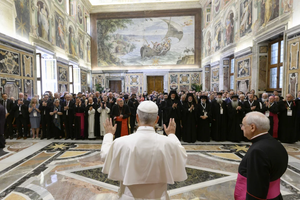
Pope Francis has made greater unity with the Orthodox a priority of his pontificate; he has especially expressed his desire for Western and Eastern Catholics to share a common Easter date, particularly leading up to 2025, due to the convergence on the two calendars.
In a 2022 audience with a delegation from the Patriarchate of the Assyrian Church of the East, Pope Francis said the two Easter dates “at times make us laugh.” In 2015, he even suggested that the Catholic Church could forgo its traditional calculation tied to the spring equinox if a unified date is agreed upon.
Important Step
Jack Figel is communications director of the Romanian Catholic Diocese/Eparchy of St. George in Canton, Ohio, who worships as part of the Byzantine Catholic Eparchy of Passaic, New Jersey (both in union with Rome).
Most Eastern Christians in union with Rome use the Gregorian calendar, he noted; tensions between Orthodox Churches caused by the Ukraine War, in fact, led both the Ruthenians in Europe and the Ukrainian Greek Catholic Church to adopt the Gregorian calendar just over a year ago.
Western Christians, he explained, select the Easter date based on the vernal (spring) equinox at the meridian of Jerusalem, March 21, when day and night are each 12 hours (marking the beginning of spring).
Easter is the first Sunday following the first full moon after the vernal equinox. The Julian calendar is currently 13 days behind the Gregorian calendar. Hence, Orthodox currently use April 3 as their date for the spring equinox and Orthodox Pascha can fall several weeks after the Catholic Easter date. Additionally, Orthodox insist that Pascha should come after the Jewish date for Passover, while this is not a Catholic view.
So, while using the Gregorian calendar results in a more accurate Easter date, Figel believes, separated Orthodox Churches are resistant to change, as the Julian calendar is part of their tradition. Further impeding progress is Pope Francis’ illness and political disputes between Orthodox Churches related to the ongoing conflict in Ukraine.
Nonetheless, Figel believes that efforts for a single Easter date should continue, as they are an important step towards unity between East and West. He asked, “How can we go to the world that is not Christian and claim Jesus to be our Savior if we can’t agree on a date he rose from the dead?”
Register readers shared similar sentiments. Doug May noted on the Register’s Facebook page that in his 10 years teaching at a Coptic Catholic seminary in Egypt, the community followed the Eastern calendar. He added, “For both Easter and Christmas, I would celebrate with the expatriate community following the Western calendar and then travel down to Upper Egypt to celebrate both a second time according to the Eastern calendar. It’s long past time that Christians agree on a joint day to celebrate Easter and Christmas.”
Great Fast, Great Week
Father John Basarab is pastor of Epiphany of Our Lord Byzantine Catholic Church in Annandale, Virginia, which is part of the Passaic Eparchy (and in union with Rome). It serves 313 families, many of whom are of Eastern European ancestry. During Pascha, the community observes the Great Fast (Lent), which begins two days before Ash Wednesday and ends the Friday before Palm Sunday, followed by Great Week (Holy Week) and Pascha.
There are similarities and differences between the Byzantine and Roman Rites, he said; during the Great Fast, for example, the community abstains from meat on Wednesdays and Fridays. The Great Fast reminds us of the 40 days Christ fasted in the desert at the beginning of his public ministry, Father Basarab said.
His eparchy (diocese) began using the Gregorian calendar after World War II, he noted, as the Roman Rite is dominant in the United States. He, too, believes that celebrating Easter/Pascha on a common date “would be a much better witness to the world.”
Father Nicholas Kostyk is a priest of the Ukrainian Catholic Eparchy of St. Nicholas (in union with Rome) and associate pastor of St. Nicholas Ukrainian Catholic Cathedral in Chicago. His eparchy uses both the Gregorian calendar and a modified Julian calendar, depending on the parish.
He offered a different view on the common date. While it would certainly be “a good thing,” he opined that different dates “hasn’t infringed on our unity. We’re still in communion and believe the same things. Unity of faith doesn’t mean unity of expression.”
‘Double Celebrations’
Father Richard Sofatzis, a Catholic priest in the Archdiocese of Sydney, has a very personal perspective on the issue. He grew up in a mixed Catholic and Orthodox environment, since his father is Greek Orthodox and his mother, who died in 2017, was Catholic.
The priest’s Catholic mother, who was born in England, and his Greek Orthodox father, who was born on the Greek island of Lemnos, agreed before their marriage to baptize and raise their children in the Catholic faith, but to send them to a Greek Orthodox primary and secondary school.
At Easter, Father Sofatzis’ family would have “double traditions and double celebrations,” he said, noting that, as children, he and his siblings “always enjoyed celebrating Easter twice” — doing all the usual things, like chocolate eggs, for Catholic Easter and, a few weeks later, the Greek traditions for Greek Easter.
“The fact that Easter is the same this year is, I think, really important,” Father Sofatzis said. “I’m really hoping more than anything else, even if [Catholics and Orthodox] can’t achieve full unity, we could work towards that common date for Easter — something I’ve been looking forward to for many years.”
Catholic News Agency contributed to this report.
WATCH ON EWTN
- Keywords:
- common easter date