Tenacity and Faith in the Philippines
COMMENTARY
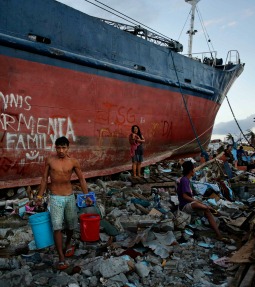
As Pope Francis embarks on his trip to the Philippines with a special visit to the Archdiocese of Paló, the Holy Father will witness the extraordinary tenacity of a people devastated by the largest storm in history, whose raging waters, driven by winds of more than 300 mph, took the lives of more than 10,000 in November 2013.
Last year around this same time, I presented a speech to a meeting of the Philippine bishops’ conference (CBCP) to mark a milestone of the International Catholic Migration Commission’s historic partnership with the PCCB aimed at the prevention of human trafficking. There, I was able to witness how focused the Philippine people are in coming together to confront adversity.
More than 450 priests, nuns and laypeople participated in the event from more than 50 Catholic dioceses around the country. The bishops also invited many members of other faith traditions to the gathering to discuss the strategies that were proving most effective to combat trafficking and then to better coordinate and cooperate to make their fight most effective.
The Philippine government recognized the importance of the PCCB initiative and sent the vice president of the Philippines and the minister of justice to the conference and provided briefings by the Philippine FBI. Out of the small mustard seed of the Church’s grassroots efforts and partnerships came this exemplary approach to combating the scourge of human trafficking.
As the trafficking-prevention project continues, the PCCB Migration Committee and the PCCB Women’s Office are presenting the effort as a regional approach for Southeast Asia, which in turn, will serve as a model for other global efforts, in fulfillment of Pope Francis’ goal to eliminate human trafficking.
During my visit to the Philippines last year, I requested to visit the Taclóban area in order to hand deliver funds that the commission raised in its initial Internet drive for the victims of Cyclone Haiyan.
As an American, it was fascinating for me to learn that, in addition to being the landing spot for this historically devastating storm, it was on these same beaches that Gen. Douglas MacArthur landed to save the Philippine people from the ravages of the Second World War, fulfilling his pledge of “I shall return” to the Philippines, the land of his youth and where his father had served as governor.
This week, Pope Francis, in turn, will land, in order to fulfill his promise to give comfort to the victims of the cyclone — people like the young 8-year-old Filipe, whom we met when visiting a church near Taclóban.
When we arrived, Filipe was standing in the yard, touching a large poster with his hand on a woman’s picture — a picture surrounded by many other pictures of happy family gatherings. When we asked who the woman in the picture was, he replied, “My mother”; and in response to our question about “the others,” he replied, “The rest of my family.”
At that moment, we realized that we were standing on the mass grave of 15 of his extended family members. Archbishop John Du gave orders for the digging of mass graves in the Catholic churchyards when nothing was being done to bury the thousands of dead. Most of Filipe’s family died drowning in the second floor of their houses, as they clung to the roof beams when they could not break open the roofs, which might have led them to safety from the raging waters that had reached almost to the top of their homes.
Archbishop Du will undoubtedly emotionally describe to the Holy Father, as he did to me, the challenge he has faced since the storm. The archbishop has had to rebuild 70 out of 74 churches in his diocese, including the cathedral, after they were torn apart.
Besides serving as spiritual centers, in the Philippines, the Church is often the only dependable infrastructure the people can rely on. The loss of church buildings can mean the loss of a lifeline for the neighboring people.
Pope Francis will also see with his own eyes the huge ships that were tossed by epic winds like corks onto coastal shantytowns from the shallow bay. Local survivors living in lean-tos on the beach recounted the tragic sounds of the voices of the people who had been trapped under the ships where no one was able to rescue them.
During the papal trip, the courage of a people who has managed to live through the adversities of war and epic storms will be evident to the Holy Father, and his paternal presence will be an enormous comfort. The Pope will witness a land where his love and devotion for the poor, for migrants (the Philippines has more than 11 million citizens working abroad), for refugees (hopefully, many now able to return to the Taclóban area) and for trafficked persons (thousands of Filipino women and children are currently trafficking victims) will have a particularly vibrant meaning amidst these people of extraordinary faith and concerted communal action.
The International Catholic Migration Committee is humbled to have been a partner of the Philippine Bishops’ Conference, together with the Philippine bishops and people. We welcome the visit of Pope Francis to bring the Philippines’ challenges to the world’s attention. Pope Francis’ visit will highlight not only a land of need, but, most importantly, a land of enduring faith.
John Klink is president of the International Catholic Migration Commission Inc.