Hundreds of Catholics Turn Out for Eucharistic Procession in Historic Williamsburg, Virginia
More than 10,000 Catholics have participated in the Cabrini Route of the procession, which has traveled up the Eastern Seaboard and visited multiple dioceses.
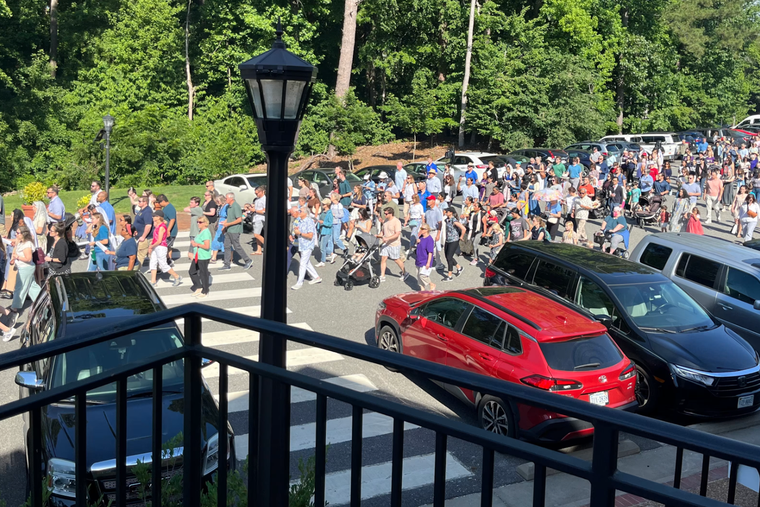
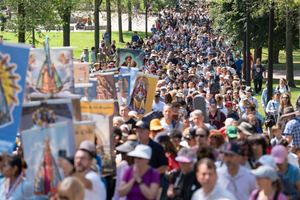
Hundreds of Catholics processed through Williamsburg, Virginia, on the morning of June 5 as the National Eucharistic Pilgrimage made its way through the colonial-era capital city in the eastern part of the state.
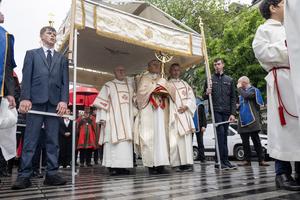
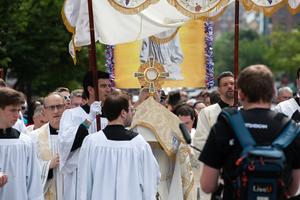
A team of priests carried the Blessed Sacrament in a monstrance through the campus of the College of William & Mary, the nationʼs second oldest university, before finishing in front of the 17th-century Wren Building, the oldest academic building in continuous use in the United States.
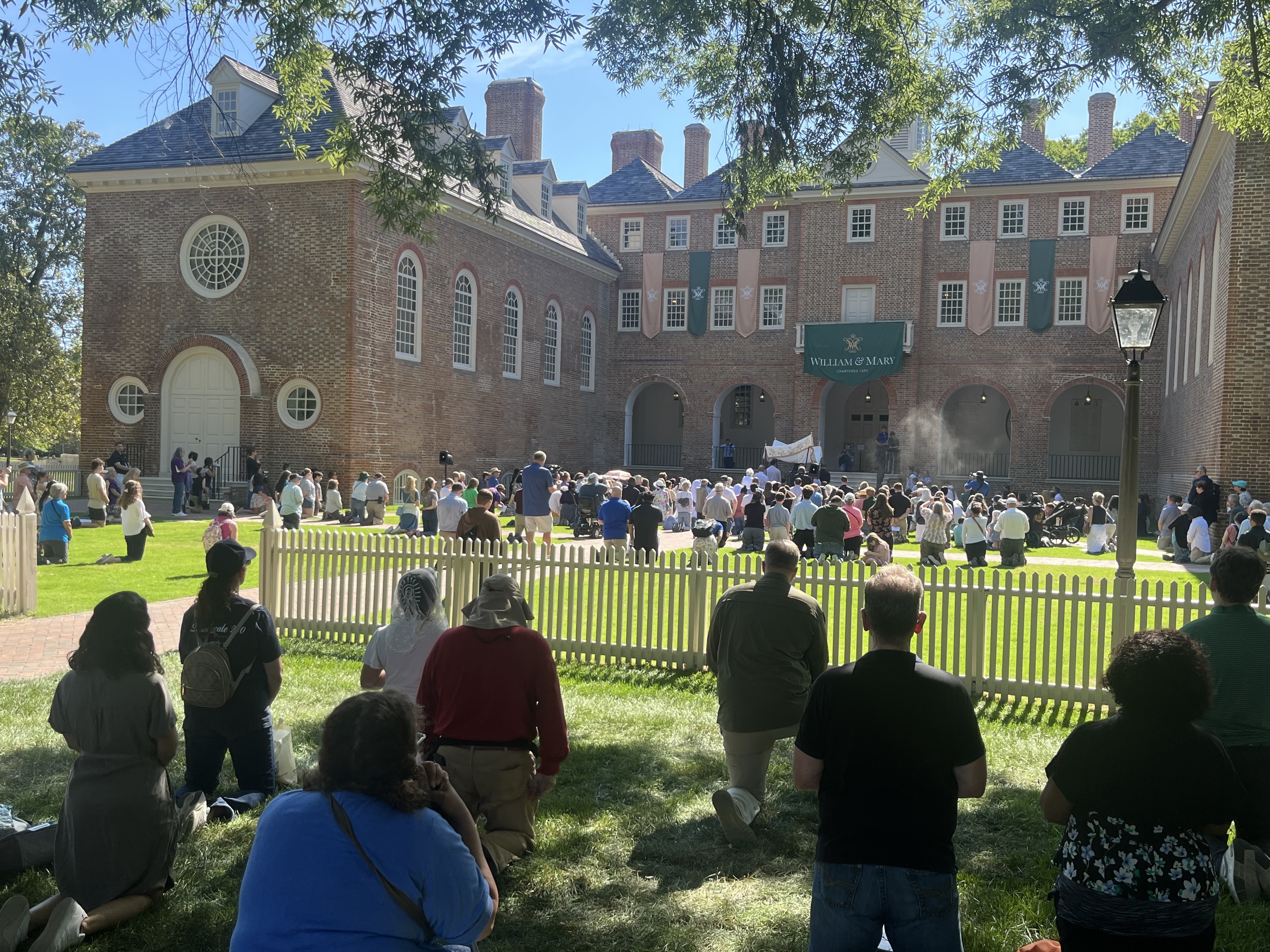
Young Catholics carried amplifiers on their backs through which hymns were projected as the procession made its way through the historic area. The faithful sang along with the hymns as they walked.
The Williamsburg event was the latest public display of faith in the national procession, which launched on Pentecost in the Diocese of St. Augustine, Florida, before making its way through Georgia and the Carolinas.
After its route through Virginia — which included stops in Roanoke and Richmond and which will also include a stop in the Diocese of Arlington — the pilgrimage will travel to the Archdiocese of Washington and then further north, stopping in Baltimore; Camden, New Jersey; Portland, Maine; and numerous other dioceses and archdioceses.
‘Something Thatʼs Been Going on for Centuries’
The procession featured a broad mix of the faithful, including young adults, elderly Catholics, religious sisters, and families large and small.
Tony and Crystal Rivera-Silva came up with five of their children from nearby Newport News. Tony told EWTN News that the family joined their home-schooling group to be a part of the procession.
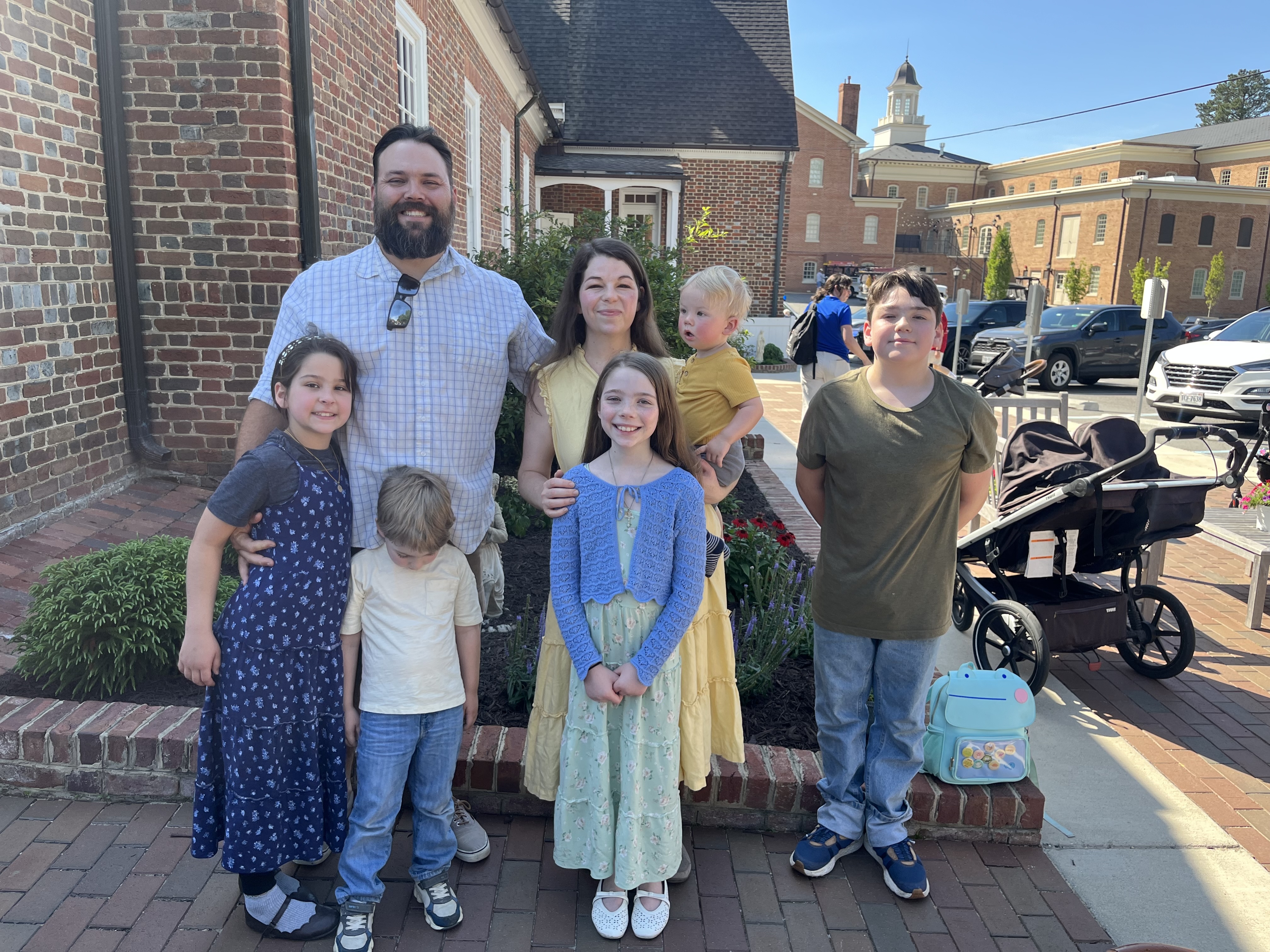
“I just love it for our children, in particular for them to have this experience that will hopefully draw them to stay in the faith and draw them to love the Lord,” Crystal said.
The family has participated in smaller processions in the past, they said, but this was the largest one in which theyʼve ever taken part.
“I was telling the kids as we were processing, ‘People have been doing this since the Middle Ages’,” Crystal said. “It’s just so cool to be a part of something that’s been going on for centuries.”
Among the clergy present in Williamsburg was Father Michael Herlihey, OFM Cap, who announced as the procession began that he would be hearing confessions at the back of the crowd as it wound its way through the campus.
“I was a chaplain last year on the pilgrimage, and it occurred to me, we’re not just bringing one sacrament, we’re bringing two,” he told EWTN News.
Searching for “creative ways” to bring confession to the faithful, he said he decided to simply begin hearing them during the processions themselves.
“Every procession, I just go to the back of the line and hear confessions,” he said.
“I was in Illinois and heard them for three hours, in the middle of a cornfield, in front of a tractor,” he said with a laugh.
Andrew Waring, director of the Diocese of Richmondʼs evangelization office, told EWTN News that the response to the pilgrimage has been “fantastic.”
The evangelization office and multiple other diocesan departments have been planning for the event since October 2025, he said.
“They told us in the beginning that the number of registrants would not accurately reflect the number of people that would show up,” Waring said. “We’re routinely seeing two to three times as many people show up for the events as registered. We filled the Cathedral of the Sacred Heart [in Richmond] yesterday with nearly 600 people. We had 400 people in the procession in downtown Richmond.”
Both of the processions in Roanoke and Newport News saw around 500 Catholics turn out, he added.
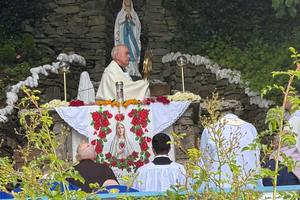
At a Mass after the procession at which Richmond Bishop Barry Knestout was the principal celebrant, Father Eric Ayers, noted the rich historic significance of the region, which includes not just Williamsburg but Jamestown and Yorktown, all three of which have been pivotal locations in American history.
Ayers recounted the arrival of a Jesuit missionary group to the area in the late 16th century. “They must have felt great anxiety and vulnerability being far from home, in a new land and culture, so different from their own, isolated, with no one to protect them,” the priest said.
“All they had was their faith — and I am sure the tangibility of Christ with them in the Eucharist must have been a great comfort.”
“The Eucharist has always been a source of strength and unity in times of challenge and transition,” he said.
A Eucharist pilgrimage, meanwhile, “reminds that God is first in our life and in our nation and must be the lens through which we see everything else,” he said.
The procession has been greeted by thousands of Catholics along the route, while a group of young adult perpetual pilgrims has accompanied the Blessed Sacrament throughout its entire journey up the coast.
Spearheaded by the National Eucharistic Congress, the excursion is the third major Eucharistic procession to take place in the U.S. in recent years after multiple pilgrimage routes in 2024 ahead of that yearʼs National Eucharistic Congress and an additional procession in 2025 from Indianapolis to Los Angeles.
This yearʼs route coincides with the 250th anniversary of the founding of the United States; the 2026 procession has taken the theme “One Nation Under God,” a nod to the 75th anniversary of that having been officially added to the U.S. Pledge of Allegiance.
The pilgrimage will finish in Philadelphia during the Fourth of July weekend. A few weeks prior, at their spring plenary meeting, the U.S. bishops will consecrate the United States to the Sacred Heart of Jesus on June 11.
- Keywords:
- eucharistic processions