Marriage Is a Sign of God's Love for Mankind
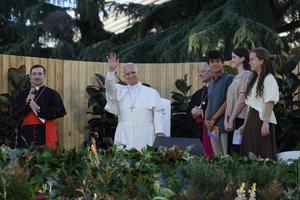
Pope John Paul II addressed a crowd of 13,000 pilgrims who gathered in St. Peter's Square for his general audience Oct. 6. The Holy Father offered his reflections on the second half of Psalm 45 in his ongoing series of teachings on the psalms and canticles of the Liturgy of the Hours. He spoke about the first half of the psalm during his general audience Sept. 29.
The second part of Psalm 45, which was written for a royal wedding celebration, describes the beauty of the resplendent bride and future queen and the joy of her maiden companions. “Because of its perspective on marriage, we can dedicate it to all married couples who live out their married life with a strong commitment and an inner zeal,” John Paul said, noting that the love of the married couple is a sign of the love of the Father for mankind and of Christ for the Church. “The vocation to marriage is a turning point in life and a life-altering event,” he added.
John Paul pointed out that the psalm exalts the beauty of the bride as a reflection of God's splendor and recalls passages from the Song of Songs, particularly chapters 4 and 7, and the wedding feast of the Lamb described in chapter 19 of the Book of Revelation. At the same time, the joy of the wedding party is also highlighted: “Genuine joy, which is deeper than simple happiness, is an expression of love, which contributes to the well being of the person who is loved with serenity of heart.”
Finally, Pope John Paul II noted the emphasis on fertility at the end of the psalm. “This is a relevant topic in our days, in the Western world that is often incapable of entrusting its own existence to the future by generating and caring for new creatures so that they might continue the civilization of peoples and fulfill the history of salvation,” he said.
The audience opened with a musical rendition of the second half of Psalm 45.
The gentle portrait of a woman, which was just presented to us, constitutes the second part of the diptych contained in Psalm 45, a serene and joyful nuptial song that is recited during evening prayer of the Liturgy of the Hours. After having contemplated the king, who is celebrating his wedding (see verses 2-10), we now focus our attention on the figure of his bride and queen (see verses 11-18). Because of its perspective on marriage, we can dedicate this psalm to all married couples who live out their married life with a strong commitment and an inner zeal, which, as St. Paul suggests, is a sign of a “great mystery” — the mystery of the love of the Father for mankind and the love of Christ for his Church (see Ephesians 5:32).
However, this psalm opens up an even greater horizon. Indeed, it focuses on the Jewish king and, from this perspective, the ensuing Jewish tradition perceived this psalm as a portrait of the Davidic Messiah, while Christianity has transformed this hymn into a song in honor of Christ.
The Queen and Bride
However, let us first turn our attention to the portrait of the queen that the court poet, who is the author of the psalm (see Psalm 45:2), describes with a great deal of grace and feeling. The reference to the Phoenician city of Tyre (see verse 13) inclines us to believe she is a foreign princess. For this reason, the call to forget her people and her father's house (see verse 11), which the princess had left behind, takes on a special meaning.
The vocation to marriage is a turning point in life and a life-altering event, an idea that already emerges in the Book of Genesis: “That is why a man leaves his father and mother and clings to his wife, and the two of them become one body” (see Genesis 2:24). At this point, the bride and queen, along with the wedding procession that is bearing gifts, advances toward the king, who is fascinated by her beauty (see Psalm 45:12-13).
Beauty and Joy
The insistence with which the psalmist exalts the woman is important: She is “all glorious” (see verse 14) and this magnificence is expressed in her wedding dress, which is threaded with gold and decorated with fine embroidery (see verses 14-15). The Bible loves beauty as a reflection of the splendor of God himself; her clothing can also be seen as a sign of an inner light that shines forth and a purity of soul.
On one hand, we can find parallels in some wonderful passages from the Song of Songs (see chapters 4 and 7). On the other, we can find parallels in the passage from the Book of Revelation that depicts the “wedding day of the Lamb,” namely Christ, with the community of the redeemed, which makes the symbolic value of the wedding garments even clearer: “For the wedding day of the Lamb has come, his bride has made herself ready. She was allowed to wear a bright, clean linen garment” (Revelation 19:7-8).
Along with beauty, joy is exalted, which can be seen in the festive procession of the “maids of her train,” the young girls who accompany the bride “with glad and joyous acclaim” (see Psalm 45:15-16). Genuine joy, which is deeper than simple happiness, is an expression of love, which contributes to the well being of the person who is loved with serenity of heart.
The Future of Mankind
Finally, in his concluding words that express his best wishes, the psalmist describes another reality that is radically inherent in marriage: fertility. In fact, reference is made to “sons” and “generations” (see verses 17-18). The future of all mankind is now assured and not just that of the dynasty simply because the married couple will offer new creatures to the world.
This is a relevant topic in our days, in the Western world that is often incapable of entrusting its own existence to the future by generating and caring for new creatures so that they might continue the civilization of peoples and fulfill the history of salvation.
A Portrait of Mary
As it is known, many Fathers of the Church have taken this portrait of the queen and applied it to Mary, beginning with the cry at its very beginning: “Listen, my daughter, and understand; pay me careful heed …” (see verse 11). This is what happens, for example, in the Homily on the Mother of God by Crispinian of Jerusalem, a Cappadocian who was one of the founding monks of the monastery of St. Euthymius in Palestine and who was custodian of the Holy Cross in the Basilica of the Anastasis in Jerusalem after he became a priest.
“It is to you that I address my words,” he says, turning to Mary, “to you who are to be wed to the great ruler; to you I dedicate my words, to you who are about to conceive the Word of God, in the way he knows … ‘Listen, my daughter, and understand; pay me careful heed:’ Indeed, the happy announcement of the redemption of the world has been confirmed. Pay careful heed and what you will hear will lift up your heart … ‘Forget your people and your father's house:’ Do not pay attention to your ties here on earth because you will be transformed into a heavenly queen. Hear, he says, how much he who is the Creator and Lord of all things loves you. Indeed, the king, he says, desires your beauty, the Father himself will take you as his bride, and the Spirit will arrange all the conditions that are needed for the wedding ceremony. Do not think that you will give birth to a human child ‘for he is your Lord and you will adore him.’ Your Creator has become your child; you will conceive him and, with the others, you will adore him as your Lord” (Testi mariani del primo millennio, I, Rome, 1988, pp. 605-606).
(Register translation)
- Keywords:
- October 17-23, 2004