ACLU Lawyer Takes Pointed Questions in Saints-Statues Case Oral Arguments
But it isn’t obvious which way Massachusetts high court will go in the St. Michael and St. Florian case.
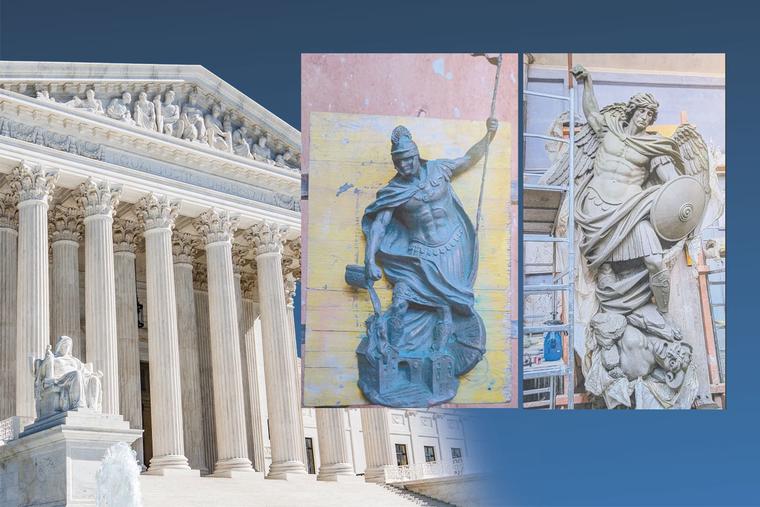
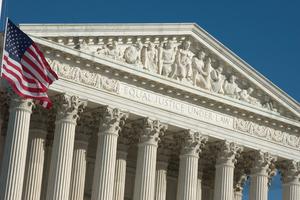
Justices on Massachusetts’s highest state court seem ready to modify 1970s-era Lemon test standards on government interactions with religion, but they didn’t tip their hand during oral arguments Wednesday on whether they’ll allow statues of two Catholic saints to be installed on a city public safety building.
Even so, a lawyer for the ACLU of Massachusetts took more pointed questions from justices than her counterpart from Becket law group, especially over her contention that putting statues of St. Michael the Archangel and St. Florian on a government building would impermissibly elevate Catholicism.
At issue is whether installing the statues would violate Article 3 of the Massachusetts Constitution, which (as amended in 1833) guarantees equal protection of “all religious sects and denominations” and also prohibits subordinating one to another. But the dispute also has the potential to reach the U.S. Supreme Court on First Amendment grounds.
Six of the state court’s seven justices engaged in the lively discussion at the Massachusetts Supreme Judicial Court in Boston on Wednesday morning.
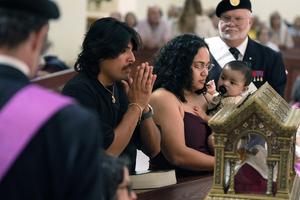
At one point Justice Serge Georges Jr. noted that Islam, Judaism and several other Christian denominations also honor St. Michael, in addition to the Catholic Church.
“Adding more religion to these statues does not remove the Article 3 problem,” Rossman said.
“Why not?” interjected Justice Delila Argaez Wendlandt, sharply. “Because Article 3 specifically says ‘no subordination of any one sect or denomination to another.’ So the fact that multiple sects find this symbolic does seem relevant, at least, to the Article 3 inquiry.”
Rossman responded by saying that the state Constitution “encompasses a general principle of government neutrality” when it comes to religion that doesn’t raise one set of religious beliefs or religion more generally “above nonreligious beliefs.”
“And even if there were three, four, five religions that found these figures to be important, that would still be elevating religion over nonreligious beliefs,” Rossman said, adding that an expert has found the statues reflect “Catholic iconography” in the way St. Michael and St. Florian are portrayed.
Justice Elizabeth Dewar asked Rossman that if religion were removed from the discussion and Michael and Florian were determined to be “mascots” for police and firefighters, if it would then be constitutionally permissible to put statues of them on the building.
“Or are you saying that the well is poisoned because they originally came from a religious tradition?” Dewar asked.
Justice Georges noted that police and firefighters in Quincy “are very much in favor of the fact that this has some professional meaning to them.”
“Are we going to turn these kinds of constitutional questions into kind of, I don’t know, a heckler’s veto?” Georges said.
Rossman said, “No,” adding that the Quincy statues are widely seen as sending specifically religious messages that aren’t permissible if they are from the government.
“I want to be clear: If there was a statue that directly reflected another religion, if there were two 10-foot-tall Jewish stars, or two 10-foot-tall moon and crescent and stars that were outside the building, it would pose the same issue,” Rossman said.
Possible Federal Appeal Looming
Quincy’s mayor, Thomas Koch, has said he picked the $850,000, 10-foot-tall bronze statues from Italy for the exterior of the city’s new $175-million public safety building to honor police officers, whose patron saint is St. Michael, and firefighters, whose patron saint is St. Florian, a Roman martyr associated with miraculously putting out a fire with a single pitcher of water.
Koch is a practicing Catholic, but he has said in a sworn statement that advancing religion had nothing to do with his selection. Friend-of-the-court briefs from organizations representing police and firefighters support the statues, arguing that Michael and Florian are long-standing figures associated with their profession.
The ACLU of Massachusetts, which filed a lawsuit last year on behalf of Quincy residents who object to the statues, has cited only the state Constitution and state court precedents, not federal law. But Massachusetts Justice Scott Kafker anticipated potential federal free-exercise-of-religion issues under the First Amendment of the U.S. Constitution during oral arguments.
“The U.S. Supreme Court is really concerned about government action that appears to be hostile to religion,” Kafker said.
“We can’t provide less protection than the Supreme Court on free exercise. We can’t allow more hostility to religion than the Supreme Court would tolerate. And they have very low tolerance,” Kafker said. “I’m trying to understand, if you could put up any kind of statue in this building, but you can’t put up these ones that have a religious element to it, is the Supreme Court going to be troubled that that’s singling out religion somehow in a way that’s inappropriate?”
Rossman noted that lawyers for the city have raised a potential appeal to the U.S. Supreme Court (including in statements to the Register late last month) but she said it should be very clear that there is “no potential violation of federal law” if the state courts ban the statues from being installed.
The Massachusetts Supreme Judicial Court has one precedent on point — Colo v. Treasurer, a 1979 decision that allowed the state Legislature to employ two Catholic priests as paid chaplains while adopting as “guidelines” four standards that the U.S. Supreme Court set forth during the 1970s, beginning in a 1971 case called Lemon v. Kurtzman. Those standards for judging if a law that affects religion pass muster, known as the Lemon test, are whether the law has a “secular legislative purpose,” whether its primary effect “neither advances nor inhibits religion,” and whether it fosters “an excessive government entanglement with religion.” A fourth standard, which derives from a different case, is whether a law has “divisive political potential.”
The U.S. Supreme Court abandoned the Lemon test standards in June 2022 (in a case called Kennedy v. Bremerton School District), calling them “ahistorical” and “atextual.” But they remain part of Massachusetts court precedent, unless the state’s highest court modifies or ditches them.
Massachusetts Justice Kafker suggested that the state court’s Colo decision in 1979 “implies that Lemon’s going to have some problems” and might be a good place to start “with some modifications to Lemon.”
Just Like Moses?
Quincy is a city of about 100,000 just south of Boston. The city is asking the state’s highest court to overturn a preliminary injunction issued by a state superior court judge in October 2025 prohibiting the city from installing the statues on the new public safety building, which became fully operational in March 2026.
On Wednesday, the city’s lawyer, Joseph Davis, senior counsel for Becket, also took pointed questions from some of the justices, but not as many as the ACLU’s Rossman.
The sharpest came from Justice Gabrielle Wolohojian, who noted that no other police or fire department buildings in Massachusetts have images of St. Michael and St. Florian on them.
“And in that context, why doesn’t it heighten our concern about government speech that’s embodied in the two statues?” Wolohojian said.
Justice Georges suggested that the religious content of St. Michael and St. Florian is why people pay attention to them.
“Is the city asking us to separate the secular kind of professional meaning of that from the religious intersection that gives those symbols their force? That’s what gives us the force, right?” Georges said.
Davis acknowledged that St. Michael and St. Florian have religious significance, but he said they also have a wider secular significance as symbols embraced by police and firefighters, even those who aren’t religious.
“Do these statues serve secular purposes generally? And I think the answer is ‘Yes,’ based on what the firefighters and the police officers have told you,” Davis said.
Davis noted that the state Supreme Judicial Court and several other courts have a statue of Moses with the Ten Commandments, arguing that Moses is both a religious figure and a lawgiver with secular relevance.
He said the statues of St. Michael and St. Florian similarly have “a mixed significance,” adding that courts shouldn’t be “policing public statues for religiosity.”
The Massachusetts Supreme Judicial attempts to issue decisions within 130 days of oral arguments, which suggests a decision by mid-September.