Are St. Michael and St. Florian Headed to the Supreme Court?
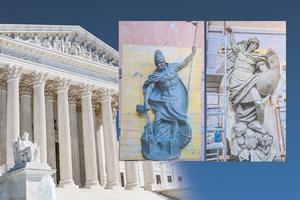
The ACLU wants to stop a Massachusetts city from installing 10-foot-tall statues of the patron saints of police officers and firefighters on a new public safety building. The nation’s highest court may have to resolve the dispute.
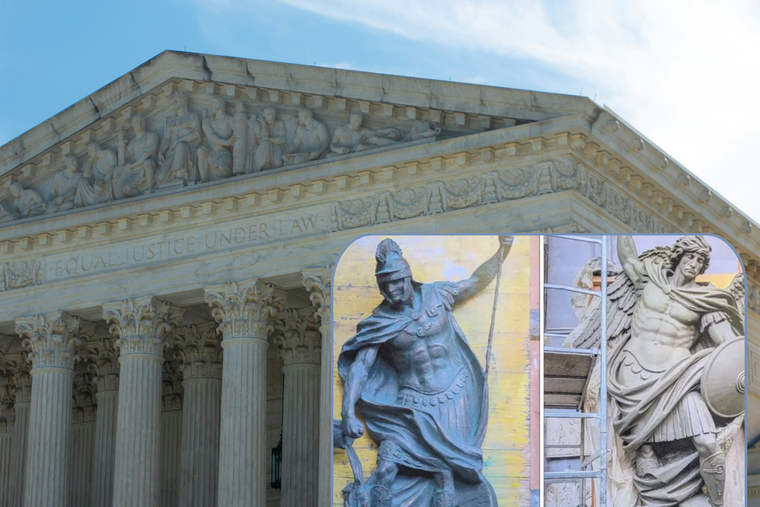
A court case in Massachusetts over whether a city government can install statues of two Catholic saints on its new public safety building with potential to reach the U.S. Supreme Court may help determine whether religious art has a continuing place in the public square, a lawyer representing the city said.
Joseph Davis, senior counsel for Becket, told the Register that if the American Civil Liberties Union of Massachusetts succeeds in preventing statues of St. Michael the Archangel and St. Florian — the patron saints of police officers and firefighters, respectively — from adorning the façade of the building in Quincy, a city of about 100,000 just south of Boston, he expects legal challenges to existing art with a religious theme on public property in other places.
“Massachusetts, like the rest of the country, is really chockful of religious images in public places, and this shouldn’t be a surprise, because religion is part of our culture,” Davis told the Register.
“It is kind of an iconoclastic endeavor — taking away this beautiful public art meant to uplift everybody who uses the public safety building,” said Davis.
Not so, says Jessie Rossman, legal director at the ACLU of Massachusetts, whose brief to the state’s highest court emphasizes the newness of the statues and their specifically Catholic connection.
Rossman told the Register that the Quincy residents challenging the statues are asking the state’s highest court to follow the state Constitution and its own precedent.
“Doing so will not lead to wholesale eradication of public artwork throughout the Commonwealth. To the contrary, the case law makes clear that when it comes to religious iconography, context matters,” Rossman said by email through a spokesman.
“Here, the context involves permanently affixing two large statues of Christian saints as the sole and prominent adornments at the entrance of a public building that is designed to provide basic, essential services to all residents, regardless of their religious beliefs,” Rossman said.
Both lawyers plan to speak during oral arguments before the Massachusetts Supreme Judicial Court set for May 6.
Catholic, but Not Just Catholic?
Quincy’s $175-million, 122,000-square-foot, four-story public safety building became fully operational in mid-March 2026, but without the two 10-foot bronze statues that Quincy Mayor Thomas Koch quietly added to the plans sometime after the city council approved the project a few years ago, at a projected cost of about $850,000. The statues are supposed to go about halfway up one side of the exterior of the structure, according to an artist’s rendering in a court filing.
In May 2025, after the news of the statues leaked to a local newspaper, 17 residents of the city sued in state superior court, claiming the presence of the statues would violate the Massachusetts Constitution, which guarantees equal protection of religions but also bans “subordination of any one sect or denomination to another.”
“The statues make me feel like I don’t count because I am not a Catholic,” one of the plaintiffs said, according to court papers.
In October 2025 a judge sided with the plaintiffs, granting a temporary injunction preventing the city from installing the statues — which, Davis told the Register, are sitting in a warehouse outside Boston while the case continues. The state Supreme Judicial Court agreed to hear the case in January.
In the Catholic Church, St. Michael the Archangel is the patron saint of police officers, while St. Florian (250-c. 304) is the patron saint of firefighters.
Koch, a practicing Catholic, has said he did not pick St. Michael and St. Florian to promote religion but instead to “honor, inspire, and encourage our First Responders,” according to court papers.
The ACLU of Massachusetts challenges his claim.
“The statues, whose imagery is drawn directly from Catholic iconography, lack a predominantly secular purpose. The primary effect of permanently installing two new, oversized, overtly religious statues as the sole adornments on the City’s public safety building is to advance religion,” the ACLU of Massachusetts’ brief states.
But Michael isn’t just a Catholic figure, the city’s brief points out — he is also honored by Anglicans and Lutherans, among other Christians, and he appears in both Hebrew Scriptures (Daniel 10:13, 21) and the Quran.
Organizations representing police officers and firefighters have submitted friend-of-the-court briefs arguing for installing the statues.
“First responders of all stripes, religious creeds, and political affiliations — and not just Catholics or Christians — cherish both saints for their symbolic importance to the profession,” states a brief for the National Fraternal Order of Police and Massachusetts Fraternal Order of Police.
It’s one of 12 so-called amicus briefs supporting the city that the state’s highest court has received in the case, versus two supporting the residents challenging the statues.
‘Lemon Test’ in Question
The ACLU of Massachusetts’ lawsuit is based on the state Constitution and state court precedents, not the U.S. Constitution or federal court precedents. But past federal cases involving government and religion loom large because they have played a role in past Massachusetts justices’ thinking.
Many of the arguments in the Quincy statues case center on one Massachusetts Supreme Judicial Court case, Colo v. Treasurer (1979), which was brought by a gadfly state representative who often clashed with legislative leaders — H. Thomas Colo (1929-2017) himself a Catholic — over the part-time salaries the state paid to two Catholic priests, one as chaplain to the state House of Representatives and the other as chaplain to the state Senate. Colo and his fellow plaintiffs claimed the payments violated the federal Constitution’s prohibition of the establishment of religion and the state Constitution’s prohibition of favoring one religious sect over another.
The state’s highest court disagreed, finding that the chaplaincies didn’t seem to be closed to clerics of other faiths and that neither constitution requires total separation of church and state.
Along the way, the state Supreme Judicial Court invoked the federal so-called Lemon test, which derives from a 1971 U.S. Supreme Court case called Lemon v. Kurtzman, in which the U.S. Supreme Court set forth three standards for judging if a law that affects religion passes constitutional muster. They are: whether it has a “secular legislative purpose”; whether the primary effect “neither advances nor inhibits religion”; and whether it fosters “an excessive government entanglement with religion.” To that, the Massachusetts court added a fourth standard, derived from another U.S. Supreme Court case: whether a law has “divisive political potential.”
Yet the state’s highest court also called these four criteria “not mechanistic ‘tests’” but instead “guidelines to analysis.”
That leaves the lawyers for each side arguing over how and whether past federal court precedents should affect this state case, with both sides claiming Colo cuts their way.
Adding to the complexity: The U.S. Supreme Court formally abandoned the Lemon test in June 2022 (in a case called Kennedy v. Bremerton School District), calling it “ahistorical” and “atextual.”
But the ACLU of Massachusetts argues that there’s no need for the state’s highest court to ditch Lemon.
“That the [federal] Supreme Court has now abandoned Lemon does not compel this Court to do the same,” the ACLU brief states.
But that’s exactly what several friend-of-the-court briefs supporting the city’s side are urging the Massachusetts Supreme Judicial Court to do, including a brief representing the Islam and Religious Freedom Action Team and the Jewish Coalition for Religious Liberty, which was filed by University of Massachusetts School of Law professor Dwight Duncan but largely authored by Stephen Edelblut, a third-year law student at Suffolk University Law School.
Duncan, when contacted by the Register shortly after the lawsuit was filed in May 2025, thought the Quincy residents challenging the statues were likely to prevail under state law. But he has since changed his mind. The Register asked why.
“Basically, because I think the attempt of the ACLU to limit this to state law is in fact futile. And so U.S. Supreme Court review is quite feasible/likely,” Duncan said. “The trend in the U.S. Supreme Court is to uphold public displays of religion because they don’t require anybody to do anything. They’re just an acknowledgment of the presence of religion in people’s lives.”
He likened challenging the legality of the St. Michael and St. Florian statues to trying to shout down a speaker in a public forum.
“If they had a statue of, like, Superman, or Hercules, I don’t think anybody would object to it,” Duncan said. “Why should some figure, because it’s also religious, be vetoed? It’s akin to the heckler’s veto under the First Amendment freedom of speech.”
On the other side, a friend-of-the-court brief from eight constitutional scholars who support the residents challenging the statues argues that the statues send a “message of religious favoritism” that violates the state Constitution by making Quincy’s public safety building “a place where Catholicism holds a privileged position.”
The ACLU’s Rossman told the Register she sees no attack on religion in trying to keep statues of saints off a public building, which she said “must be welcoming and accessible to all.”
"Let me be very clear: The relief the plaintiffs are seeking poses no conflict with federal law. Government neutrality toward religion is not hostility or discrimination — it is the exact opposite,” Rossman said.
The Quincy case may have legs. If the ACLU of Massachusetts wins, Davis said he expects similar challenges to public art with a religious theme because most states have a provision in their state constitutions prohibiting the establishment of religion.
He also said he sees potential federal issues that could interest the U.S. Supreme Court if the state’s highest court rules against the city.
“Yes, we expect to win at the state level. But there is a very important federal issue in the background here — that the ACLU wants to resurrect this old standard that was hostile to religion. Having lost the Lemon test at the federal level, now they want the states to be hostile to religion,” Davis said.
He added, “That would itself violate the federal Constitution, to the extent that you’re making state law hostile to religion.”