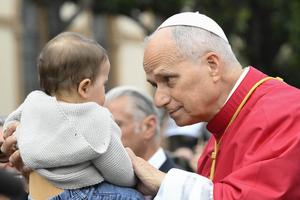
John Paul Calls University Students to 'Search Unceasingly for God'
VATICAN CITY — Whether one is a conventional university student or a student at the university of life's “hard knocks,” Pope John Paul II had profound words of encouragement and hope at his traditional annual papal Mass for students Dec. 11.
Opening with the words of the Prophet Isaiah, “Do not be afraid, I am coming to your aid,” the Holy Father reminded thousands of student pilgrims in St. Peter's Basilica that this promise of God came to its fullness in the birth of Jesus in Bethlehem.
“In him, God became one of us,” the Pope proclaimed. “This is why we must not be afraid. The time of Advent that we are living exhorts us to hope.”
Reading his entire homily, John Paul encouraged students during their time at university to “search unceasingly for God” and not to “keep a distance through doubts and difficulties.
He again recalled Isaiah, quoting the verse, “I shall turn the dry ground into springs of water.” This is the “great promise of God to the poor,” the Pope said, because “they have a strong thirst for truth, justice and peace, present in all mankind.”
The Pope added: “God, as the Prophet Isaiah assures us, holds you with his right hand — he is beside you. Through his comforting accompaniment, he will give you all you need to fulfill your mission through university.”
John Paul then turned his attention to Europe.
The Holy Father has been resolutely campaigning for Europe to return to its Christian roots, and the Mass was celebrated on the eve of a pivotal intergovernmental conference in which European politicians were to discuss the inclusion of references to God in the new European Constitution.
The Pope emphasized the contribution the “university world” could play in the process of European integration.
He said although social, political and economic structures were important in maintaining the unity of Europe, he stressed that the “humanistic and spiritual aspects must absolutely not be neglected.”
It is “indispensable that Europe today safeguards its patrimony of values,” he continued, and that it recognizes “above all that Christianity is able to promote, conciliate and consolidate them.”
He said Christmas underlines these Christian values because with the birth of Jesus in the “simplicity and poverty of Bethlehem, God has given the dignity of existence to each human being — he has offered all the possibility of participating in the divine life. This immeasurable gift can always find hearts that are ready to receive it.”
The Holy Father ended his homily by invoking the maternal intercession of Mary.
“It is her who protects every one of you, your families and academic community to which you belong,” he said. He closed by wishing all a happy Advent and Christmas.
Speaking after the Mass, graduate student Bill English from Washington, D.C., said the Pope is drawing “much needed” attention to learning and the “goodness of the intellect” at a time when universities are undergoing an “intellectual crisis” and when the “intellectual base of universities is empty.”
English, who is currently studying Christian ethics at Oxford University, was particularly heartened by the Pope's words of encouragement.
“I think it's fantastic that he encouraged us not to be afraid,” he said. “It is difficult to be a Catholic on campus these days, but by the Pope saying it's nothing to be ashamed of is a great source of strength.”
Politics student Joseph Nawrocki, also studying at Oxford, agreed.
“There is a lot of hostility to the Catholic faith in universities these days,” he said. “But I’ve realized that coming from a Catholic university to Oxford how much of an integral part my chaplain played in the part of formation, which gives me the courage to speak out.”
On the subject of Europe, English noted, “The truth of Christ is the same truth that universities were founded to seek.” The unity of Europe, he added, should depend on “the universities that were the most unifying institutions in Europe.”
Both students had been attending a four-day conference on the mobility of European students, which examined how universities through Catholic chaplains and students could tackle the New Evangelization in the new Europe.
The Holy Father managed to reach out to non-practicing Catholics, too.
“I don’t actually believe in God,” said Catholic-raised Rome student Nicole Goodie from New Hampshire. “But after going to Mass this evening, I'm going to start rethinking my whole religion.”
Father John Keenan, chaplain at the University of Glasgow, was particularly encouraged.
“The Pope could have said so many things, but to say ‘don’t be afraid’ and to recount Christ becoming man, so rooted in the truth, gave it a double consolation,” he said.
“It was lovely to have said it at Advent,” Father Keenan added. “It was inspiring, uplifting and gave me a lot of hope.”
Edward Pentin writes from Rome.
- Keywords:
- Vatican
- Dec. 21, 2003-Jan. 3, 2004

Edward Pentin Edward Pentin is the Register’s Senior Contributor and EWTN News Vatican Analyst. He began reporting on the Pope and the Vatican with Vatican Radio before moving on to become the Rome correspondent for EWTN's National Catholic Register. He has also reported on the Holy See and the Catholic Church for a number of other publications including Newsweek, Newsmax, Zenit, The Catholic Herald, and The Holy Land Review, a Franciscan publication specializing in the Church and the Middle East. Edward is the author of The Next Pope: The Leading Cardinal Candidates (Sophia Institute Press, 2020) and The Rigging of a Vatican Synod? An Investigation into Alleged Manipulation at the Extraordinary Synod on the Family (Ignatius Press, 2015). Follow him on Twitter at @edwardpentin.