New York’s Catholic Governor Hasn’t Said If She’ll Sign Assisted Suicide Into Law
The Democratic-controlled state Legislature passed the bill on June 9, but Catholic leaders and other opponents of the measure believe it’s still possible to persuade Democratic Gov. Kathy Hochul to veto it.

Catholic leaders in New York lamented the state Legislature’s passage of an assisted-suicide bill on June 9, with one describing it as a “dark day” for the Empire State.
But those same leaders stress that there is still a glimmer of hope: Gov. Kathy Hochul, who is Catholic, hasn’t publicly disclosed her position on the bill.
Hochul is a Democrat and a social liberal, but assisted suicide — or, as supporters prefer to call it, medical aid in dying — doesn’t always cut along political lines.
An example is a video created by the New York State Catholic Conference that shows five state legislators speaking against the bill from the floor earlier this spring. All are Democrats, all are from racial minorities (either African American or Haitian), all support legal and publicly funded abortion — the four who were in the Legislature in January 2019, for instance, voted for the New York Reproductive Health Act, which removed several of the state’s previous modest restrictions on abortion.
But the five members of the New York State Assembly — the majority leader, Crystal Peoples-Stokes, D-Buffalo; the deputy majority leader, Michaelle Solages, D-Elmont; Rodneyse Bichotte Hermelyn, D-Brooklyn; Latrice Walker, D-Brooklyn; and Nikki Lucas, D-Brooklyn — were among 21 Democrats in April who voted against the assisted-suicide bill. (As did all Republicans; the bill passed 81-67 in the Democrat-dominated Assembly, which is the state Legislature’s lower chamber. It passed the New York State Senate, 35-27, on June 9.)
Their opposition doesn’t shock Matt Vallière, executive director of Patients’ Rights Action Fund, which opposes legalizing assisted suicide.
“Across the country, we’ve seen it time and time again: This issue just doesn’t cut down the usual political, social or worldview lines,” Vallière told the Register.
Social Justice?
Supporters of assisted suicide say that people with painful terminal illnesses deserve to choose when they die and to have medical experts help them end their lives.
“I like to think about it as, it’s not so much about ending a person’s life, but shortening their deaths, because they have been granted — given — that terminal prognosis,” said one of the New York bill’s sponsors, state Sen. Brad Hoylman-Sigal, D-WFP Manhattan, during floor debate June 9.
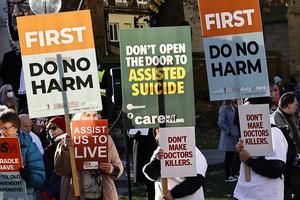
Some opponents say suicide is immoral. Some also say that legalizing assisted suicide is dangerous for society because it makes vulnerable people a potential target for pressure to end their lives before natural death occurs.
Social conservatives who oppose assisted suicide, including many Republicans, tend to use right-to-life language. Social liberals who oppose it, including many Democrats, tend to use social-justice language. But they end up at the same place.
The five Black female legislators who spoke out against the bill in April said they see it harming their communities.
“I am voting No today because we do live in a place where our health care system is a business. It’s not about a right. It’s about if you have money,” Solages said before the floor vote April 29. “And access to care, including palliative care and hospice care, is deeply unequal. In a system where people are routinely denied treatment because of their income or insurance or even their zip code, how can we in confidence say that we are supporting this?”
Bichotte Hermelyn said that while she supports what she called “the choice of being able to end one’s own suffering early,” she opposes the bill out of what she called “the great risk of targeting vulnerable communities of color, given the historical health disparities that they continue to face.”
“Although this bill is rooted in empathy, it raises real concerns for communities that already struggled to receive fair treatment, and for this reason, in good faith, I cannot support this legislation without worrying about how this will affect our most vulnerable populations,” Bichotte Hermelyn said.
Lucas called herself “proudly pro-choice.”
“But choice, real choice, must be meaningful. It must be grounded not in desperation, not in despair, not in the lack of options, but in hope and dignity and support,” Lucas said. “And I ask, how can we call this choice when so many of our communities, communities like my own, have been denied the very things that would make a different choice possible?”
“In New York today,” she continued, “in the very neighborhoods I represent, end-of-life care is not equally accessible. Palliative care is patchy. Hospice is too often unaffordable or culturally inaccessible. Pain management, mental health support, home care — these are luxuries, not guarantees. If you are Black, Hispanic, low-income, the likelihood is higher that you will experience your last days not with comfort, but with suffering, fear and isolation. It is these structural inequalities that concern me because when a system has failed to provide quality of life, it cannot suddenly be trusted to manage death.”
Jessica Rodgers, coalitions director of Patients’ Rights Action Fund, which sees assisted suicide as a threat to people with disabilities, told the Register some progressive legislators see it as a threat to their constituents.
“Communities of color have experienced disparities within the health care system. Legislators that represent these historically marginalized communities understand the unique dangers that assisted suicide brings,” Rodgers said.
Catholic Bishops Against Bill
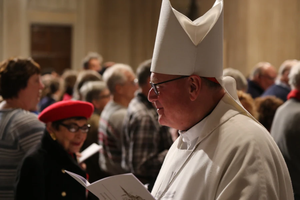
New York’s Catholic bishops oppose the assisted-suicide bill, which goes against the Church’s teachings on human life.
“Suicide contradicts the natural inclination of the human being to preserve and perpetuate his life. It is gravely contrary to the just love of self. It likewise offends love of neighbor because it unjustly breaks the ties of solidarity with family, nation, and other human societies to which we continue to have obligations. Suicide is contrary to love for the living God,” the Catechism of the Catholic Church states (2281).
Bishop Salvatore Matano of the Diocese of Rochester, New York, urged Gov. Hochul to veto the assisted-suicide bill in a letter earlier this week.
“When we subjectively determine when life begins and ends, when it is viable or not, or when it is too burdensome to endure, we begin a path toward self-destruction. Life is no longer precious, but just another commodity in the business of living,” Bishop Matano wrote. “Relativism becomes the absolute, and even the value of life itself is questioned.”
Surprising Silence
Assisted suicide is explicitly legal in nine states because of a statute passed by a state legislature or in a statewide referendum — Oregon (1997), Washington (2008), Vermont (2013), California (2016), Colorado (2016), Hawaii (2019), Maine (2019), New Jersey (2019) and New Mexico (2021). Delaware enacted a statute legalizing assisted suicide in May 2025, though it hasn’t yet taken effect.
Assisted suicide is also allowed in Montana because the state Supreme Court there ruled in 2009 that no state law prohibits it.
In addition, the District of Columbia legalized assisted suicide in 2017, after the D.C. City Council passed a measure, the mayor signed it, and Congress declined to block it.
New York would become the 12th state to legalize assisted suicide if Hochul signs the bill.
Hochul’s predecessor as governor of New York, Andrew Cuomo, a fellow Democrat, said in April 2019 that he would sign a bill legalizing assisted suicide if it landed on his desk, which never happened while he was in office.
So Hochul’s silence on the issue is striking.
Nor is it clear when she might make a decision.
While both chambers of the state Legislature have approved the bill, it hasn’t yet been sent to the governor, which means the clock hasn’t started ticking for her decision on it.
Dennis Poust, executive director of the New York State Catholic Conference, which represents the state’s diocesan bishops on public policy matters, told the Register that legislative leaders and the governor’s office often work together on timing, which means that Hochul could ask the Legislature to send her the bill sometime this summer or even after Thanksgiving.
“It does buy her some time to make an informed decision,” Poust said. “It’s very possible that this is a decision she didn’t want to make. She may just take her time.”
State legislative committees did not hold public hearings on the bill after it was filed earlier this year. Poust told the Register that’s standard practice in New York, irrespective of which party controls the Legislature.
Lack of recent public input — Compassion & Choices, which supports assisted suicide, has on its website testimony from a New York legislative hearing seven years ago, in June 2018, and nothing more recent — is one of the arguments opponents of the bill put forward for killing it.
“It’s horrible government. The people do not get a voice. The members who took the vote deserve to hear from both sides,” Poust said by telephone. “And it’s another point that we’ll be making to the governor — the Legislature acted without getting input from experts.”
“It’s very difficult for legislators to take an informed, educated vote when they don’t hear from stakeholders, and that’s exactly what happened in this case,” Poust said.
Hochul has taken several steps to try to prevent suicide since she became governor of New York in August 2021.
In July 2022, her administration announced it had implemented a special 988 hotline number to connect callers statewide to the National Suicide Prevention Lifeline. In September 2024, she signed a bill requiring that college IDs have contact information for the same suicide-prevention number and started a $5-million campaign to raise awareness of 988.
“No New Yorker should suffer alone with crushing thoughts of suicide, especially when help can be one phone call away,” Hochul said, according to a press release from her administration published that month.
Poust, who leads the New York State Catholic Conference, told the Register that his organization is stumping for greater access to pain management for end-of-life patients, as opposed to ending their lives through assisted suicide.
That’s a problem in New York, particularly among poor people. He noted that an April 2022 study reported that New York was last among the 50 states in the proportion of Medicare patients who received hospice services before death — while assisted suicide is on the rise in Canada, where assisted suicide accounted for 4.7% of all deaths in 2023, and elsewhere.
Poust said, “So I think we’re in a very dangerous place; minority legislators get that, and I think that will resonate very much with Gov. Hochul.”
- Keywords:
- assisted suicide
- gov. kathy hochul
- new york