God’s Infinite Love for a Tiny Embryo
What do we see in a human embryo who is tinier than a snowflake in his or her first days of life?
In that minuscule body we may “see and almost touch the hand of God,” Pope Benedict XVI said Feb. 27 to the participants in an international congress on “The Human Embryo Before Implantation.”
“Man was given a very high dignity, which has its roots in the profound bond that unites him with his Creator,” the Pope remarked. “In man, in every man, in any phase or condition of his life, shines a reflection of the very reality of God.”
The colorful frescoes of the
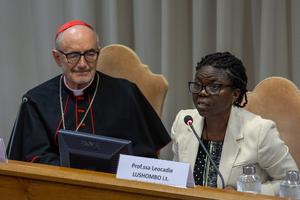
I had the privilege of participating in the Feb.
27-28 congress organized by the
How does conception come about? What happens in the first 200 hours of an embryo’s life before he or she is implanted in the mother’s womb, which protects and nourishes him or her during the following nine months? How reliable is prenatal diagnosis?
Scientists and experts presented their latest
findings on these topics in the
We enjoyed a family atmosphere. It was easy to make friends with men and women who are fully committed to the spread of what John Paul II called “the gospel of life.”
“I am glad to express my appreciation and gratitude
to the
In his first encyclical, Deus Caritas Est (God Is Love), Benedict recently reminded us that the Church is, by her very nature, committed to diakonia (the ministry of charity).” And what better diakonia can we have than protecting the life and integrity of the unborn, whom Mother Teresa called the “most defenseless of the defenseless”?
In their slide-show presentations, scientists showed us impressive pictures of a minuscule rounded body in its first hours after conception. How small and fragile that body is! Yet it has an infinite value. The reason?
“The love of God does not make distinctions between the newly conceived infant still in his or her mother’s womb, the baby, the youth, the grown adult or the elderly, because in each of them he sees the sign of his own image and likeness,” the Holy Father said. “This boundless and almost incomprehensible love of God for man shows to what degree the human person is worthy of being loved for himself, regardless of any other consideration — intelligence, beauty, health, youth, integrity and so forth.”
Unborn Jesus
We understand this truth better in light of the mystery of the Incarnation. God himself became once a zygote, a morula, a blastocyst — a tiny embryo before his implantation in Mary’s womb.
The brochure of the congress displayed the picture of an Eastern icon, showing Our Lady and St. Elizabeth embracing each other. Transparent in their wombs, a small Jesus — in the shape of a well-formed fetus — blesses a small John the Baptist, who is bowing to him.
When Mary visited her cousin,
Jesus had been conceived only a few days earlier. “
The Gospel passage of the Visitation, Benedict noted, “gives witness to the hidden but active presence of two babies.”
It doesn’t matter that a human person is tinier than a snowflake at the beginning of life. He or she is infinitely loved by God.
In the end, he or she is as tiny as their Creator was when he became a human being for our redemption.
Legionary Father Alfonso Aguilar
teaches philosophy at
- Keywords:
- March 12-18, 2006