What’s Special About the Most ‘Fruitful’ US Dioceses? ‘It’s the People.’
The sees of Nashville and Tulsa are among those that are flourishing — in cities where Catholics are a distinct minority.

The Register’s ongoing “Catholic Hubs” series has sought to highlight places where Catholicism seems to be on the upswing, rather than on the decline — places where efforts to promote and live out the Catholic faith really seem to be working. But it’s difficult to describe such places without recourse to buzzwords, like “vibrant,” “thriving” or “flourishing.”
Whatever the adjective, it’s clear that the Dioceses of Nashville and Tulsa are among those Catholic places worth highlighting. In an analysis published last year in Catholic World Report (CWR), Nashville and Tulsa tied for first place among the nation’s most “fruitful” dioceses.
The CWR analysis examined every U.S. diocese to determine which ones have the most seminarians, infant baptisms, Catholic weddings, and adult Catholic converts relative to the existing Catholic population. Weighing all of these factors together produced a unified “fruitfulness” score for each diocese — with “fruitful” defined as places with a “bright future” when it comes to Catholicism, in contrast with the barren fig tree in Christ’s parable (Luke 13:6-9).
Notably, Nashville turned out to have the most infant baptisms per capita of any diocese, while Tulsa had the second-most baptisms and the second-most weddings of any diocese.
For Hayley Shovlin, a Nashville native, the flourishing of her home diocese into a place that is “fruitful” has been a joy to witness. Everything about the Catholic community in Music City, she said, is geared toward getting its people to heaven.
“There are amazing people trying to be saints everywhere, at all the parishes,” Shovlin, 34, told the Register.
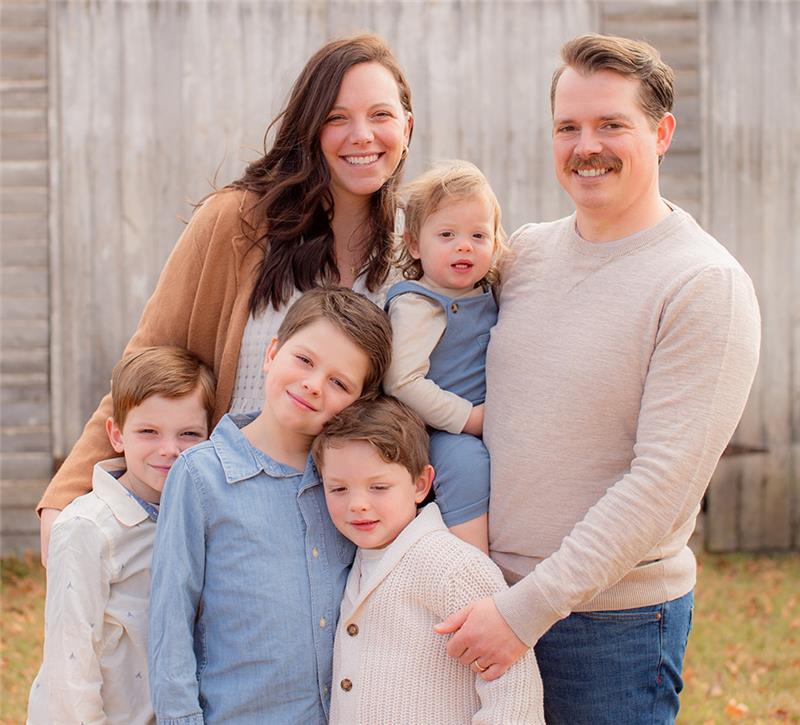
Hayley, her husband Barry, 37, and their four sons attend Sunday Mass at Nashville’s St. Mary of the Seven Sorrows, a historic parish downtown that offers a more traditional liturgy. They often go for confession, adoration and daily Mass at St. Ann parish, which is closer to their home.
Even in a city where Catholics only make up a single-digit proportion of the populace — it’s been quipped that Nashville has “more Baptists than people” — the Catholic community feels alive and energetic to the Shovlins. Catholics in Nashville are generally active and engaged and eager to start or join parish initiatives. There are many young priests — in fact, one of Hayley’s brothers is a deacon soon to be ordained to the priesthood — and all the clergy the Shovlins know are deeply invested in serving their people’s spiritual needs, she said.
“There’s no excuse to not get to Mass, confession, adoration — it’s everywhere, and it’s daily. It’s all over town. Jesus is in so many tabernacles here. He’s on so many altars multiple times a day. There are so many opportunities for the sacraments, which is obviously the heartbeat of our Church,” she said.
What Makes a ‘Fruitful’ Diocese?
Tulsa, the other “top” diocese according to the CWR analysis, is not experiencing rapid population expansion like in Nashville. With just 61,000 Catholics, Bishop David Konderla said the primary engine of growth in Tulsa is a deliberate and active culture of invitation at the parish level, which has produced a surge of converts through the Order of Christian Initiation of Adults (OCIA) process.
Perhaps the most compelling attribute that the two cities share is the fact that, in both dioceses, Catholics are a distinct minority. In Tulsa, only about 7% of the population is Catholic; in the Diocese of Nashville, it’s closer to 4.5%.
“When there are so few Catholics around, you really do more identify with the ones that there are,” Bishop Konderla said. “The Catholic population has a lot of strength for how small it is.”
In fact, almost all of the dioceses in CWR’s top 10 are small: the Dioceses of Wichita, Kansas; Savannah, Georgia; Knoxville, Tennessee; Birmingham, Alabama; Grand Island, Nebraska; and Salina, Kansas; the Archdiocese of Indianapolis; and the Diocese of Memphis, Tennessee.
In contrast, larger dioceses with millions of Catholics, such as Los Angeles (No. 124), New York (No. 168), Chicago (No. 135) and Dallas (No. 150) tended to fare worse in terms of fruitfulness.
Growth and Opportunities
Nashville Bishop J. Mark Spalding, speaking to the Register, noted that his is a diocese experiencing rapid, large-scale growth — about 1.5% on average per year for the Nashville metro, while the national average is well under 1% — primarily driven by large numbers of people moving into Middle Tennessee. People are primarily moving to the area for economic opportunities, he said, but also because the region is perceived as family-friendly and value-oriented, creating the soil for a vibrant and dynamic Catholic culture to spring up.
Despite the obvious positives, the rapid influx of Catholics has created urgent infrastructure needs, including the need to build more parishes — but high property prices, a symptom of the region’s economic boom, present major hurdles. Despite the uncertainty, Bishop Spalding is hopeful.
“When God gives you challenges, he’s going to give you even more blessings to deal with those challenges,” he said.
Bearing Much Fruit
The Diocese of Nashville benefits from “a good crop of priests,” Bishop Spalding told the Register, as well as the presence of the Dominican Sisters of St. Cecilia, better known as the “Nashville Dominicans,” a teaching order of Catholic religious sisters founded in 1860 which is now present in dozens of schools nationwide.
Father Luke Wilgenbusch, ordained in 2019 and serving as vocations director for the Nashville Diocese, told the Register that many of the current seminarians, like the population at large, are transplants. The diocese is seeing many vocation inquiries from young adults, and a major goal is to foster more interest among high-school-aged men.
“We’re blessed to not be in situations where we’re closing and consolidating parishes, but we are building parishes and expanding,” the priest said.
“People want a Church structure that they can relate to in a personal way, but they also want it to be competent and professional,” he added. “I think we strike that balance really well in Nashville.”
Southern (and Midwestern) Hospitality
The importance of a warm, family-oriented wider culture in fostering a fruitful Catholic community is demonstrated among the dioceses in the CWR’s top 10, many of which are in the South. And this cultural factor likely extends into places like the Midwest — for example, the lone archdiocese in the top 10, Indianapolis.
Indianapolis’ Catholic population, at 204,000, isn’t that large, but at a population proportion of around 12%, it’s higher than some of the other fruitful dioceses. It has benefitted in the past decade and a half from numerous major Catholic conferences taking place at its downtown convention center, including the 2019 SEEK Conference, 2024’s National Eucharistic Congress, and the 2025 National Catholic Youth Conference.
Indianapolis Archbishop Charles Thompson, speaking with the Register, said he has found that even among non-Catholics in Indiana’s capital — who he interacts with frequently through interfaith initiatives — Catholicism is widely “recognized and appreciated.”
“I preach that we have to be Christ-centered,” he said. “If we’re Christ-centered … everything else will fall in place. It doesn’t mean it always will be easy. But it will all fall into place.”
‘People Here Are Trying’
For Shovlin, the community her family enjoys in Nashville, buoyed by the sacraments, is the perfect environment in which to raise her sons. And when it comes down to it, the biggest positive factor for Shovlin is the people — both lay and clerical.
“People here are trying. We try to support our priests; we try to support our families. There’s a lot of mercy from everybody, which I think is great; and there’s not a lot of judgment,” Shovlin said.
“No one here in Nashville is perfect. But people are trying really hard to do what they can to help our whole community get to heaven.”
Shannon Mullen contributed to this story.
- Keywords:
- u.s. catholics
- u.s. dioceses