America at 250: 5 Stories of Catholics Resisting Anti-Catholicism in America
Stories of Catholics encountering opposition to their religion, compiled during this semiquincentennial anniversary of the Declaration of Independence.
During the morning of Monday, March 14, 1859, an educator at the Eliot School in the North End of Boston beat a 10-year-old boy with a stick.
In an age of corporal punishment, such discipline was not unusual. But the reason was.
Thomas Whall, a Catholic who had been born in Ireland, had refused to recite the Protestant King James Version of the Ten Commandments after being told not to do so by a priest and by his father.
But the school said he had to. And Thomas wouldn’t.
So an assistant to the principal, McLaurin Cooke, got out a three-foot-long rattan stick, three-eighths of an inch thick, and started whipping Thomas’ hands with it, over the course of a half-hour.
“The blows were not given in quick succession, but with deliberation,” a judge who heard the case later wrote.
Thomas Whall is one of many Catholics in the history of America who suffered for their religion and resisted what they considered attacks on it, helping carve out a place for Catholics in American society and expanding Americans’ conception of religious freedom.
Just as the routes of the recent and forthcoming National Eucharistic Processions (2024, 2025 and 2026) highlight people and events in American Catholic history, including many unknown to most American Catholics, this story focuses on five examples of Catholics encountering opposition to their religion, compiled during this semiquincentennial (the longest of the various ways of saying “250th”) anniversary of the Declaration of Independence.
His Own Choice
Reciting the Ten Commandments was a regular practice in the Boston common schools, as the public schools were known at the time, at the direction of an 1855 state law that required “the daily reading of a portion of the Bible, in the common English version” — meaning the Protestant version — and a directive from the Boston School Committee “that the pupils learn the Ten Commandments, and repeat them once a week.”
The substance of the two versions was the same, but the Protestant version differed from the Catholic version in numbering and emphasis, and a priest at St. Mary’s in the North End, addressing boys of the parish during religious education, “told them not to be cowards to their religion, and not to repeat the Commandments in school, that if they did he would read their names from the altar,” according to one later account.
Some sources say Thomas’ fellow Irish Catholic schoolmates cheered him on as he was getting whipped.
Then, in an I-am-Spartacus moment, 60 boys of the school said they, too, wouldn’t read the Protestant version of the Ten Commandments and were told to leave the school. The next day, 300 boys left, according to Notre Dame historian John McGreevy’s 2003 book Catholicism and American Freedom: A History.
Thomas Whall became a folk hero, receiving plaudits and awards from Catholics all over the country.
But when his father filed a criminal complaint for assault and battery against the educator who had administered the beating, the judge took a different view.
Sebeus Maine — who before becoming a Boston Police Court judge had been elected to the Massachusetts Senate in 1854 during the (anti-Catholic) Know Nothing Party tidal wave that claimed nearly every seat in the state Legislature (including his) — found that the beating over the course of 30 minutes “was neither excessive nor inflicted through malice” and that it was also Thomas Whall’s own fault, since he could have stopped it by simply complying.
“The extent of the punishment was left as it were to his own choice. From the first blow that fell upon his hands from the master’s rattan, to the last that was given, it was in his power to make every one the last,” the judge wrote.
He also found that the assistant to the principal was simply enforcing a reasonable and constitutional rule that was nonsectarian in nature and that Thomas was punished not for his religion but for “insubordination.”
“The idea that the judge would side with someone who was beating a kid who didn’t want to recite the King James Bible is just amazing,” Karen Park, a Catholic historian and author of the Ex Voto newsletter, told the Register.
The incident led to the quick formation of a Catholic school for boys at St. Mary’s, which, according to McGreevy’s book, within a year had 1,150 students.
The founding parish priest, writes McGreevy, “enjoyed marching them two by two from the school to the church on religious holidays, in full view of startled non-Catholic spectators.”
No Non-Protestants Need Apply
Several states at least theoretically banned Catholics from holding public office in their original state constitutions after independence in 1776, including New Jersey, South Carolina, Georgia, New Hampshire and Vermont. New York effectively banned Catholics through an anti-Catholic oath required of public office holders by state statute.
North Carolina, in its state Constitution of 1776, barred anyone “who shall deny … the truth of the Protestant religion” from “holding any office” in the state (Article XXXII). Yet the microscopic Catholic population in the state produced two prominent politicians in the early decades after independence.
One was Thomas Burke (c. 1747-1783), who was born in Ireland, the third governor after independence. The other was William Gaston (1778-1844), whose mother was a Catholic and who became the first student of what is now Georgetown University. Gaston served in the state Legislature, in the U.S. House of Representatives, and on the state’s Supreme Court.
Both men appear to have justified their public oaths to uphold the state Constitution by saying that they didn’t “deny” Protestantism, which requires what Gaston later called “some overt act of negation of its truth,” but merely disagreed with it. (The details are in an unsigned academic journal article called “Judge Gaston and the Constitution of North Carolina” in The American Catholic Historical Researches of July 1910.)
Even so, Gaston successfully argued during the state’s constitutional convention of 1835 for an amendment removing the appearance of a Protestant religious test.
Burning Down the Convent
Many Protestants in 19th-century America were fascinated and disturbed by the Catholic idea that some men and women are called to be celibate and concluded that nefarious things must necessarily be going on in convents.
“Catholicism is a sinister and even sexually perverted alternative to the wholesomeness of the Protestant nuclear family,” is how Park, co-editor of American Patroness: Marian Shrines and the Making of U.S. Catholicism (2024), summed up a common view among American Protestants of the time.
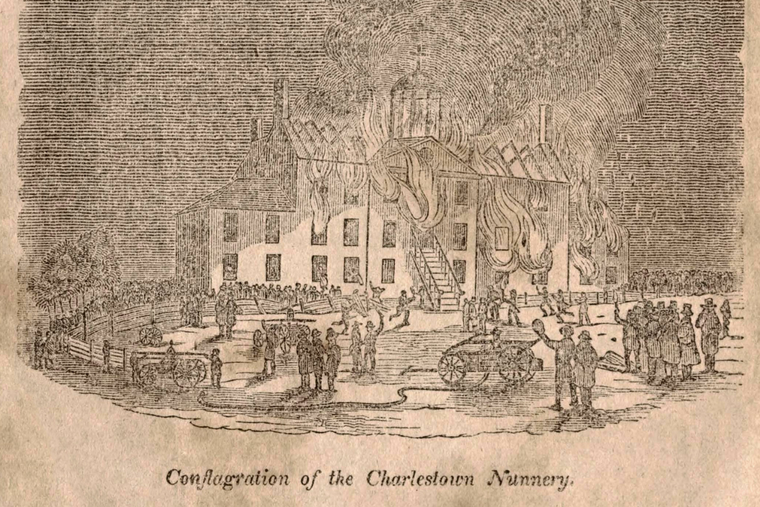
So when a Protestant young woman during the early 1830s joined and subsequently left an Ursuline convent in what was then Charlestown, Massachusetts, and wrote a book claiming mistreatment (denied by the nuns), the book found a ready audience. Privately circulated copies before the book was published may have helped inspire a mob to burn down the convent in August 1834, which they justified by trying to “rescue” another woman who was there of her own free will.
The mob sent the eight nuns and about 50 girls at their boarding school scurrying into the night, as they broke furniture and furnishings, broke into a mausoleum and desecrated the corpses of deceased nuns, burned down the buildings, and, one night later, found a tabernacle one of the nuns had hidden in a bush and desecrated consecrated Hosts, according to Nancy Lusignan Schultz’s book Fire & Roses: The Burning of the Charlestown Convent, 1834 (2000).
Firefighters called to the scene the first night did nothing to help the nuns. Neither did local public officials. The local militia did not show up.
At the trials that followed, witnesses who might have identified the arsonists received death threats. The judge refused the prosecutor’s request that the members of the all-Protestant jury be asked if a witness were “of the Catholic persuasion,” for it might “have the effect of lessening the weight of such witness’s testimony in his mind,” according to a report on the trials published shortly afterward.
All but one of the defendants were acquitted, and that one, a 17-year-old boy, had his sentence commuted by the governor. The state Legislature refused to compensate the nuns for their losses.
The Ursuline sisters didn’t return there, but the bishops of Boston kept the land and the ruins as a sort of memory site for about 40 years, before selling the property and, according to tradition, using some of the stones in the foundation to build the new (and current) Cathedral of the Holy Cross in the South End of Boston during the mid-1870s.
Anti-Catholic Investigation Blows Up
Two years later, in 1836, a young, emotionally disturbed woman in Philadelphia who claimed (apparently wrongly) to have spent time in a convent in Montreal told a story that became a popular book, Awful Disclosures of Maria Monk, or, The Hidden Secrets of a Nun’s Life in a Convent Exposed.
Although quickly debunked — “she just didn’t know enough about convents,” said Lehigh University historian Monica Najar, who has studied Monk’s life, according to an article on the university’s website — the book quickly found an audience. Some historians say it was the second bestselling book in America before the Civil War, behind Uncle Tom’s Cabin.
The book helped inspire anti-Catholic Know Nothings who dominated the Massachusetts Legislature in 1855 to form a special committee to investigate convents and Catholic schools, known as the Nunnery Committee.
Rather than fight, the nuns opened up their buildings to the state legislators and showed them around.
The first was Notre Dame Academy in Roxbury.
“Their perseverance notwithstanding, the Know-Nothing sleuths uncovered no hidden passageways, guns, ammunition, skulking lechers, or skeletons in the closets; but they did manage in their cellar-to-attic search to terrify the schoolchildren (one of whom shrieked, ‘The house is full of Know-Nothings!’), to flush a nun from her devotion in the chapel, and to determine that a youngster, confined to her bed, was, as the nuns assured them, a girl,” wrote historian John Mulkern in a 1982 article on the subject.
The committee found no scandals but managed to create one, when one of its members, during a fact-finding trip in Lowell that required an overnight stay in a hotel, charged to the state government room and board for a prostitute in the room next to his.
The Know Nothings went from dominating state government in the 1854 election to barely winning the 1855 election to getting wiped out in 1856. While there are several reasons for the party’s collapse, the nunneries’ investigation was a factor.
No Catholic Schools in Oregon — 1922
Voters in Oregon approved a state referendum in November 1922 that effectively banned Catholic schools.
The measure, which was supported by Freemason organizations and the Ku Klux Klan, required children between age 8 and 16 to attend public schools, with a handful of exceptions. Supporters said the law would promote “American ideals” by promoting “One Flag — One School — One Language.”
It passed, 50%-46%.
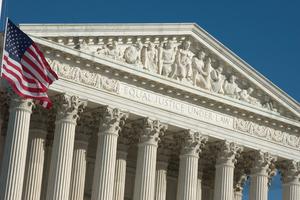
The law never took effect because the Society of Sisters of the Holy Names of Jesus and Mary, which ran Catholic schools in the state, sued in federal court, along with other nonpublic schools, and won an injunction that led to a landmark U.S. Supreme Court case overturning the law called Pierce v. Society of Sisters.
“The child is not the mere creature of the State; those who nurture him and direct his destiny have the right, coupled with the high duty, to recognize and prepare him for additional obligations,” the court said in its unanimous opinion.