Class of 2026: Catholic Commencements Offer a More Demanding Call
This year’s commencement addresses inspire new graduates to meet the needs of humanity with faith.
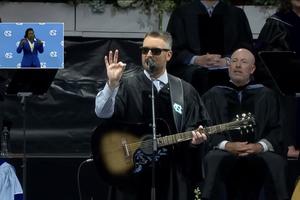
Every spring, commencement stages offer familiar promises: Follow your passion; change the world; believe in yourself. At Arizona State University, actor Harrison Ford told graduates that “passion brings you joy” but “purpose brings you meaning.” At the University of North Carolina, country singer Eric Church told graduates that “the difference between a life that sounds like music and a life that sounds like noise is whether you stop and listen.” These were uplifting messages of course, but on Catholic campuses this spring, the Class of 2026 heard something more demanding.
From a Florida campus where a governor invoked the Founders’ sacred fire of liberty to a Texas university where a cardinal prescribed gratitude as the only antidote to a culture of entitlement, the addresses delivered this season shared a common thread: that the Class of 2026 graduates not into a world of unlimited possibility, but into a world with urgent needs, and that meeting those needs begins with the courage to stand for what is true.
That conviction crossed denominational lines. At Hillsdale College in Michigan, not a Catholic institution but one with deep roots in the Western tradition, Erika Kirk, widow of the late Charlie Kirk, told graduates that life is not defined by the abundance of options but by the weight of the choices made within them and that Christ must be the axis around which all other priorities turn.
At the University of Mary and Franciscan University of Steubenville, Napa Institute founder Timothy Busch told graduates they were not receiving “a degree” but a “call to action.”
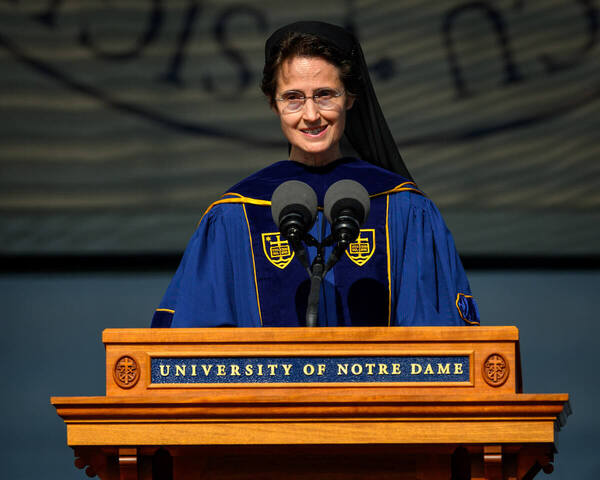
At the University of Notre Dame, Franciscan Sister Raffaella Petrini, president of the Pontifical Commission and Governorate of Vatican City State, called on the university’s 181st graduating class to become “leaders of hope”: “Do not be afraid of taking risks, because Christians must fully engage with life and the history of humanity.”
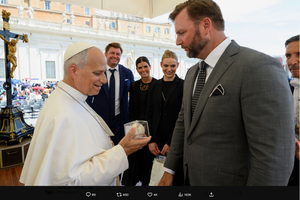
And even Pope Leo offered advice to his alma mater Villanova’s Class of 2026.
“You will have the challenge and the opportunity to make a big difference, if you carry with you those Augustinian values of veritas, unitas, caritas [truth, unity, charity],” Leo, of the Class of 1977, advised in a written message read at Villanova’s commencement on May 19.
What follows is a closer look at several of this year’s commencement speeches.
The Catholic University of America
Washington, D.C.
Msgr. James Patrick Shea, president of the University of Mary in North Dakota, returned to his alma mater on May 16 to address Catholic University’s Class of 2026 with a premise that was, by commencement standards, refreshingly unsentimental: that a great education does not solve what he called “the great mediocrity” of human life. In fact, it only makes you more aware of it.
There is only one answer, he said: “Stability. Whatever you want to call it — constancy, perseverance, endurance, steadfastness, fidelity. Stability within and without.”
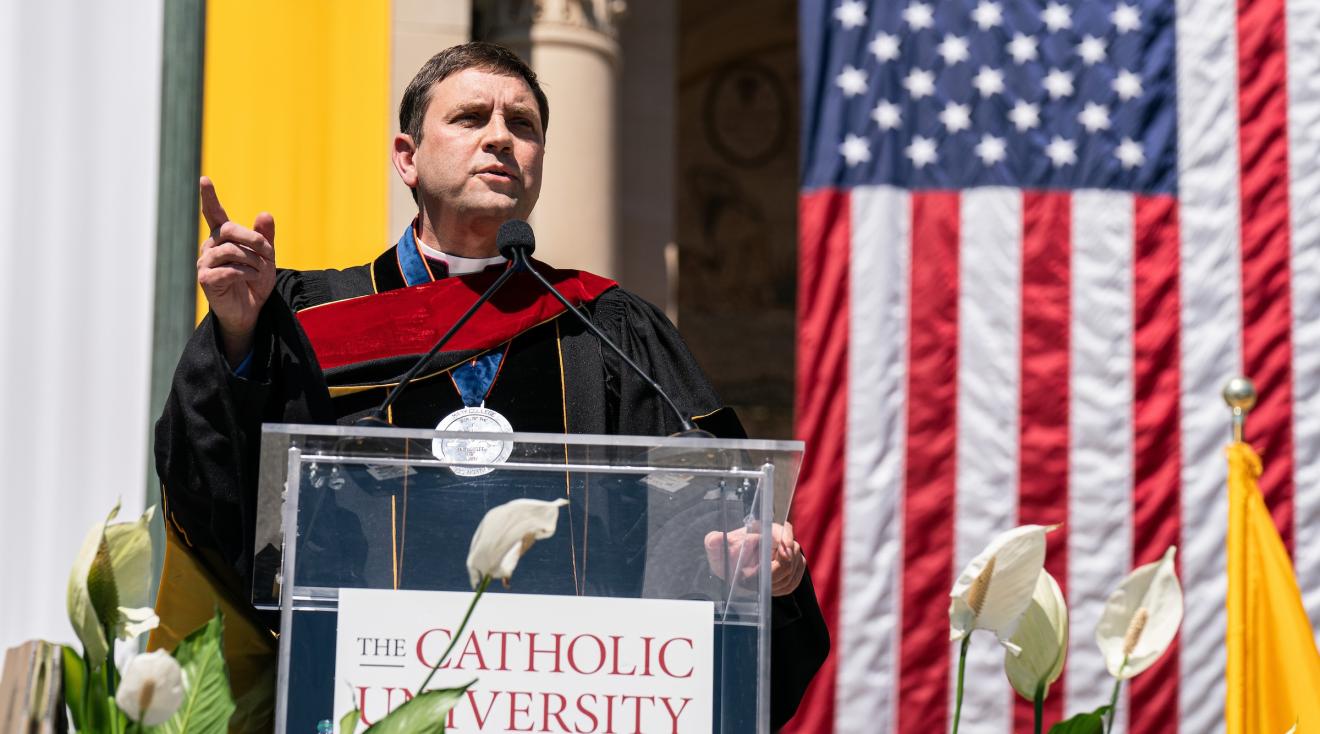
Msgr. Shea told graduates the main reason they were sitting in front of him that day was not brilliance. It was that they had not quit: “Education is endurance, and endurance contends with mediocrity.” He then closed with advice attributed to Mother Teresa: “Yesterday is gone. Tomorrow has not yet come. We have only today. So let us begin.”
Mariana Barillas, who graduated with a Master of Arts in historical and systematic theology, told the Register that Msgr. Shea perfectly captured her experience of Catholic University as “a community committed to forming both the head and the heart in service to the Church, the nation and the world.”
Charlie Hyland, also a member of the Class of 2026, said he was most struck by the reminder that nowhere in the New Testament is life with God described as an achievement. “It is an enduring and challenging, ever-evolving journey that we can always go deeper into,” Hyland told the Register. “It will take more effort to find a chapel and not to have daily Mass just a short walk away on campus, but Monsignor showed how that is the endurance that combats our human mediocrity and makes us great saints.”
Thomas Aquinas College
Santa Paula, California
Brian Burch, U.S. ambassador to the Holy See, addressed Thomas Aquinas College’s California campus graduates with a charge rooted in St. Augustine’s vision of peace — not the fragile absence of conflict, but what Augustine called tranquillitas ordinis: the tranquility of order.
His May 16 charge to graduates was direct: Order your hearts, defend human dignity, and resist a culture that markets counterfeit versions of peace through social media, careerism and consumerism. “Love this country enough to tell her the truth,” Ambassador Burch said. “Our republic’s survival, and more importantly, the salvation of souls, depends not on distant institutions, but on hearts set on fire with the love of Christ.”
Christopher Weinkopf, executive director of college relations, told the Register that the four years graduates spend on campus are something like a retreat, a chance to silence the distractions and grow intellectually and spiritually. Ambassador Burch’s address, Weinkopf said, served as a natural bridge back out.
“When they’ve completed this process, it’s very useful and enlightening for them to look out and say, ‘How is this playing out in our contemporary world?’” Weinkopf said. “Getting to hear about Ambassador Burch’s experiences of serving the country, serving the Church, and living his faith in a very public way — in some ways modeling what they’re going to be doing — is probably what’s most meaningful to them.”
Max Alvarez, a member of the Class of 2026, said the address gave language to what four years at Thomas Aquinas had been building toward. “As the ambassador spoke of the right ordering of things as the way to peace, I recalled what Aristotle says in his Metaphysics: that it belongs to the wise man to order,” Alvarez told the Register. “This is what we have been striving for over the last four years. We have sought wisdom by approaching knowledge of things through their causes, which ultimately comes to God as the first cause of all things.” He added: “While we are able to do much good because of our education, this is not a reason for vanity or boasting, for we are still but instruments in the higher order of God’s plan.”
University of Dallas
Irving, Texas
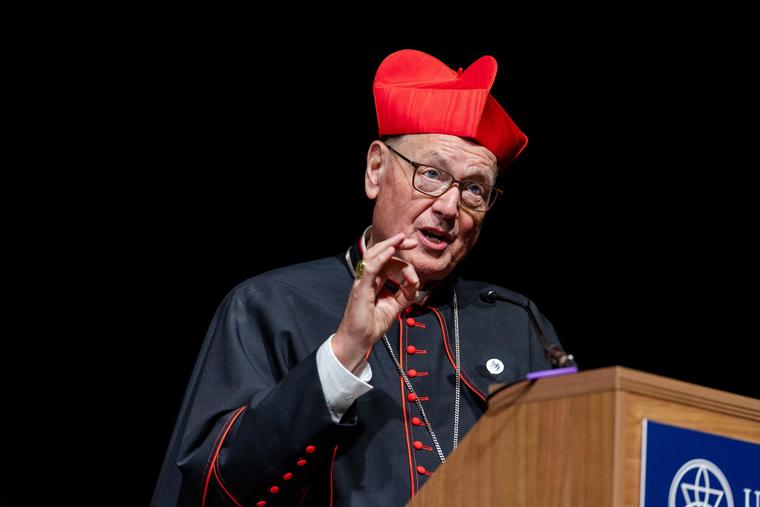
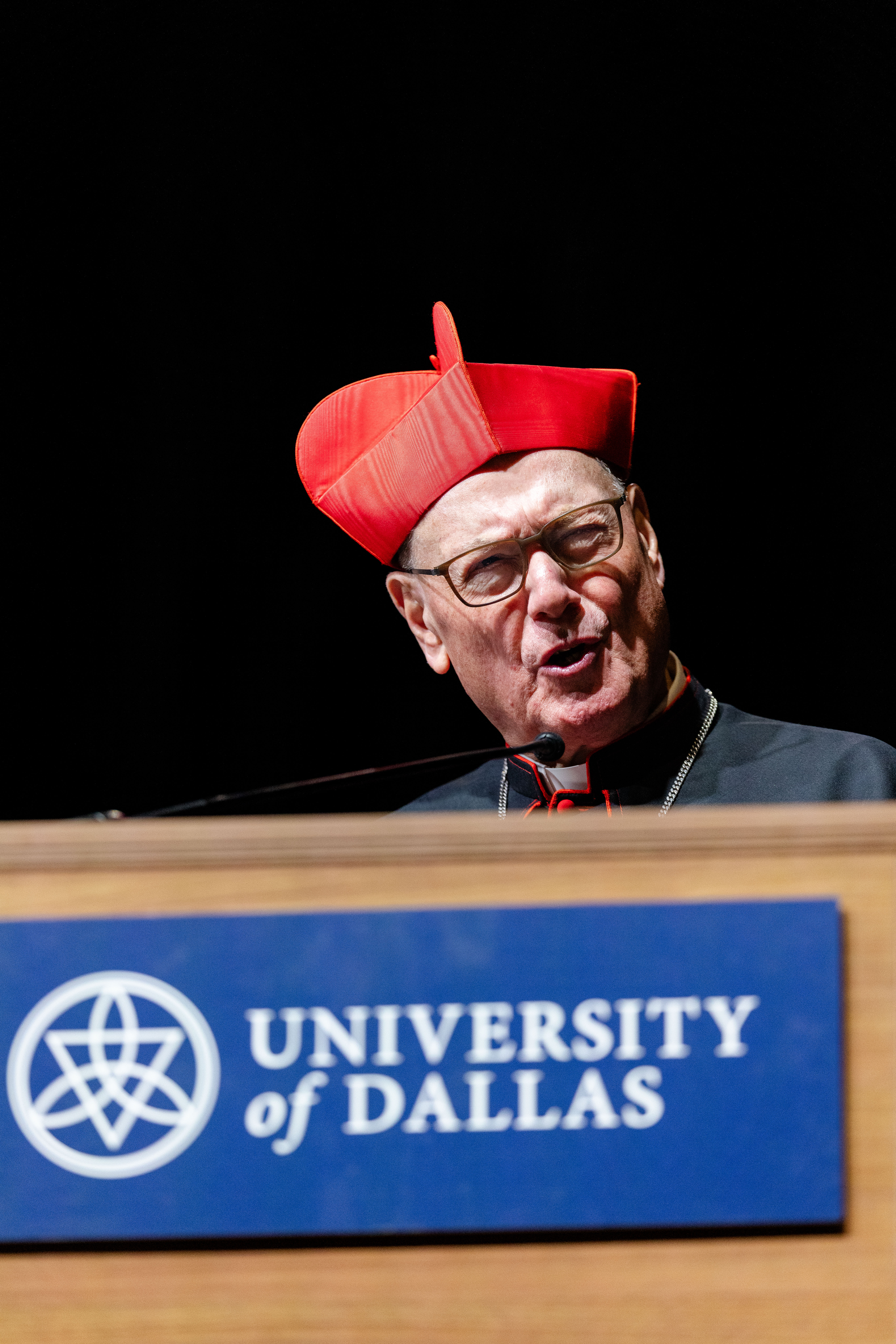
Cardinal Timothy Dolan, archbishop emeritus of New York, arrived at the University of Dallas commencement on May 16 with one word for the Class of 2026: gratitude.
“As a commencement speaker, I’m supposed to give advice,” he told graduates. “That’s easy. Be grateful.”
He invoked St. Augustine on what ingratitude ultimately produces. “One incapable of praise is sentenced to life as a monad,” Cardinal Dolan quoted, “one so wrapped up in self that he or she goes through life lashing out, loveless, using other people, not serving or respecting them.”
Cardinal Dolan offered the only cure he knew: “Gratitude. The via from me to thee, from mine to thine, from get to give, from please to thanks.” He closed with the poet George Herbert: “Give me one last thing, a grateful heart.”
Andrew Denny, who received a Bachelor of Arts in politics with a concentration in theology, said Cardinal Dolan’s message captured something the whole day had been building toward. “We did not get here by ourselves,” Denny told the university’s online publication. “Today I leave not just with a degree, but with a purpose. Now it is our turn to go out and serve.”
Ave Maria University
Ave Maria, Florida
Florida Gov. Ron DeSantis addressed Ave Maria University’s Class of 2026 on May 10, receiving an honorary degree and opening with a line that earned the crowd immediately.
“You are way more likely to run into a golf cart than you are a criminal,” he said. “And what passes for scandal here is when someone fails to genuflect at Mass.”
The governor praised Ave Maria as “the genuine article” among Catholic universities before invoking Benjamin Franklin’s warning that the Founders had produced “a republic, if you can keep it.”
“With faithful and civic-minded graduates like we honor today, who have a great foundation and are wearing the full armor of God,” DeSantis said, “the answer to Franklin’s question is Yes: We can keep the republic, and, yes, we will keep the republic.”
Benedictine College
Atchison, Kansas
Peter Cancro did not take the traditional path to Benedictine College’s commencement stage. The founder and chairman of Jersey Mike’s Sub chain had plans for college and law school, but at 17 borrowed $125,000 from his youth football coach to buy the sub shop where he had worked since age 14 instead. Fifty years later, that shop is a chain of more than 3,000 locations with more than $4 billion in systemwide sales. Cancro received an honorary Doctor of Humane Letters degree on May 16.
When the 1991 recession left the company more than a million dollars in debt, he said he turned to God. “Dear Lord, I’m not sure what to do here. Please guide me.” The peace that followed, he said, was real.
“It’s our own ministry serving others,” Cancro said of Jersey Mike’s annual Day of Giving, before closing with the advice that had carried him through: “Keep showing up, keep believing, keep working, and opportunities will find you.”
Walsh University
North Canton, Ohio
Chris Stefanick, founder and president of Real Life Catholic, opened his address to Walsh University’s Class of 2026 by honoring the battles graduates had fought that no one else could see — the anxiety and hard semesters — and then told them plainly that the real work was only beginning.
“A normal university just graduates you today,” Stefanick said May 2. “This is Walsh. This is not a normal university. This is a Catholic university. We are sending you today.”
He framed graduates as missionaries sent into a world that has largely forgotten who it is, noting that when Gen Z entered college, more than half of incoming freshmen self-reported feeling below average in mental health. “That’s a generation that’s forgotten who they are,” he said, “sitting in front of counselors looking for answers to metaphysical problems, answers that they only find in God.”
Stefanick gave graduates three directives: Do not be afraid to share the Gospel, build deep friendships, and aim for sainthood. “People can always come up with new questions when you have answers. But when we see a saint, we just want what they have.”
He concluded with a line that served as both punchline and commission: “Brothers and sisters, two-thirds of God’s name is ‘Go.’”