Eric Church Shares ‘Six Strings of Life’ in Epic UNC Commencement Address
The speech has clearly struck a chord for the millions who have watched it online.
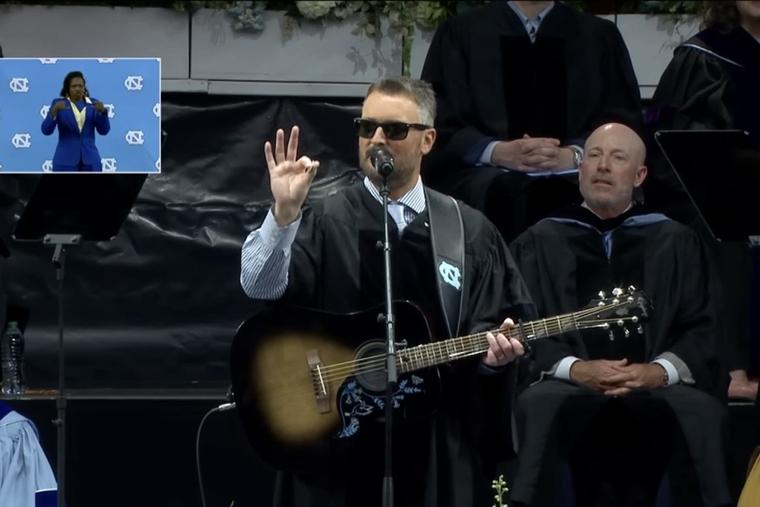
In this season of commencement addresses, country music singer Eric Church brought down the house May 9 with his incredibly thought-provoking speech summing up the “six strings of life.”
Church admitted he fretted over what to say in the eight months leading up to his speech. He recounted how he finally gave up his contemplation and just picked up his guitar to forget it all for a moment.
And that’s when he imagined the message he gave to graduates of the University of North Carolina at Chapel Hill that has clearly struck a chord with the millions who have watched it online.
“Six strings: When all six are in tune, the chords they make can stop a conversation cold, carry a broken person through the worst night of their life, or make a room full of strangers feel for three minutes like they’ve known each other forever. But if even one is off, the whole chord unravels. Not gradually, not politely. The moment you strike it, you know,” Church said while strumming along on stage.
“I believe your life runs on this principle. And I’m going to break it down for you right now and tell you about your strings.”
The Low E: Tuning Your Spiritual Foundation
It begins with the first string that is faith, the thickest string of all of them.
“The people who tend to their faith in ordinary seasons do not come undone in extraordinary ones.”
“They still hurt," Church continued.
"They still sit in hospital waiting rooms asking unanswerable questions at 3 in the morning. But they have a foundation to return to. The world will try to untune this string through busyness, through the slow accumulation of a full schedule, a full inbox, a full life. Listen to me: Tend to your faith. Not just when you’re broken, but when you’re whole.”
The A String: Why Family Is an Everyday Note
Next is family, the chord that provides warmth:
“The A string is where the music starts to get warm. It gives a chord its body, its richness. It’s the string that makes you feel like you’re not alone in a room.”
And though people may not pluck this string as much as life gets busy, especially with all the different directions grads will go in, he reminded them about the inescapable nature of family:
“Because they love you with a grace you will spend most of your life trying to deserve, will rarely demand your time. They’ll tell you they understand, and they’ll mean it. Do not take them up on it. Call your people. … The A string is not a holiday string. It’s an everyday string. Protect it.”
The D String: Finding a Spouse Who Amplifies Your Song
The next string is the closest one to the heart, the D string, “in the middle of the low and high strings, giving the chord its body and its soul. Strike a full chord and the D string is what you feel in the center of your chest. That is not an accident. That is exactly what the right spouse will do for your life.”
Picking a spouse “is the most important decision you will ever make outside of your faith. They will either amplify every other string you’re playing or slowly pull the whole instrument into an out-of-tune mess.”
He was quick to quip that this is not a problem in the Church household: “Not that I know that — I love you, honey!”
“Find your best friend, someone you want to talk to at the end of a long day,” Church advised. “Look for shared values over shared interests. You don’t need to love the same food or music; you need the same compass.”
The right husband or wife “is the string that makes the whole chord ring fuller and warmer and truer than anything you could ever play alone. Choose them wisely and then love them fiercely.”
The G String: Balancing Ambition and Resilience
The G string is where ambition and resilience both live, “and they pull in opposite directions.”
“The world has more than enough people standing at the edge of their own potential, waiting for a permission slip that was never going to arrive. Want the thing. Say it out loud. Build toward it with everything you have. And when you fail — and you will fail — Hemingway wrote it plainly, right in the sternum: ‘The world breaks everyone. Afterward, the best of us are stronger at the broken places.’ Get back up. Tune the string. Keep playing.”
The B String: Putting Down Roots in a Digital World
The fifth string represents community, and Church did not mince words about the digital fabric of this new generation, citing “the temptation to perform for everyone and belong to no one. To be globally visible and locally invisible. To have thousands of followers and no one knows actually where you live. Resist this.”
He urged them to “put down roots” and don't hesitate to volunteer.
“Build the thing your community needs, even if the internet will never see it. Generosity is not something you do after you make it; it’s how you make it. And if you get lost — and at some point, I promise you, you will — you have a place you belong now.”
The High E: Protecting Your Unique Melody
And lastly, arriving at the sixth string where melody lives, Church pointed out that this is the “thinnest string.”
“It’s the highest note, the one that carries the melody, that single line above the chord that everyone in this room recognizes and takes with them on the way home. It’s also the one bent most easily by outside pressure.”
And despite feeling lost or criticized amid endless scrolling (for those who spend too much time on social media), Church said:
“Do not let them touch your string. You were made uniquely, wonderfully, distinctly. There’s a sound only you can make. A voice that has never existed before you and will never exist again. A contribution only you can bring. A way of seeing that belongs to only you. The world does not need another cover song. It needs an original.”
Music vs. Noise
And it’s these “six strings of life and a willingness to keep them in tune” that grads were urged to focus on — no matter what.
“Your faith will go quiet when you need it loud,” Church explained. “Your family will get complicated in a way only the people who love you most can complicate things. You will go through hard seasons with your spouse. Your ambition will hollow out, and your resilience will wear thin. Your community will start to feel like an obligation, and your world will try to sand down the edges of exactly who you are.”
He added that this is “not failure. … It’s the inevitable, universal experience of living in an imperfect world that doesn’t stop to let us tune up.”
But the “difference between a life that sounds like music and a life that sounds like noise is whether you stop and listen. Whether you’re honest enough to hear which string has drifted out of tune and humble enough to make the adjustment instead of just turning up the volume and hoping nobody notices.”
Because, in the end, you will notice, Church shared, and “it will not let you go.” So “trust what your heart hears and is telling you about your song.”
Like a folk song sung around a fire, its strings plucked to a story told from the heart, Church left the graduates with his own melody, urging everyone to find their own and "make it something worth hearing."
- Keywords:
- eric church
- college commencements

Alyssa Murphy Alyssa Murphy is the Register's Managing Editor of Digital Assets. Starting her career on the airwaves in San Francisco, she has worked in all facets of media. Alyssa enjoys writing and covering stories that inspire and uplift. Register readers may be familiar with her voice from EWTN radio's Morning Glory. Alyssa currently lives in New Jersey just outside Manhattan with her husband Andrew and young daughter, Annabelle.