You Are Ready for a Life of Greatness
COMMENTARY: Now more than ever, our society needs strong families, strong churches and well-formed lay leaders.

The following is the prepared text of a commencement address delivered by Timothy Busch at the University of Mary in Bismarck, North Dakota, on April 25.
Men and women of the University of Mary Class of 2026: You are graduating from an extraordinary institution. It is extraordinary because of how it has prepared you for the rest of your lives. But the University of Mary is also extraordinary because of how it cuts against the historical grain.
How many Catholic or Christian colleges have become more religious over the past 50 years? How many institutions, founded in the faith, have deepened their commitment to Jesus Christ? The answer, unfortunately, is not that many. Most have gone in the other direction — which is to say, they’ve declined. But the University of Mary has risen in prestige and impact, all because it has gone where others have been too afraid to go. That commitment to faith is exactly what our country needs. And it’s precisely what you need as the leaders who will shape our country and our culture in the years to come.
This university has beautifully responded to the call of the Holy Spirit. I think you all recognize this truth, whether you’re Catholic or a different kind of Christian. For us Catholics, it’s clear the University of Mary is following the Holy Spirit’s guidance as given to us through the Second Vatican Council.
Vatican II breathed new life into the Church’s evangelical mission. The Council Fathers urged the faithful — both Catholic and non-Catholic — to “carry forward the work of Christ under the lead of the befriending Spirit.” And they illuminated two paths for our day and age.
The first path is through the priesthood and religious life. The second path is through our work as the laity. For you non-Catholics, “laity” is just a fancy word for regular believers; you know, those of us who aren’t priests, monks or nuns. We account for 99.99% of the Catholic faithful, and, in my opinion, Vatican II made its biggest mark by emphasizing the need to empower us. And by responding to this call so thoroughly and effectively, the University of Mary has prepared you to make the biggest mark in our society.
I’m going to spend the bulk of my remarks on what it means to be a leader of the laity. I think my thoughts are applicable to Catholics and Protestants alike. Yet, before I go on, I want to acknowledge that this institution also plays an increasingly important role in forming future priests and religious. Until recently, the University of Mary didn’t track how many graduates pursued a religious vocation because the answer was basically none. But thanks in large part to Msgr. [James] Shea’s leadership, those numbers have steadily ticked up, and you’ve even established Nazareth Seminary, in partnership with Arizona State University.
Of course, the overwhelming majority of you are not discerning a religious vocation. But make no mistake: Your work is no less important and no less urgently needed.
Thanks to the education you have received, you are prepared to become leaders of the laity. But now that you’re graduating, the question is: How exactly will you advance the faith? After four years on campus, what do the next four-plus decades look like? Practically speaking, what does it mean to be a lay leader?
The answer is different for each of you, but at the macro level, we’re all facing the same cultural and societal challenges. They ought to inform where you go from here and what you do next.
For example, this year is the 250th anniversary of America’s founding. It’s a time of division and doubt about our nation’s future. But as St. John Paul II taught us, patriotism is a spiritual duty — and loving your country is just as natural as loving your family. It certainly helps that America is fundamentally good. As the U.S. bishops said in the 1880s, the founders of this country “built better than they knew.” In fact, the Protestant founders built a nation that reflects Christian teaching more than any other nation in human history.
But in recent decades, America has significantly departed from truth and justice. We live in a time where human dignity is broadly denied; where the human person is misunderstood and abused; where power, not truth, is the measure of justice. As leaders of the laity, you must plant the seeds of cultural renewal. And you must rally our fellow citizens to restore a society grounded in faith. Now more than ever, we need strong families, strong churches, and strong expectations of ourselves and one another. And we need well-formed lay leaders to show us the way.
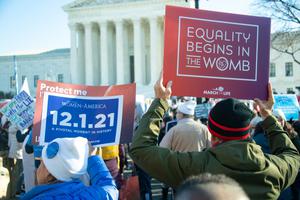
Diving down a level, many of you will be called to defend the sanctity of human life. That’s fairly easy, here in North Dakota, where the pro-life cause is going strong. But nationwide, the cause of life faces many challenges. The Dobbs decision four years ago brought this issue back to the states. Unfortunately, the activists who support the murder of innocent life have most of the momentum.
You must rise to meet this challenge: not with confrontation, but with compassion; not with judgment, but with generosity. There are so many vulnerable mothers and children who need your help. And if you come alongside them, in new and renewed ways, you will do more to shape a pro-life culture than any law or court ruling ever could.
Take it from someone who was alive when Roe v. Wade was forced on America: You have the power to forge real change. A previous generation of faithful Christians paved the way for the end of Roe. And now you can pave the way for the ultimate end of abortion itself. It will take a long time. But you have your whole life to do it. And you have truth and justice on your side.
The final challenge I’ll mention is the rise of artificial intelligence. It’s the most incredible technology I’ve seen in my lifetime, and, for a lot of people, it’s very frightening. It’s tempting to view AI as somehow different and more dangerous than everything that came before. But that’s not quite right. No technology is inherently right or wrong. It all depends on how people use that technology.
Yes, AI could easily be applied to further devalue human dignity, and, in some ways, it already is. Technology without truth can quickly become tyranny. But technology, rightly applied, can also promote human freedom and flourishing. AI can do that, but only if we have well-formed leaders who provide stability in this age of acceleration.
Our new Holy Father has hit the nail on the head. He chose his papal name to honor the last Pope Leo, who guided the Church through the Industrial Revolution. Now, Pope Leo XIV is preparing us for the AI revolution. And he has issued a clarion call to action for the laity in particular. You can answer this call by serving those who AI displaces, by getting involved in its development and deployment, and by helping others see what it can do — and can’t do. So much of our culture will look to AI as a kind of god. You can show them it’s just a tool made for our use, while pointing them to the real God in heaven.
These are just a few of the pressing challenges that define our time. I am confident you’ll rise to meet them. And while most of you are probably looking at a career in a for-profit business, I hope some of you look to nonprofits, as well. Christianity in America, including the Catholic Church, is the most vibrant in the world, and one of the big reasons is that we have a huge number of faith-driven organizations. In Catholicism, they’re technically known as “lay apostolates,” and that word — “apostolate” — speaks to their mission. These organizations are advancing the Gospel, as given to us by the apostles. And Vatican II said that lay apostolates are especially important in the modern world. (My own organization is a good example. At the Napa Institute, we work with priests, religious and lay leaders to prepare Catholics to evangelize in our secular society.)
You are ready for a life of greatness. You are ready to spread the Gospel. You have been called to take the Christian mission of evangelization into bold new territory. You can do this by creating new apostolates and serving your parish or church. You can do this on Main Street, on Wall Street, and at businesses of all sizes. And you can proclaim the truth of our faith in the families you start, the children you raise, and the life you lead.
The University of Mary has made you ready for what comes next. You aren’t receiving a credential today. You’re receiving a commission for the rest of your life. My prayer for you, as you depart, is that you embrace this calling with all your strength. It is not merely an obligation. It’s a profound opportunity to find meaning and mission in your life: to become who God made you to be.
No saint has made this point better than one who taught students like yourselves. St. John Henry Newman was an Anglican priest-turned-Catholic cardinal, and, in his spare time, he was a professor at Oxford and founded the Catholic University of Ireland. He said, and I quote, that “God has created me to do Him some definite service. He has committed some work to me which He has not committed to another. I have my mission. … I shall do good. … I shall do His work.”
To the Class of 2026: It is now your turn to do the Lord’s work. It is now your turn to find the mission that God has given to you and no one else. It is now your turn to take what you have learned here and bring it to a world that desperately needs Jesus Christ.
May God bless you as you go forth to do His will. And may the namesake of your alma mater — the Blessed Mother of Our Lord — intercede for you every step of the way.
Thank you, and congratulations once again.