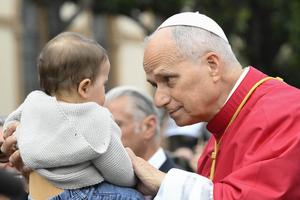
A Simple, Humble Pope
“Benedetto, Benedetto, Benedetto,” chanted thousands of young people in St. Peter’s Square after the newly elected Pope showed up at the Loggia, the Basilica’s central balcony to impart his first urbi et orbi (to the city and to the world) blessing.
With thousands of people, I ran to St. Peter’s Square as soon as I learned about the Sistine Chapel’s fumata bianca (white smoke). In less than 15 minutes, the square was crowded with Romans and pilgrims.
“Dear brothers and sisters,” said Pope Benedict XVI, “after the great Pope, John Paul II, the Cardinals have elected me, a simple, humble worker in the Lord’s vineyard.”
We clapped enthusiastically. The Pope’s face mirrored an unassuming soul who felt unworthy of the mission God has entrusted to him.
“I am consoled,” the Holy Father added, “by the fact that the Lord is able to work and act with insufficient instruments and, above all, I rely on your prayers.”
We knew his words came from his heart.
“I am so glad God gave us such a modest, saintly Pope,” said Christine d’Auchamp, 23, who came from Denmark with her brother Daniel to witness this historic event.
After the Holy Father gave us his blessing, I was interviewed for a Spanish radio program. “What do you think of the new Pope?” asked the interviewer. “He is what he said,” I replied, “a simple, humble worker in the Lord’s vineyard.”
I then recalled my experiences from the few times I met the former Cardinal Joseph Ratzinger.
For years, I visited him in the Vatican’s Congregation for the Doctrine of the Faith with a group of German boys. He always greeted each of us personally and asked us where we were from. He openly spoke to us about his tasks and the most urgent problems in the Church. He took pictures with us and spent all the time needed to sign autographs.
No rush, no formality. The cardinal was accessible, unpretentious and willing to share some time with us. In his presence, you were always inclined to forget what position he held in the Roman Curia. He looked more like a grandfather or a country pastor than a renowned theologian.
After the meeting, all the boys used to comment about the cardinal’s most striking virtue — humility.
“Before we met him, I was afraid of asking the cardinal to sign for me some of his books,” Karl Lange, one of the German boys, told me once. “When we were there with him I lost my fear. Asking him to sign the books was as easy as asking a friend to tell me what time it is.”
Karl was right. You could daily see Cardinal Ratzinger walking alone through St. Peter’s Square on the way between his office and his apartment. You could always greet him and have a short talk. He was friendly, always ready to listen.
One day, a friend of mine was visiting Rome with his family. The family met the cardinal outside St. Peter’s Square and asked him to have a picture together. “I’ll be most happy to do it,” said the cardinal.
He took pictures of the family, thinking they wanted him to be the photographer. The family had to explain to the cardinal they wanted a picture taken with him, not by him.
The last time I met Cardinal Ratzinger was at a wedding Mass on June 24, 2004. Anthony and Marta Valle, two students at the Legionaries of Christ-operated Regina Apostolorum University, had one day introduced themselves to the cardinal and asked him to marry them at St. Peter’s Basilica. The cardinal accepted the invitation. I concelebrated with him the wedding Mass in the basilica’s Chapel of the Choir. (See Inperson interview, page 1)
In his homily, the cardinal spoke spontaneously for about 30 minutes about the nature of marriage and its relationship with God. It was a deep and moving homily — a reflection coming from the heart and the mind of a prayerful, wise man of God.
I was impressed by the fact that the cardinal was willing to spend two hours of his valuable time of an ordinary weekday to bless the marriage of two young people he had never met.
That fact spoke volumes of his charity and humility — two virtues that constitute the foundations of his dedication to the Church as a priest, bishop, cardinal and now vicar of Christ.
The first German pope since the 11th century plainly laid out his philosophy before the College of Cardinals in his first audience on April 22.
“It is not a question of honors,” he said, “but of service to be carried out with simplicity and availability, imitating our teacher and Lord, who did not come to be served but to serve, and who in the Last Supper washed the feet of the apostles, asking them to do the same.”
In effect, the Pope’s only ambition is to be servus servorum Dei (the servant of God’s servants). I think God, through the election of Pope Benedict XVI, is asking each of us — and the whole Church — to be holier, that is, to grow in charity and humility.
We are grateful and blessed to have as the Vicar of Christ “a simple, humble worker in the Lord’s vineyard.”
Legionary of Christ Father Alfonso Aguilar teaches philosophy at the
Regina Apostolorum University in Rome.
- Keywords:
- May 1-7, 2005