Sam Brownback: Our Silence Fuels China’s Religious Persecution
COMMENTARY: In an interview with the Register, the former U.S. religious freedom envoy says the Chinese Communist Party fears religious freedom more than ‘aircraft carriers or nuclear weapons.’
People of faith in China continue to face imprisonment, surveillance and intimidation as the Chinese Communist Party suppresses religion while much of the world looks on in silence, wary of confronting such a powerful political and economic force.
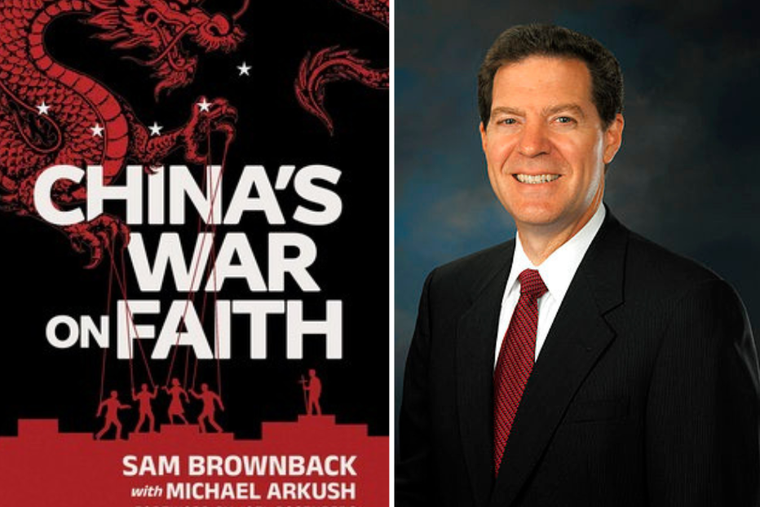
This is the subject of the recent book, China’s War on Faith (Republic Book Publishers, May 2026), by Sam Brownback, the former Kansas governor and senator who served as U.S. ambassador-at-large for international religious freedom. In the book, Brownback recounts the personal stories of Christians, Uyghur Muslims, Tibetan Buddhists and practitioners of Falun Gong who have suffered at the hands of Chinese authorities simply for practicing their faith.
Brownback is confident that truth and freedom will ultimately prevail, as it did with the fall of communism in Eastern Europe. The question, he writes, is “how long it will take and how many more innocent people will go to prison or die.” The answer, he argues, depends on whether people around the world — including the Vatican and elected leaders — refuse to remain silent.
The Register interviewed Brownback about his book, which represents the culmination of his efforts to persuade world leaders to listen to the testimony of victims and stop turning a blind eye to religious persecution in China.
In your book, you highlight the stories of individuals affected by religious persecution orchestrated by the Chinese government. Could you explain why you decided to take this approach?
Stories move people more than statistics or facts. I’ve been working on religious freedom issues for some time and we’ll put on expert speakers, we’ll put on people with lots of facts. The people that move folks are those who have been persecuted or family members [who have] been persecuted and their personal testimony. That’s what captivates the crowd. That’s what moves the heart and that’s what moves people to action. And so that’s why we really decided to do it that way.
In the Soviet era people knew there were a number of Jews being persecuted, but then they heard the story of Natan Sharansky, who was a Jewish refusenik [a person denied permission to emigrate by Soviet authorities]. They got into the personal stories of some of the people that were persecuted, and that’s what moved people. People said, “Well, why won’t you let people just go — they’re Jewish, they want to be in Israel, let them go.” And the Soviets wouldn’t do it. That became then a delegitimizing piece regarding the regime.
I think the same thing can be [done] with Communist China when you tell people these stories: Why isn’t Pastor Ezra Jin allowed to leave China to be with his family in the United States? Why are there nine Catholic bishops currently in detention or missing in China? [There are] nine. People don’t know that and they should. We should be pressing the Chinese Communist Party: Why are you treating people of faith so badly?
What is it about religious faith that is so threatening to the Chinese Communist Party?
It’s a higher authority than the government. In communism, everybody is treated as an economic entity and that alone. There’s no soul, there’s no spirit. You’re an economic beast, and that’s it. Communism is officially atheistic. Any power or authority that’s higher than the government is an existential threat to them. That’s why I argue the Chinese Communist Party is more fearful of religious freedom than they are of our aircraft carriers or nuclear weapons. They see this as something that really can attack their hold on power. They are spending currently billions of dollars each year to suppress people of faith in China, and they’ve developed the most sophisticated surveillance technology and systems on the planet to control various faith communities, whether they’re the Tibetan Buddhists, Falun Gong, Uyghur Muslims or Christians.
To what extent do you think the Chinese Communist Party’s global economic ambitions are connected to exporting this worldview?
It’s completely tied to it. They see everything through the lens of economic activity and power exclusively. There’s no room for religion or faith or the spirit in communism, and it’s a complete threat to their power. It’s also a threat to their government model. They want to run the world by power and money, and they’re well on their way.
Can you imagine how deadening that is to a population? I mean, you still see it in a number of European countries that were under communism for decades. It’s just a killer of the soul and of the spirit and the life of a place. It’s so obvious when you go into the Czech Republic and then go to Austria. The difference between these two places — even decades later, after the liberation from communism — you still feel it and see it.
In your book, you criticize the Vatican for prioritizing maintaining diplomatic relations with the Chinese Communist Party over speaking out about the persecution of bishops and regular Catholics there. Do you see any indication that things could change under Pope Leo?
I do. I think there are a number of people in Catholic leadership who are not happy with the secret deal between the Vatican and the Chinese Communist Party. And we’ve now seen bishops appointed by the CCP that were not approved or appointed by the Vatican in a hierarchical Church. And you’ve got nine Catholic bishops that are still in detention. If the quiet diplomacy that the Vatican has tried to exercise had been successful thus far, you might say, “Okay, let’s try to work with this.” But it has not. This agreement has been in place for some time and it’s been a failure.
That’s why I really hope there is change. It’s not just the Catholic Church. Tibetan Buddhists have said to me, “If the CCP can roll the Catholic Church, they can certainly get us.” So at least the Vatican could publicly point at what’s taking place to the Uyghur Muslims or to Falun Gong practitioners or to Pastor Ezra Jin, Pastor Wang Yi. If they don’t want to advocate for themselves or see that as too delicate, at least advocate for some of these other people that are so heavily persecuted.
Or at least stand up and say the Chinese Communist Party cannot appoint the next Dalai Lama. There is a system that Tibetan Buddhism uses to appoint its next religious leader, and that must be adhered to and not done by the Chinese Communist Party. The Chinese appointed the No. 2 Buddhist there, the Panchen Lama, a number of years ago after kidnapping the real Panchen Lama. He’s not the real Panchen Lama, who hasn’t been seen since.
The Chinese Communist Party’s been given a bye by the world since Nixon [opened diplomatic relations in 1972]. We cannot do this anymore. This regime has killed more of its own people than any regime in the history of mankind. That’s not a group you want running the world.
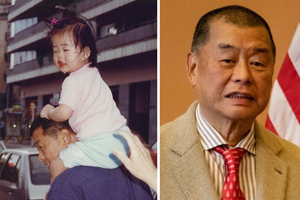
Many had hoped that President Trump would use his meeting with Xi Jinping to push for Jimmy Lai’s release, among other things. Were you disappointed that he did not?
Well, I wasn’t disappointed. I was appreciative that the president raised the Jimmy Lai case. I’m not surprised that Xi hadn’t released him yet. I pray he will, but I’m not holding my breath.
What responsibility do you think, if any, do ordinary Americans have? You wrote in your book about how former congressmen shouldn’t be lobbying for China. What about ordinary Americans? Should they start thinking about whether to buy products made in China?
I think they should. We’ve got to break these two economies apart, the United States and China. They’ve got too much leverage over us and they use it. We’ve got to do it soon over these key supply chain issues like medicines and rare earth minerals that are used in computer chips and weapons systems. We’ve got to start sourcing things from other places.
But, you know, ultimately, if the CCP is not going to change, we’ve just got to build an economic system away from them. And we can do this. It will benefit the United States [as] many of these jobs will come back to the United States and there will be more investment here. It may cost us more, but in the long run it’ll be far better for us.
And we really don’t have a choice. The Chinese Communist Party wants to take us out. We’ve got to confront them. The sooner we recognize that and are willing to confront that, the more our options and the higher our likelihood of success. These guys are far tougher than the Soviets ever were.
In your book, you write about how your religious faith inspired your interest in religious freedom as a political issue. Could you talk about that a little bit for our readers?
I saw in my life what faith did for me, how it transformed me and how it was my free choice. It just drove into me that much deeper the right that every single soul on the planet deserves to pick the direction of their own soul — and not to be limited or circumscribed by a government or a mob or anything else. This is a right given by God to decide whether you want to follow him or not, and no government has the right to limit that.
Yet you see an acceleration of religious persecution around the world. Maybe that’s in response to the growing religiosity of the world, because we’re really back pursuing the spiritual again as a world. Not everybody, not everywhere. On the flip side of that is if governments don’t protect the right to religious freedom for everybody, you’re going to see increasing amounts of clashes of civilization around the planet between Islam and Christianity, between Hinduism and Islam.
The answer is religious freedom for everybody, everywhere, and that right protected and enforced by governments. Government’s role is to not pick a winner in religion — it’s to protect the right the individual has. And if we’ll do that, we will have far less of these clashes of civilization, if the government will play its role and play it straight.
This interview was edited for clarity and length.