What Does Science Really Say About God’s Existence?
A book that integrates philosophy, morality, history and enigmas — because the question of God spans all forms of knowledge.
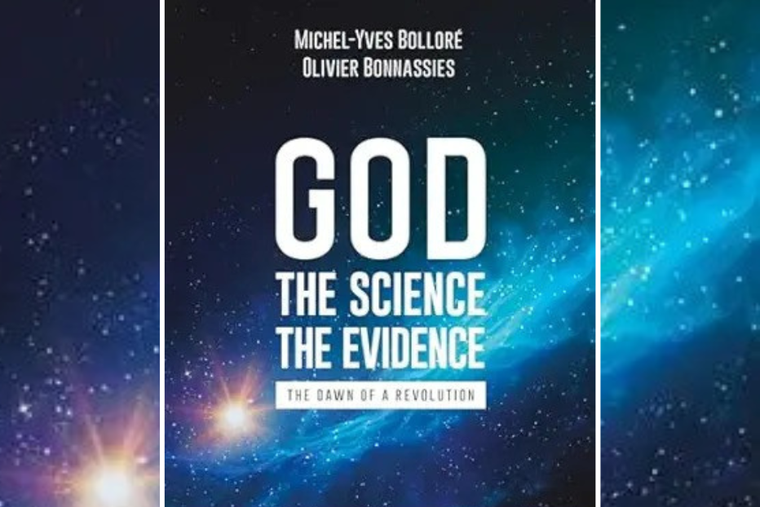
Whether or not God exists “is not just one question among others — it is the question,” says one author of a newly translated book about the interplay between science and faith. “It asks whether we are nothing or something; whether our lives have ultimate meaning or not.”
For Michel-Yves Bolloré, co-author of God: The Science, the Evidence: Dawn of a Revolution, faith and science are not in opposition. Rather, faith “is the willingness to follow reason wherever it leads.”
Critics have long argued that faith and science cannot coexist and that the Catholic Church is somehow anti-science. However, there has been a recent resurgence in efforts to disprove this assertion and to demonstrate the rationality (and even the strong scientific basis) for belief in God. Figures such as Jesuit Father Robert Spitzer, Jesuit Brother Guy Consolmagno and St. John Paul II have contributed masterfully to this effort.
Originally published in 2021 in French, God, the Science, the Evidence: Dawn of a Revolution is a notable contribution to this conversation. It was co-written by Bolloré, a computer engineer, and Olivier Bonassie, a former unbeliever and founder of the news agency Aleteia. The book, released this October in English, was the result of four years of intensive research and collaboration with dozens of scientists, physicists, historians and philosophers.
Bolloré recently spoke with the Register about the book and the effort to show that faith and reason really do go hand in hand.
How did the book come about, and how did your collaboration take shape?
Olivier and I came to faith by very different paths. In his 20s, while studying mathematics and engineering at Polytechnique in Paris, Olivier was a complete agnostic. By chance, he read a book about the existence of God and was astonished to discover that reason could lead toward belief. He eventually converted to Catholicism, and after a successful career as an entrepreneur, he chose to dedicate his time to Christian projects.
I, on the other hand, grew up in a Catholic family from Brittany, where faith was simply part of life. I loved science as well and studied computer engineering. As an adult, I became deeply interested in whether my faith had a rational foundation, and I devoted years to reading and studying that question.
We first met in the early 2000s. Our shared fascination with the relationship between science and faith quickly made us friends. We both noticed that while the scientific landscape had changed dramatically in recent decades, there was no comprehensive, accessible book for general readers explaining this shift. So we decided to write it.
It took us almost four years. From the start, we wanted it to be clear and readable, without oversimplifying the science. We also wanted to integrate philosophy, morality, history and enigmas — because the question of God spans all forms of knowledge.
In the preface, you refer to “the implications arising from the latest scientific advances.” What sort of implications are these? Can science really point toward a Creator?
For centuries, science was seen as opposing the idea of God. A materialist worldview took hold, and people assumed that if proofs of God existed, we would already know them.
But the most recent discoveries — in cosmology, physics, biology and quantum mechanics — tell a different story. The Big Bang, the expansion of the universe, the extraordinary fine-tuning of physical constants, and the origins of life all seem to point beyond time, space and matter. What we show in the book is that these diverse lines of evidence converge toward the idea of a creative intelligence — what many would call God.
In essence, the question has only two possible answers: Does God exist or not? For materialism to be true, three things must hold: Our universe must somehow be eternal, with no absolute beginning. Billions of parallel universes must exist to explain the incredible fine-tuning by chance. Life must have arisen naturally from inanimate matter.
Yet, as we document in the book, modern science challenges all three assumptions. The evidence now points, quite surprisingly, toward the necessity of a Creator.
The book explores a vast array of evidence from many scientific disciplines, (physics, astronomy, biology, etc.), plus philosophy, history, morality and more. How did you synthesize such a massive amount of material into a single (albeit lengthy) volume? And is it more illuminating, having all this information presented in one place?
This project is much larger than any single discovery. What makes it powerful is the convergence: evidence from independent disciplines — cosmology, quantum physics, molecular biology, history and moral philosophy — all pointing in the same direction.
Rather than focusing on one line of argument, we wanted to show the broader pattern. This is why it is important that we didn’t focus solely on cosmological or evolutionary evidence like other writers. When findings from such different areas all undermine the same materialist assumptions and all suggest order, purpose and intelligibility, it becomes more difficult to ignore.
No single expert can master all these domains, so we relied on the guidance of more than 30 specialists to ensure accuracy and rigor. The result, we hope, is a book that is both comprehensive and accessible.
There has been a resurgence in literature and other resources, which refute the erroneous notion that there is some sort of conflict between faith and science. How does your book contribute to that effort?
Our book offers a panoramic view of this history — from the birth of modern science to today’s discoveries — and shows how the evidence now converges in the opposite direction. If we return to logic, the question of God’s existence is not a matter of opinion; it is either true or false. If we do not yet fully know the answer, it is only because our scientific knowledge remains incomplete. Faith, then, is not opposed to science — it is the willingness to follow reason wherever it leads.
At the same time, our book brings to the public the debates and discoveries that have, until now, mostly taken place within laboratories and academic circles. There are many excellent books written for specialists, but most assume a high level of scientific knowledge. We wanted to make this discussion accessible to everyone. I rewrote chapters until my own family could follow the story easily. Our goal was to create a book that even a high-school student could understand — clear, logical and grounded in evidence.
We also wanted to show what scientists themselves actually think. God, the Science, the Evidence cites more than 100 scientists — including 63 Nobel Prize winners — in their own words about the limits of purely material explanations. Readers are often surprised by how many leading scientists acknowledge belief in something beyond matter and chance.
To extend that conversation further, we have also created a documentary featuring 12 Nobel laureates exploring the same themes. Our aim is simple: to make sure this information isn’t confined to universities or behind closed doors. Everyone deserves access to these ideas and to see how science, far from disproving faith, is now illuminating its reasonableness.
Over the course of the four years working on this book, did your research lead you to any unexpected places or unexpected conclusions? Was there anything that really surprised you?
Yes, absolutely. Working on this book for four years was an extraordinary experience for both of us. As we explored so many different fields — cosmology, physics, biology, philosophy — we were continually surprised by how much evidence there actually is pointing toward the existence of a Creator. In fact, there was far more than we expected, and it was much stronger than we imagined at the start.
What struck us most was the extraordinary complexity, organization and harmony of the universe. The deeper we looked, the more coherence we found — from the laws of physics to the structure of life itself. It became clear that the universe is not random or chaotic, but ordered in a way that invites understanding. That realization was both humbling and profoundly inspiring.
What do you, personally, find to be the most compelling scientific argument or evidence for the existence of God?
For me, it isn’t a single piece of evidence, but rather the convergence of so many discoveries, across so many disciplines, in such a short period of time. Over the past century, advances in cosmology, physics, biology, and even information theory have all begun to point in the same direction: toward a universe that appears finely tuned, ordered and intelligible.
What I find most compelling is that these insights come not from theology, but from science itself. Each discovery, in its own way, seems to suggest that the universe is not an accident — that there is meaning and intention woven into its very fabric.
What do you hope readers will take away from the book?
Our hope is that anyone who sincerely wants to think about the question of God’s existence will find, in this one book, a clear and accessible overview of the evidence. We wanted to bring together, in plain language, what modern science now tells us about the origins and order of the universe, so that readers don’t need a background in physics or theology to engage with these ideas.
Ultimately, we don’t tell readers what to believe. We simply present the evidence as clearly as possible and invite each person to reach their own conclusion.
WATCH RELATED INTERVIEW ON EWTN
- Keywords:
- faith and reason
- existence of god