Catholic Speaker Shares ‘Field Guide’ to Frassati-Inspired Path to Holiness
From the mountains to Mass, Bobby Angel explores the Frassati ethos — an invitation to live authentically, boldly and fully.
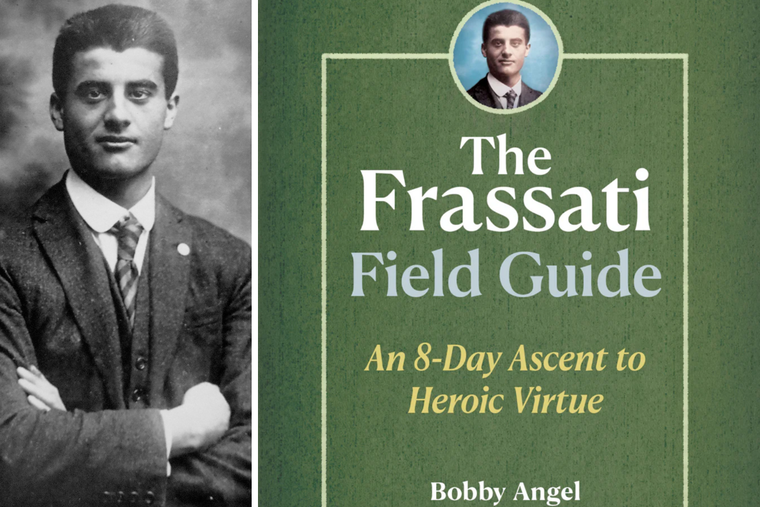
As Pier Giorgio Frassati’s canonization date nears — Sept. 7 — many biographies have been published about his life; one new book stands out among the rest, a guide that invites people on the adventure toward Christ through Frassati’s witness.
“Freedom becomes life-giving when it is oriented toward love,” writes Bobby Angel in The Frassati Field Guide, published late July by Ave Maria Press.
Angel and his wife Jackie host a YouTube channel where they regularly contribute to Ascension Presents and FOCUS. Angel is theologically trained and secularly educated, with degrees from the University of Florida and St. John Vianney College Seminary.
The eight-day field guide invites readers to encounter Pier Giorgio’s life, character and relationship with God. Each day focuses on a different heroic virtue to be acted upon; through meditating on courage, excellence and wonder, devotion, generosity, loyalty, surrender, hope and freedom, readers will gain an adventure to the heights with God.
Defining saints as “Christians who don’t give up.” Angel believes that “[saints] allow the Lord to transform their lives … for God’s greater glory and for the conversions of others.” Frassati relentlessly gave himself to others, from abandoning love to honor his parents, to praying for his dying grandmother at his deathbed.
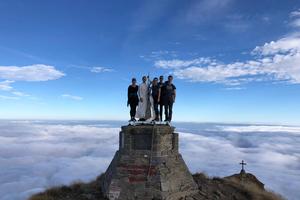
At the Jubilee of Youth, Bishop Robert Barron mentioned Frassati’s motto verso L’alto (“toward the heights”) during his keynote speech. Later, Bishop Barron defined the heights as “to give your life an ever greater degree away.”
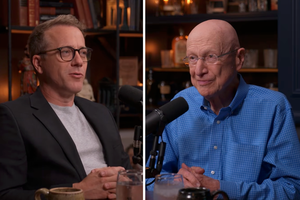
In a recent interview, the Register asked Angel a similar question about Frassati’s motto, field guide, and the youth culture.
What does “toward the heights” mean? And how does your field guide take the youth to the heights?
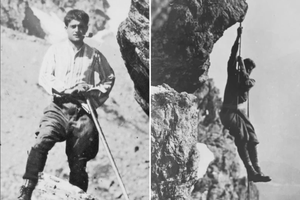
Also “to the heights” is famously scribbled on one of the last known photographs of him climbing that we have. And obviously there’s a physicality, the ascent of the mountain and to endure and not give up, as well as the spiritual climb. To not settle for mediocrity, but to strive for the heights of holiness, which again, doesn’t make you unrelatable. It makes you at its best very approachable, but different. You’re living for something else. You’re living for someone else. … And I don’t think you could have met a more joyful young man than Frassati.
What first attracted you to Frassati, and how did he shape your spiritual life?
I encountered his story in my college years, some 20 years ago, as I was diving into my faith. Seeing this man whom Pope John Paul II was elevating as a “Man of the Beatitudes,” his physicality standing atop the mountaintop, all these pictures of him laughing with his friends: It was such an attractive model at the time. You could be fully engaged with life. It didn’t mean you had to run off to a monastery to be holy. The whole “glory of God is man fully alive” [St. Irenaeus]. I feel like that is why Frassati spoke to me.
What is the purpose or aim of the guide?
This guide is an introduction to who Frassati was, as well as structured in an eight-day retreat format. Kind of a DIY, do-it-yourself, on-the-go, busy-person retreat that also has you reflect and hopefully put his virtues into action. There are a lot of great bios about Frassati, including some written by his sister. And so … this book was a little different; that if you know his story, you’ll hopefully learn a little bit more. And if you don’t know who he was, you’ll get a good overview of his life. Also, it’s aesthetically designed to be something you’d find in an outdoor store; the feel of it [is] something you can hopefully throw in your backpack or purse and take out into the wild and get it dirty and good and stained.
So that is what you mean by encountering him rather than just learning you’re walking through him, correct?
Yeah. He’s your retreat master, and the goal is to put his virtues into action. So it’s not just, I read a nice book about a saint who can live up to that. You know, I stay on the sidelines. It is, this is how he lived his call to holiness. How are you going to take the virtues he lived and put them into action yourself?
How do you define heroic virtue?
Virtue is that habit of excellence where I have habituated myself to choosing well and choosing what’s going to bring the most wholeness and integration in my life. And the piece is: Will I lay down my life for other people? You know, most of the time through inconveniences or just being generous of spirit. But even if it came to that ultimate sacrifice — of can I lay down my life for a friend? — which I think we all aspire to; you will have to make such a [sacrifice] in such a radical situation. But we can all live that everyday heroism in choosing the good and the excellent.
And Frassati, one thing that makes him so special is that he’s very self-giving. And in our culture today, it’s not as we define freedom as limitless. And you go over this in one of the sections in your book: How do you think young Catholics can reclaim freedom as a path to holiness through Frassati?
There’s definitely the freedom as license as we understand it in our Western, definitely American, culture, rather than a freedom to choose what is the good. And the endless options, the endless scroll of the internet can lead to the kind of paralysis of I’m just numbing out in my life, and there’s kind of too much freedom without direction; rather than what is my freedom for? And Frassati knew that was Christ above all, and if I have that as my anchor, then I can use my freedom well.
So pivoting off of that, what lessons should young people take away from this guide? And how are you hoping people can achieve excellence through the guide?
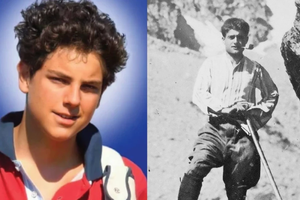
That holiness is accessible. It’s not just for monks or religious. It can be lived in the here and now, in your friendships, in your studies, in your recreations. He wasn’t a great student. Education didn’t come easy to him. He would rather be with friends or climbing a mountain. There’s a real appeal there because a lot of people will say, “Yeah, that’s me.” And this guy was a saint. He took his prayer seriously, and he took his recreation seriously too. The Holy Spirit is also raising up these young men like Frassati, Carlo Acutis and others to show this generation it’s not “when I’m in a vocation, I’ll be holy” — the temptation to make vocation an idol, of marriage or priesthood. … These young guys — who Our Lord called very young … at 24, Carlo at 15 — are literally saints. We can live our lives as such too, in the very unique state and place we are in the world.
By actually living it instead of reading it. … Where does Frassati’s example challenge me? Where does it make me uncomfortable? He would literally take off his shoes and give them to the poor. He would walk home barefoot; he would give his coat; he would give his allowance. For me, that was also striking. His joy, his outdoorsmanship, sure. But also he would spend whole nights in prayer before he would climb; his seriousness of the Rosary, of trying to make daily Mass at a time where secularism was definitely on the rise. Even amongst his family, he was kind of seen as, “What are you doing? What’s wrong with you?” So in spite of that, to be challenged, to be a little bit better, a little bit more bold in our faith.
Do you have anything else you’d like people to know about your guide?
It’s always to Christ through Frassati, for Frassati himself would not want to be the end goal. He would say, “Keep going; point upwards to the heights: to Christ.”
Although Frassati’s life was cut short at 24 years old, his life symbolized a mountain, deeply rooted in God, and defined in excellence.