7 Sacraments, Countless Misconceptions — One Clear Catholic Guide
Father Chris Alar’s new book tackles widespread confusion about the sacraments — offering Scripture, tradition and common sense to set the record straight.
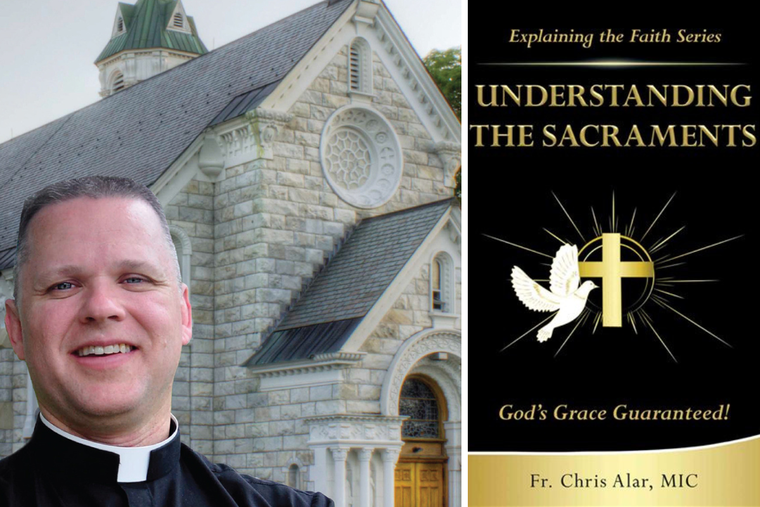
Concise and colorful, enlightening and edifying — Understanding the Sacraments is all of these and more. This book clears up misconceptions about the seven sacraments, teaching and inspiring readers to easily understand and know how to grow spiritually via the sacraments.
This page-turning work by Father Chris Alar — provincial superior of the Blessed Virgin Mary, Mother of Mercy Province of the Marian Fathers of the Immaculate Conception and host of EWTN’s weekly show Living Divine Mercy — is a compelling “go-to” guide to the sacraments.
During a recent conversation with the Register, Father Alar previewed some of the sacramental misconceptions and some of the ways he corrects them in this new book.
Speaking of baptism, what “big mistake” are people making with this sacrament?
Not baptizing our babies. … People say, “Oh, well, I’m going to let them [their children] make the choice. I’m going to wait for them to turn 18 and see if they want to be baptized.” Well, no family has a new baby and then says, “We’re going to let them grow up to be 18 and then see if they want to be a member of our family or not.” No — they’re a member of your family from the day they’re conceived. The second you find out you’re pregnant, that baby is a member of your family. So with baptism — why would we wait till we’re 18 to become a member of God’s family? In the book, there are many scriptural and historical Church references to the fact that early Christians should baptize infants. I quoted Peter (Acts 2:38-39). I quoted Paul: “I did baptize also the household of Stephanas” (1 Corinthians 1:16).
And what is one of the big mistakes people make about confession, or reconciliation, that you deal with and correct from many places in the New Testament?
They believe they don’t need to confess their sins to a man. And the point is, Christ established this in Matthew 16:19, Matthew 18:18, John 20:23: Jesus had ultimate authority to forgive sin. But when you have ultimate authority, you have the power to delegate that authority. And he delegated that authority to the priests. So, yes, the grace of forgiveness comes from God, but it goes through the priest. He delegated that authority to forgive to the priest. So we do need the priest. Jesus said, “Whose sins you retain are retained in heaven and whose sins you forgive are forgiven in heaven.” How can a priest forgive or retain if he doesn’t hear your sins? How is a priest going to either forgive my sins or retain my sins if I never confess my sins? Even the Book of James tells us to confess our sins to one another right after speaking about the elders (some translations, it is presbyters, which means “priests”). So if we reject confession to a priest, then basically we’re saying what Jesus did by giving his authority to the priest was insignificant, meaningless.
When Jesus healed the leper, which represented mortal sin, he didn’t say, “You can go home now.” He said, “Go to the priest so the priest can declare you clean” (referring back to Leviticus). And that’s what we do in the confessional. God’s grace forgives us, but the priest is declaring us clean. God set it up this way. And so that’s why he said to the leper, “Go be declared clean by the priest.” The misconception is that I go directly to God. … So if you say, “I go directly to God,” my answer is, “Well, gee, God didn’t come directly to you. God came to you through his priests. So you, too, need to go to God through the priests.”
It’s the same in confession. The priest is in persona Christi. He’s in the person of Christ; he’s not replacing Christ as a mediator. He’s working with Christ as the mediator.
What is just one of the misconceptions people today have about the Eucharist that you deal with and correct?
That the Eucharist is just a symbol because Christ didn’t mean it literally, or we would be cannibals. First of all, that’s not true because the Body and Blood that we get in Communion is not the earthly Body and Blood of Christ. It’s the glorified Body and Blood of Christ after his resurrection. Secondly, it’s not just a symbol. The Greek word trogon, the word used, means to “gnaw,” to “chew” with your teeth. So Jesus is not talking figuratively. The verb trogon means to literally “chew with your teeth.” And so that’s what we have to be aware of. John 6 makes it very clear that unless we eat the Body and drink the Blood of Christ, we have no life in us.
“Confirmation is the most underrated of the seven,” you write. Why do you see it as the most underrated?
It’s the fulfillment of baptism, and you can’t underestimate that. In baptism, we received the seven gifts of the Holy Spirit. But those gifts aren’t fully activated until we’re confirmed. It’s like somebody giving me a check, but then I put it in a drawer. It’s not until I cash it that the power is released and fully effective. In our faith, the seven gifts of the Holy Spirit we get at baptism are activated at confirmation. And then we go out and we bear the 12 fruits of the Holy Spirit. Basically, the gifts are activated and start to bear fruit at confirmation.
For matrimony, you correct several of today’s misconceptions — and tackle why people shy away from Paul’s directive. Please give a hint as to how you correct today’s misconception of that meaning in marriage.
When it says, “Wives, be submissive to your husband,” it’s not degrading the wife. “Sub” means “under,” like with “submarine.” “Marine” means “water,” so “under the water.” So “sub” means “under.” A wife is submissive to her husband, but it doesn’t mean she’s a slave. They have equal dignity. Somebody can have equal dignity and equal status yet be subordinate to another. In the Trinity, all three have equal status, but the Son is subordinate to the Father, even though they’re equal, and the Holy Spirit is subordinate to the Son, although they are equal as well.
So husband and wife are equal in dignity. But “submissive” means sub (under) the mission of the husband. And the mission of the husband is to get the wife and children to heaven. Every wife should be submissive in that sense, not submissive in fear of being mistreated or abused. That’s not it at all. But she needs to be “under” the “mission” of his role to get them to heaven. She needs to cooperate to allow this to happen. It means allowing him to serve you as head of the family — service of protection, not domination. That’s the mission of the father, of the husband. And if the husband doesn’t do that, then he’s the one culpable.
Please share one of the misconceptions that you correct for the sacrament of the anointing of the sick.
Anointing in and of itself is not the last rites. It can be part of last rites, but it’s not last rites by itself. Last rites also include viaticum, confession, confirmation and even baptism if needed.
There is also a misconception that we can anoint anytime somebody goes under anesthesia, and this is not true. The only reason you get anointing is if the surgery is due to a sickness intrinsic in the body, one that could cause death. Let’s suppose it’s a cosmetic surgery. A woman goes in to have a facelift, and she goes under anesthesia. That does not warrant an anointing because that surgery in and of itself is not for a sickness that is threatening death. Having a facelift is not threatening her life.
We don’t anoint soldiers rushing into battle, even though they’re in danger of death.
The sacrament is not meant to be handed out like party favors. [For example] one lady came up to me and she said, “Oh, Father, I get headaches. Please anoint me.” They say they get anointed every week at the healing Mass. They’re confusing the sacrament of anointing with anointing with oil as a blessing. We do healing Masses, but it’s not the sacramental anointing. For instance, at the National Shrine of The Divine Mercy, we “anoint” with Faustina oil, but that simply means a blessing. Anointing means a “blessing.”
For the sacrament of holy orders, your colorful explanations and reasons anchored in Scripture and Jesus himself on why only men can be priests are clearly like a treasure lying right in the open. Can you share just one reason?
Jesus washed the feet of the apostles at the Last Supper. In Exodus 40, this was done at the priestly ordinations of Aaron and his sons. Christ chose only men and ordained them. He then delegated his power to the apostles, to be priests in his image. They are in persona Christi, “in the person of Christ.” And since Christ was a man, the priest has to be a man — it is not sexist or chauvinistic. It is how Christ established it, and we cannot change that. We also call the priest “Father” because it is from him that the “life-giving seed” comes. … It comes from a man and is received by the feminine (the Church), and that brings forth life. That is why we call the Church established by Christ “Mother Church.”
Explaining the Faith Series
Understanding the Sacraments
By Father Chris Alar, MIC
Marian Press
170 pages; $16.95
To order: EWTNRC.com or call (800) 854-6316; Item: 6457
- Keywords:
- sacraments
- sacramental life