Exiled Venezuelan Warns Tyranny Follows Post-Christian Culture
Alejandro Peña Esclusa, a former political prisoner exiled in Italy, discusses Maduro’s recent capture and Venezuela’s possible paths forward. Christian cultural reconquest is, for him, the precondition for any lasting political freedom.
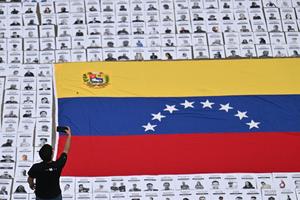
When Nicolás Maduro was captured by U.S. forces Jan. 3, reactions abroad quickly polarized between enthusiasm at the neutralization of a dictator and accusations of illegitimate foreign intervention.
In Venezuela, the reaction was more circumspect, as the population is aware that the removal of a leader is not enough on its own to dismantle a regime.
For the Catholic Church in Venezuela — one of the few institutions to have resisted the communist regime consistently — the moment is being read as a decisive threshold.
For democracy advocates, the question is not only whether a dictatorship has fallen, but how a nation brutalized by decades of Marxism, corruption and violence can now undergo a genuine moral and political transition.
That distinction is central to the analysis of Alejandro Peña Esclusa, a former presidential candidate and Catholic intellectual who spent a year imprisoned without trial under Hugo Chávez in 2010 before being forced into exile. Speaking in an interview with the Register, Peña Esclusa, now based in Italy, insisted that while the removal of Maduro has brought widespread relief, it has not yet delivered freedom.
A Cartel-State
Peña Esclusa was among the earliest figures to warn that real power in Venezuela lay not in elections but in a security apparatus shaped from abroad, above all by communist Cuba. That apparatus, he argues, remains intact, which is why Maduro’s removal has not yet produced a proper regime change.
“More than 90% of the population is very happy that Maduro was ousted,” he said. “But happiness does not mean security. The structure of violence is still there.”
This reality, Peña Esclusa insisted, explains Washington’s current approach to the transition.
María Corina Machado, who led the democratic opposition in the disputed 2024 election, has no control over armed forces and therefore cannot impose a transition at this stage. Delcy Rodríguez, Maduro’s longtime vice president and a central figure inside the regime, is instead being used as a channel to force the state’s coercive structures to capitulate. Only once that apparatus is dismantled, he argued, can elections and civilian rule become meaningful.
At the heart of the crisis, Peña Esclusa continued, is something unprecedented: a state subordinated to organized crime.
“Maduro was not just involved in drug trafficking,” he said. “He was the head of the most powerful cartel in Latin America, responsible for about 20% of the cocaine consumed in the Western Hemisphere.” As proof of Cuba’s grip, he added that when Maduro was captured, all 32 of his bodyguards were Cuban. “Not one Venezuelan. That tells you everything.”
The Legitimacy of U.S. Intervention
On the question of foreign intervention, which raised moral concerns abroad, Peña Esclusa was unequivocal: “Maduro stole the 2024 election and ruled illegally by repression,” he said. “The U.S. intervention was authorized by the legitimately elected president, Edmundo González, and by María Corina Machado.”
A government that integrates drug trafficking into the state, collaborates with armed and terrorist networks, and relies on systematic repression, he argued, ceases to function as a sovereign authority and instead becomes a criminal structure. “This was not about ideology alone,” he said. “It was about stopping a criminal structure with global consequences.”
Asked how the post-communist transitions in Central and Eastern Europe can inspire the ongoing process, Peña Esclusa warned against partial transitions that preserve corrupt networks under new faces.
“In many cases, former communists remained in control of institutions. There were pardons, impunity. Venezuela must work actively against that.”
“Justice matters,” he said. “Without it, freedom remains fragile.”
The Catholic Church as a Credible Force
Throughout Venezuela’s decades-long descent, the Catholic Church stood out as one of the very few institutions capable of expressing moral limits and public truth. That role, Peña Esclusa stated, explains why it was a constant target of intimidation, harassment and open hostility under both Chávez and Maduro.
“The Church represents the opposite of Marxism,” he commented. “Freedom, human dignity, transcendence, the value of life.”
For him, the Church is today the most credible force for national reconstruction. And recent events tend to give credit to that idea.
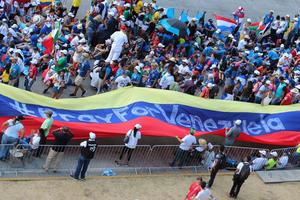
Only days after Maduro’s capture, a massive Marian procession honoring La Divina Pastora (Divine Shepherdess) drew crowds in the city of Barquisimeto. From the pulpit, the local bishop openly called for freedom for political prisoners.
“For 26 years,” Peña Esclusa noted, “the documents of the Venezuelan Episcopal Conference have been a moral guide for the people. They have always aligned with what the nation needed.”
For Peña Esclusa himself, faith has been the constant axis of his public and personal commitments. It was severely tested when he spent a year imprisoned without trial in El Helicoide, Venezuela’s most notorious political prison.
“I survived because I prayed every day,” he recalled. “The Rosary, Scripture. Without a strong relationship with God, you cannot face a bloody dictatorship that threatens your life and your family.” Suffering, he believes, strengthened rather than broke his vocation.
Reversing Cultural Marxism
The exile that followed sharpened the conclusions he had already begun to draw from Venezuela’s collapse. Forced to look at his homeland from a distance, it became obvious that dictatorship was made possible by a long process in which Christian culture itself was first eroded.
That insight led him to focus his work, in particular his latest book, Classical Art and Cultural Marxism (2024), on what he calls “cultural warfare.” Drawing explicitly on the influential Italian communist thinker Antonio Gramsci, Peña Esclusa claimed that modern Marxism abandoned the strategy of armed revolution in favor of cultural conquest.
“Gramsci understood that the No. 1 enemy was the Catholic Church,” he said. “If you conquer the world of ideas, those ideas will conquer the world.” In Venezuela, he contended, the dismantling of Catholic culture within most institutions — its language, symbols and anthropology — preceded and enabled the consolidation of authoritarian power.
From that perspective, political change without cultural reversal is, in his view, bound to remain fragile. What he witnessed in exile convinced him that the cultural offensive Gramsci theorized had succeeded even more deeply in the West than in much of the Global South. “When I arrived in Europe and saw empty churches,” he recalled, “I asked myself: ‘What happened here?’”
For Peña Esclusa, any genuine recovery — whether in Venezuela or elsewhere — must therefore begin by inverting that Gramscian project. If Marxism sought to erase Christian culture in order to dominate politics, renewal must start with the reevangelization of culture itself.
“Classical art is a form of evangelization without words,” he said. From Florence to the Vatican Museums, beauty reveals the unity of truth, goodness and God. “Artists who loved God expressed that love through beauty. That beauty forms the soul.”
Against the deliberate ugliness and transgression promoted by ideological movements, beauty restores order at the deepest level, he said, by reawakening a sense of the human person as created and oriented toward transcendence.
If Peña Esclusa retains confidence in Latin America today, it is not because of political momentum but because large parts of society remain anchored in lived religious practice rather than ideologies.
“People are less exposed to materialist theories,” he observed. “Daily life remains rooted in God, family and tradition.” Such continuity is, in his view, decisive. Where faith remains lived, political power encounters limits and renewal has a chance to endure.
- Keywords:
- church in venezuela
- venezuela
- post-christian